
Digital PR is one of the most misunderstood investments in a growth marketer’s toolkit. It gets lumped in with content marketing, confused with social media management, and occasionally dismissed as the soft cousin of performance marketing.
None of those framings are accurate, and treating it as any of them will cost you the compounding authority that makes it worth doing in the first place.
At its core, Digital PR is the practice of earning editorial coverage, mentions, and links from credible external sources in ways that strengthen both your brand’s perceived authority and its organic search performance. The distinction from traditional PR is not just the channel. It is the measurement framework, the target audience, and the feedback loop with search visibility that make it a commercially meaningful investment rather than a reputation management exercise.
Google has been explicit about this. Brand signals, coverage from authoritative publishers, and the pattern of who mentions you and how, factor into how search systems evaluate your site’s credibility.
This is not a theoretical claim. It is the mechanism behind why some sites rank durably in competitive categories despite not having the largest content output or the most aggressive link acquisition programs.
Why Digital PR Belongs in a Serious Growth Strategy
Most link-building programs focus on what you can control: outreach campaigns, guest post placements, directory submissions, and content-led link acquisition. Digital PR operates differently because its outputs, organic editorial coverage and earned mentions, are harder to manufacture and therefore harder to replicate.
When a national publication cites your research, when an industry journalist quotes your spokesperson in a market analysis piece, or when your brand appears in a roundup published by a credible trade outlet, those signals are qualitatively different from links acquired through content exchange programs. Google’s quality systems are increasingly capable of distinguishing between the two, which is why the asymmetric return on genuine earned media keeps growing as manufactured link profiles become easier to identify.
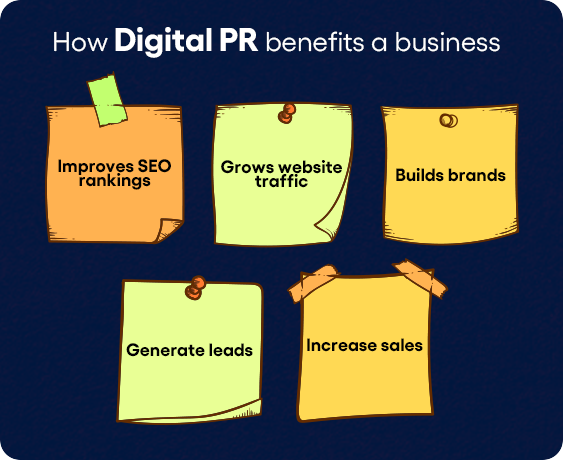
The commercial case is straightforward. Brands with strong Digital PR programs tend to have lower CAC over time because organic search compounds. They rank on competitive terms where paid acquisition costs are high, and they hold those positions with less ongoing spend than sites without the underlying authority. The investment in Digital PR is front-loaded, and the returns are delayed, which is why it is underinvested in. But the unit economics over a three to five-year horizon are difficult to argue against.
John Mueller of Google has noted that brand signals and PR can outweigh technical SEO factors in some contexts. That statement tends to get passed around without the nuance:
It applies specifically to competitive categories where technical quality across competing sites is already high and where brand authority becomes the differentiating signal.
In practice, this means the brands that have invested in editorial credibility have a structural advantage that technical optimization alone cannot close.
The Components of a Digital PR Program
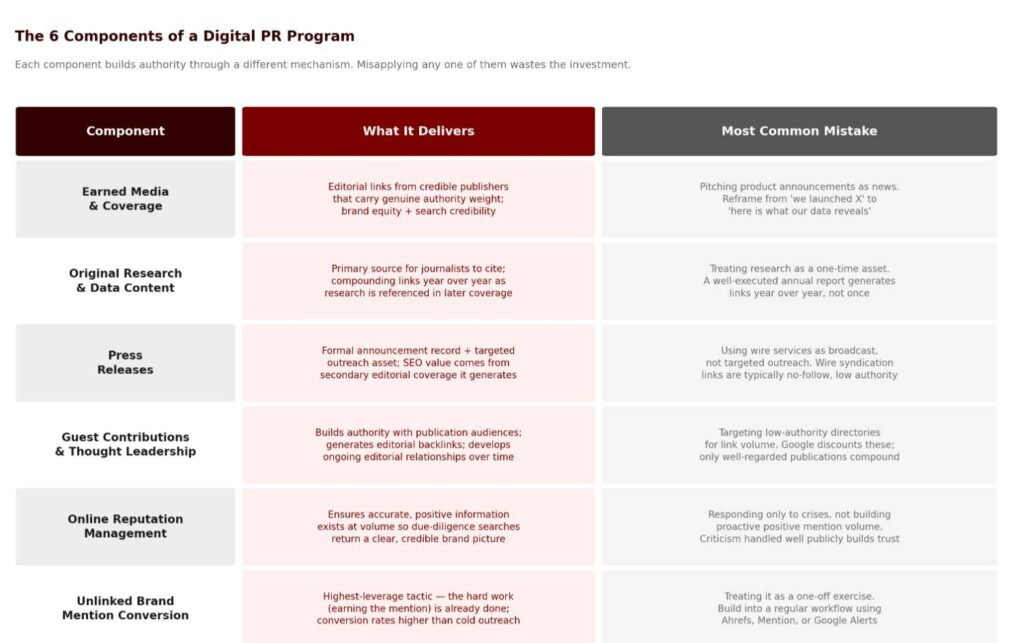
Earned Media and Editorial Coverage
The highest-value output of any Digital PR program is unprompted editorial coverage from publications your target audience trusts. These can be:
- a product launch covered by a major trade publication,
- a spokesperson quoted in an industry trend piece,
- a company milestone that generates news cycle coverage.
These placements build brand equity and generate links that carry genuine authority weight.
Getting here consistently requires infrastructure:
- media relationships built over time,
- a communications function that can identify story angles before they become obvious, and
- a brand with enough substance to generate genuine news.
Campaigns that manufacture newsworthiness through surveys, data studies, or contrarian positions can work, but they work best when they are connected to genuine business activity rather than fabricated to fill a PR calendar.
The mistake most brands make: Pitching product announcements as news. Journalists do not exist to distribute your marketing. The angle has to be newsworthy to their readers, not just promotional for your brand. Reframe the story from “we launched X” to “here is what our data reveals about how this market is changing,” and the conversion rate on pitches improves substantially.
Original Research and Data-Led Content
Data is one of the most reliable mechanisms for earning editorial links at scale. When your brand publishes
- proprietary research,
- a survey of your customer base,
- an analysis of an industry trend, or
- a benchmark study in your category, you give journalists and content creators a primary source to cite.
The compounding dynamic here is worth understanding. A well-executed annual research report does not generate links once. It generates links every time it is referenced in subsequent coverage, year over year, sometimes for years after publication. The cost per link acquired through this method typically decreases with time while the authority contribution continues.
The research does not need to be academically rigorous. It needs to be credible, specific, and genuinely useful to the publications you want to target.
A B2B software company surveying 500 practitioners in its category about their tooling decisions and publishing the results is producing something that trade publications, analysts, and practitioners will cite. That is the goal.
Press Releases: Still Useful, Often Misused
The press release is among the oldest communications tools in the category and remains relevant when used correctly. The problem is that most brands use press releases as a broadcast mechanism rather than a targeted outreach tool, which dilutes their effectiveness.
A press release serves two distinct functions:
- It is a formal record of a company announcement, and
- It is an outreach asset sent to specific journalists with a personalized pitch that connects the announcement to something they actually care about.
The document itself is secondary to the targeting and angle.
From an SEO standpoint, press releases distributed through wire services have limited direct link value because those links are typically no-follow and the domain quality of wire service syndication is low.
The SEO value comes from secondary coverage: journalists who pick up the story and write their own piece, creating followed editorial links from publication domains that carry actual authority weight.
Strategic tip: Build a press release calendar around genuinely newsworthy business events like funding rounds, partnerships, significant product milestones, notable data releases, executive appointments, and responses to industry-level news where your brand has a credible perspective. Volume for the sake of it achieves nothing.
Guest Contributions and Thought Leadership
Contributing original content to publications in your category, whether written articles, data insights, or expert commentary, builds authority in two directions simultaneously. It signals expertise to the audiences of those publications, and it generates editorial backlinks that strengthen your domain’s authority in search.
The distinction between valuable guest contributions and low-quality guest post programs is important here. Publishing original analysis, genuinely expert perspective, or category-specific insight in well-regarded industry publications is Digital PR. Publishing generic articles on directories and low-authority blogs to acquire links is something else, and Google’s systems have become increasingly effective at discounting it.
The editorial bar matters. Publications that accept anything regardless of quality send weak authority signals. Publications with real editorial standards that reject pitches, push back on claims, and maintain genuine reader trust send strong ones. Targeting the latter is harder and slower, but the compounding return is meaningfully different.
The relationship dimension is also worth naming. Regular contributors to a publication develop editorial relationships that generate ongoing placement opportunities, invitations to comment on industry stories, and the kind of institutional familiarity that creates coverage when your brand has actual news.
Online Reputation Management as a PR Function
Brand reputation online is not static. Review sites, social platforms, industry forums, and media coverage all create a distributed picture of your brand that potential customers, partners, and investors encounter before they ever speak to your team.
Managing that picture is not about suppression or defensive spin. It is about ensuring that accurate, positive information exists in sufficient volume and credibility that a reasonable person conducting due diligence comes away with a clear and favorable understanding of what your brand is and who it serves.
Practically, this means
- monitoring where your brand is mentioned,
- responding to legitimate feedback constructively and publicly,
- addressing errors or misrepresentations in coverage, and
- building a pattern of engagement that signals organizational accountability.
The brands that handle criticism well publicly do not just protect their reputation; they build it, because skeptical audiences are more persuaded by how a company handles problems than by how it markets itself when everything is going well.
From a search perspective, reputation management intersects with Digital PR because the entities and sentiments associated with your brand name across the web contribute to how Google evaluates your brand signal.
Consistent, positive, and credible mentions across authoritative sources reinforce brand authority in ways that purely on-site signals cannot.
Unlinked Brand Mentions: The Underutilized Asset
When your brand is mentioned in a publication but not hyperlinked, that mention still carries brand signal value, but it does not deliver the direct link equity that a followed hyperlink would.
Identifying and converting these unlinked mentions into links is one of the highest-leverage tactics in a Digital PR program precisely because the hard work, getting the mention, is already done.
The outreach is straightforward:
- find instances where your brand or research has been cited without a link,
- identify the journalist or webmaster responsible, and
- request the addition of a link to the relevant page on your site.
Conversion rates on these requests are typically higher than cold link acquisition outreach because you are not asking for coverage you have not earned.
Tools like Ahrefs, Mention, and Google Alerts make mention monitoring manageable at scale. Building this into a regular workflow rather than treating it as a one-time exercise ensures you capture the full link value of the coverage you earn.
Building a Digital PR Strategy: The Operational Framework
Start With Audience and Publication Mapping
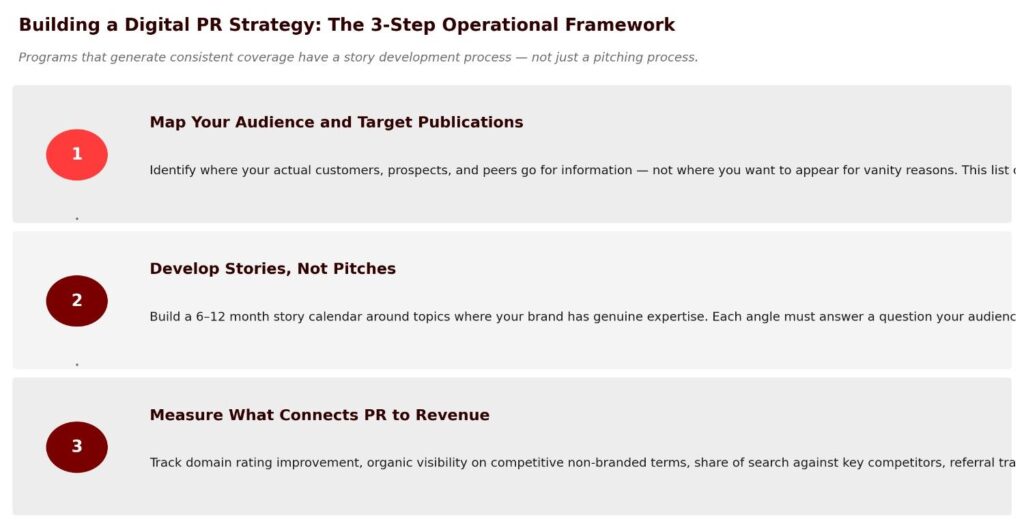
Before any outreach, build a clear map of the publications your target audience trusts. Not where you want to appear for vanity reasons. Where your actual customers, prospects, and industry peers go for information.
For a B2B software company, this might be three or four major trade publications, a handful of influential practitioner newsletters, a small number of analyst firms, and a set of podcasts with strong industry followings.
For a D2C brand, it might be lifestyle publications, category-specific editorial outlets, and a set of creators with genuine audience trust in the relevant vertical.
The publication list determines everything downstream:
- the story angles that will land,
- the journalists worth building relationships with, and
- the type of research or content that will generate citation value.
Develop Stories, Not Pitches
The difference between PR programs that generate consistent coverage and those that generate occasional placements is usually a story development process rather than a pitching process. Journalists do not need more pitches. They need story angles that serve their readers.
Develop a six to twelve-month story calendar around topics where your brand has genuine expertise and credible perspective.
Each story angle should:
- answer a question your target audience cares about,
- draw on something proprietary to your business (data, customer insight, operational experience), and
- connect to a news cycle or evergreen topic that the publications you are targeting cover regularly.
Measure What Connects PR to Revenue
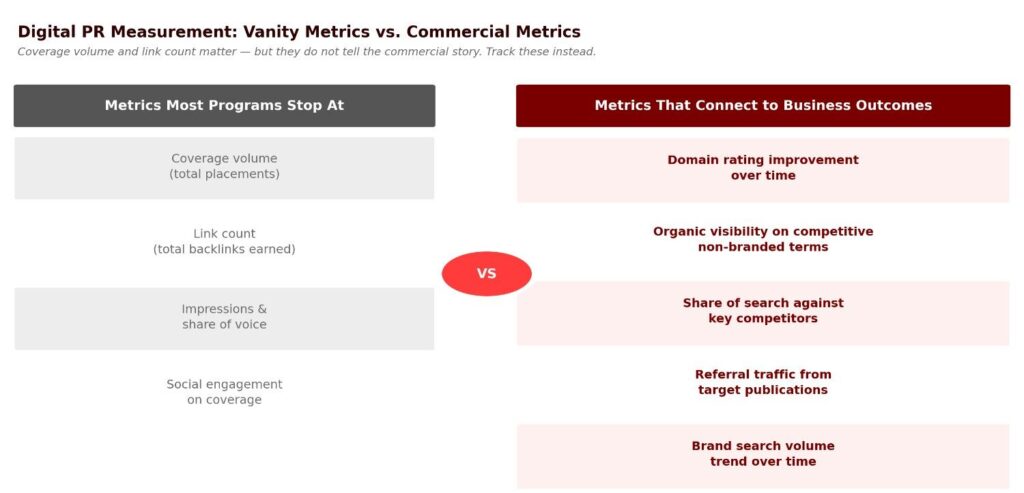
Digital PR measurement often stops at coverage volume and link count. Those metrics matter, but they do not tell the commercial story.
The metrics that connect Digital PR to business outcomes are:
- domain rating improvement over time,
- organic visibility on competitive non-branded terms,
- share of search against key competitors,
- referral traffic from target publications, and
- brand search volume trends.
These are the indicators that tell you whether the authority you are building is translating into search performance improvements, which is ultimately the commercial mechanism behind the investment.
For brands with longer consideration cycles, tracking assisted conversions from referral traffic and measuring how earned media coverage influences pipeline velocity gives you a more complete picture of Digital PR’s contribution to revenue.
The Compounding Logic of Digital PR Done Well
Digital PR is not a campaign. It is a capability.
The brands that create an authority asset that compounds over time and becomes increasingly difficult for competitors to replicate build it as a sustained function, with
- a media relationship database,
- a story development process,
- a research publication cadence, and
- a measurement framework connected to organic performance.
The brands that treat it as a one-off project, a burst of outreach activity around a launch or announcement, see correspondingly limited returns.
The authority signal requires consistency because it is built from a pattern of credible mentions across time, not from a single high-profile placement.
If your growth strategy involves organic search as a meaningful channel, and for most D2C brands, B2B companies, and technology firms with any sales cycle complexity, then Digital PR is not a supplementary activity. It is part of the foundation that determines how efficiently the channel performs.
Curious About How Digital PR Can Help Your Brand?
If you want to understand what your current brand authority profile looks like in search, where the coverage gaps are relative to your competitive set, and what a realistic Digital PR program would look like for your category, a structured audit is the right starting point. Request a brand authority and link profile review to get a clear picture of where you stand and what the highest-leverage moves are.