
Google rankings and AI visibility are not the same metric, and treating them as interchangeable is one of the most expensive mistakes a marketing team can make right now.
The gap between the two is real, growing, and already affecting pipelines for brands that have invested years into organic search.
A brand can hold three of the top five positions for a high-intent keyword, generate consistent organic revenue from it, and still be completely absent when a potential buyer asks ChatGPT, Gemini, or Google’s own AI Overviews for a recommendation in that category.
That is not a hypothetical. It is the situation most mid-market and enterprise brands are in today, whether they know it or not.
This piece explains why the divergence exists, what it costs you commercially, and what the path to closing it actually looks like in practice.

What the AI Search Gap Is, and Why It Exists
The AI Search Gap is the structural difference between how a brand performs in traditional search engine results and how it is represented (or not represented) inside AI-generated answers. The two systems are built on fundamentally different logic, which is why ranking success in one does not translate to the other.
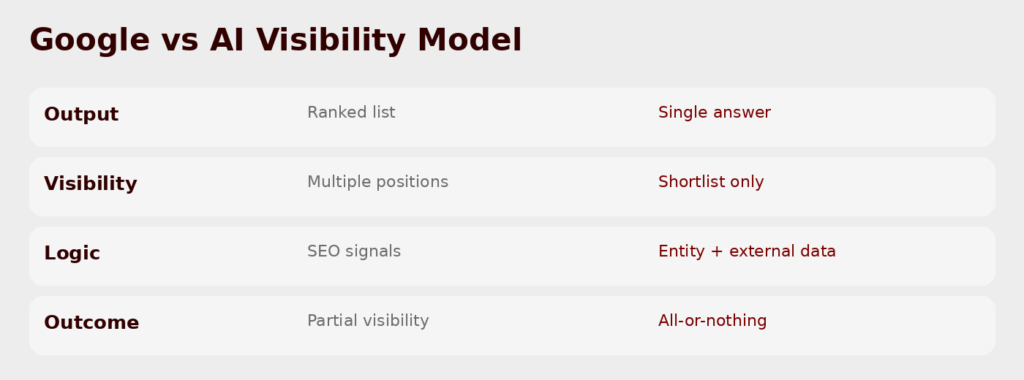
Google is a retrieval system. It indexes pages, evaluates relevance signals like backlinks, content quality, and technical optimization, and returns a ranked list of results. A user sees ten options, maybe more with scrolling. A brand ranked eighth still gets exposure.

AI answer engines work differently. They synthesize information from training data, live web crawls, structured databases, editorial sources, and third-party citations into a single consolidated recommendation. There is no page two. If the model does not have sufficient, consistent, credible signal about your brand, you simply do not appear in the answer.
The result is a binary problem. Google gives you a ranking. AI gives you a mention or nothing.
ChatGPT processes an estimated 66 million search-like queries per day. The users generating those queries are not getting ranked lists. They are getting one answer, sometimes two or three brands in a shortlist. Brands outside that shortlist do not exist in that interaction.
Why Strong Google Performers Go Missing in AI Results
This is the part that surprises most CMOs when they first encounter it. The assumption is that strong SEO signals carry over. They do not, at least not cleanly, and here is why.
AI Models Learn from a Different Signal Set
Google’s algorithm rewards on-page optimization, link authority, and technical infrastructure. AI models are trained on, and retrieval-augmented with, a much broader set of sources: Wikipedia, Wikidata, Crunchbase, Trustpilot, G2, news archives, Reddit, industry publications, and public databases.
Your website is one input among many, and it is weighted less than you might expect.
If your brand exists primarily within its own website, with minimal third-party coverage, AI models have limited material to work with. They default to brands with richer, more distributed digital footprints.
Inconsistent Brand Data Creates Credibility Problems
AI systems cross-reference information across multiple sources. If your brand name, founding date, product categories, or key claims appear differently across different directories and databases, the model treats that inconsistency as an unreliability signal. It does not flag the inconsistency to the user. It simply excludes the brand and picks a cleaner data source.
This is a structural problem that keyword optimization cannot fix.
Marketing-Heavy Content Does Not Compress Well
AI models are designed to extract and summarize factual, structured information.
Pages built for persuasion rather than information density, without clear feature comparisons, FAQ-style explanations, or factual summaries, are difficult for AI to process into confident recommendations.
A product page that sells is not the same as a product page that informs, and AI responds to the latter.
Entity Recognition Requires External Confirmation
For an AI model to confidently identify and recommend your brand as a known entity in a category, it needs confirmation from sources it already trusts.
Press coverage, expert mentions, review platform presence, editorial citations, and structured database profiles all function as verification signals. Without them, the brand exists in the training data but lacks the confirmation that pushes it into active recommendations.
A solar energy company held the top ranking on Google for its primary category keyword for over two years. When asked by ChatGPT to recommend solar panel providers in that market, the model listed three US-based competitors, one Australian brand, and a local rival. The top-ranked company was absent. The differentiating factor was not SEO performance. It was PR coverage, Reddit discussions, review volume, and structured citations. AI knew the others existed in context. It did not have sufficient signal to include the market leader.
Why This Problem Compounds Over Time
The practical risk here is not just about today’s AI recommendation. It is about the direction of travel and what happens to brands that wait.
AI Overviews Are Displacing Organic Results
Google’s AI Overviews now appear above organic results for a growing share of informational and commercial queries. A brand ranked first organically can be invisible in the AI Overview that sits above it. The click goes to the brands mentioned in the summary, not to the ten blue links below.
This is not speculation. Publishers and brands have already documented meaningful traffic decline tied to AI Overview expansion, and Google has shown no indication of slowing that rollout.
Younger Buyer Cohorts Are AI-Native
Gen Z and younger millennial buyers already use AI tools as their default research layer. They ask ChatGPT which CRM to evaluate, which supplement brand to consider, and which B2B platform has the better integration stack.
They are not starting on Google in the way prior cohorts did. The habit is forming now, and it will not reverse.
If your brand is not visible to this segment during the research phase, you are losing pipeline before the consideration stage even begins. That has direct CAC implications.
AI Platforms Are Moving Toward Monetization
As AI search platforms mature, sponsored placement and partner integrations will become more prominent. The brands with established organic AI visibility will have significantly more leverage in those conversations than brands entering cold. Building AI presence now is cheaper than buying it later, and there will be a later.
Models Are Getting More Selective, Not Less
Current AI models are relatively early in their ability to distinguish between well-known and weakly-known brands. Future models will be better at this.
They will cross-reference more sources, apply more rigorous entity recognition filters, and set a higher bar for inclusion in recommendations. Brands that lack strong entity signals now will find the gap harder to close as model sophistication increases.
What AI Visibility Optimization (AIVO) Actually Involves
The term “AI SEO” is already being overloaded with vendor claims, so it is worth being precise about what the work actually looks like. This is not a single campaign or a content sprint. It is a multi-layered effort to establish your brand as a recognized, well-evidenced entity across the sources AI models trust.
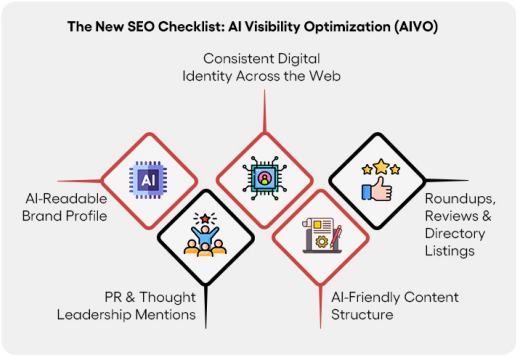
1. Structured Entity Profiles Across Trusted Databases
The foundation is making sure your brand exists cleanly and consistently in the sources AI models treat as authoritative:
- Wikipedia and Wikidata, where applicable,
- Crunchbase, Google Business Profile, industry-specific directories,
- G2 or Trustpilot if relevant to your category.
These are not backlinks in the traditional sense. They are source materials. An AI model encountering your brand name in a user query needs reference points to confirm what the brand is, what category it operates in, and whether it is credible enough to recommend. Structured profiles provide that foundation.
Inconsistencies across these profiles undermine confidence. Audit them before you try to build on them.
2. Third-Party Editorial Coverage with Named Citations
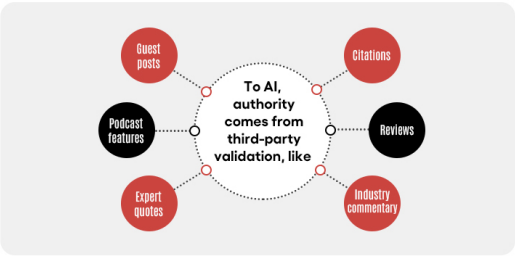
AI models weigh third-party editorial content significantly higher than self-authored content.
A mention of your brand in an industry publication, a named quote in a news article, an inclusion in an expert roundup, and a feature in a trade media outlet all of these contribute to the model’s understanding of your brand as an established entity.
This is why digital PR should be treated as an AI visibility investment, not just a brand awareness channel. The coverage that gets your founder quoted in a trade outlet is also the coverage that teaches an AI model to recognize your brand in a category.
Volume matters. A single press mention is insufficient. Consistent, distributed coverage across multiple credible sources over time is what builds the signal weight AI models respond to.
3. Content Architecture Designed for AI Comprehension
Most brand content is written to persuade a human reader. AI models need content structured for information extraction. That means:
- clear, factual descriptions of what you do,
- structured comparison of features against alternatives,
- FAQ sections that directly address the questions buyers ask, and
- entity-focused explanations that define your brand, category, and differentiation without relying on marketing language.
Think of it as writing for a reader who has no prior context about your brand, no patience for narrative, and a specific question to answer. That is roughly how a retrieval-augmented AI model approaches your content.
4. Presence in the Conversations AI Models Learn From
Reddit threads, Quora discussions, Trustpilot reviews, G2 comparisons, forum posts in your category. These community and user-generated sources carry real weight in how AI models learn about brand reputation and category positioning. If your competitors are being discussed in these spaces and your brand is not, AI models will reflect that imbalance.
This is not about gaming platforms. It is about ensuring that genuine discussion of your brand, your product’s performance, and your category perspective exists in the places AI models treat as signals of real-world relevance.
5. Schema Markup and Machine-Readable Signals
Organization schema, Product schema, FAQ schema, and review markup all help AI systems extract and classify your brand information more accurately. These are not ranking factors in the traditional Google sense at this point, but they are comprehension aids.
A model that can clearly parse your brand’s category, products, and attributes will represent you more accurately than one left to infer from unstructured marketing copy.
The Strategic Trade-Off You Need to Account For
There is a version of this conversation that makes AI visibility sound like an add-on, something you bolt onto an existing SEO program. In practice, it often requires reallocating resources, and that deserves honest treatment.
Traditional SEO investment, particularly content production at scale, has a diminishing return in a world where AI Overviews absorb the click before it reaches your page.
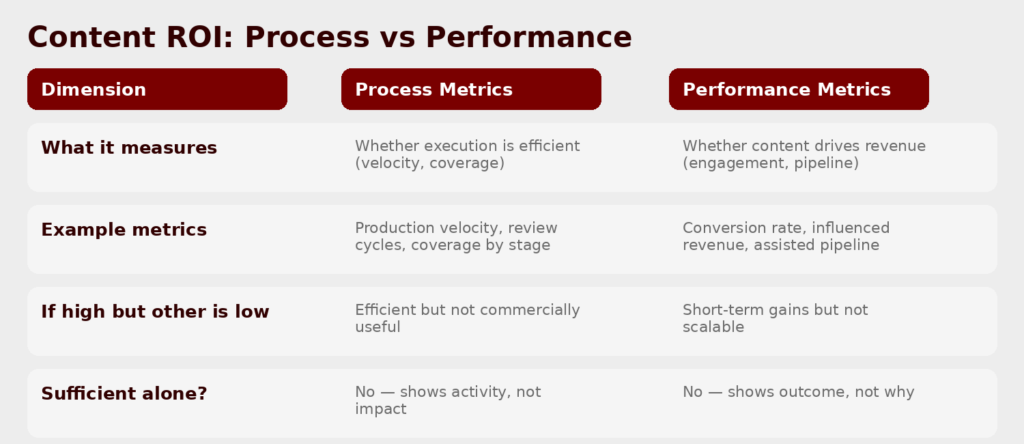
The brands that are thinking clearly about this are auditing their content programs and asking which assets exist to generate organic traffic versus which exist to build category authority and entity recognition. Those are different briefs, and they often require different execution.
Digital PR, which many brands have historically treated as a soft brand channel, is now a hard technical input into AI visibility. That repositioning has budget implications.
Entity optimization and structured data work are often unglamorous and do not produce overnight results. The brands that are doing it now are building a compounding advantage. The brands waiting for clear proof of ROI before starting are letting competitors establish the entity signals that will be harder to displace later.
That is not a guarantee. It is a probability that compounds over time.
If you want to understand where your brand stands across these dimensions before your competitors do, a structured AI visibility audit is the right starting point. Get a second opinion on where the gaps are.
How to Prioritize if You’re Starting from Zero
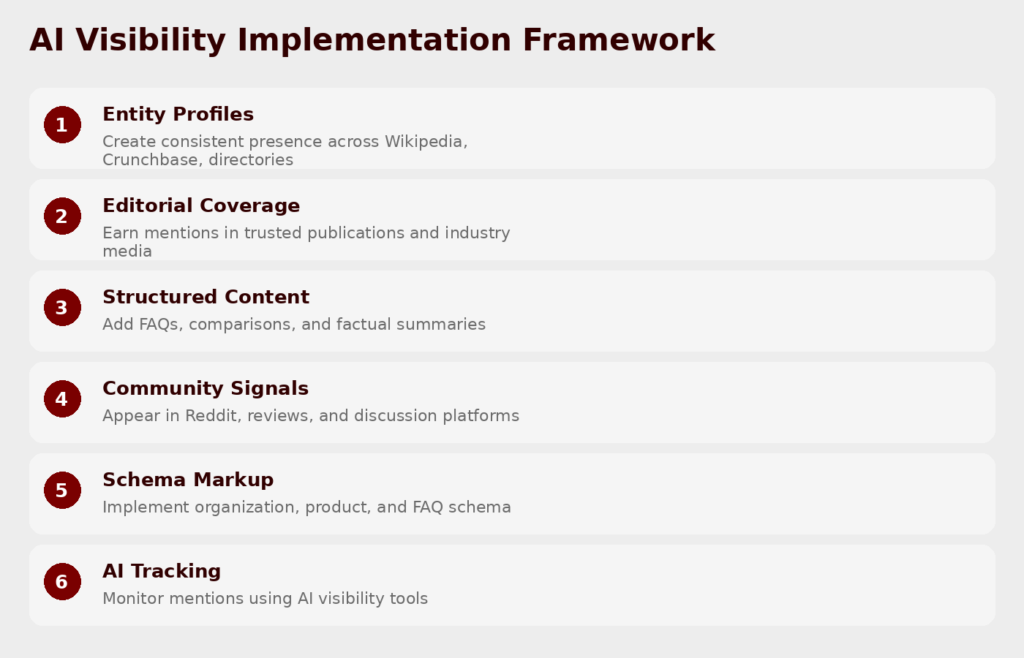
Not every brand can do everything simultaneously. Here is a practical sequencing that reflects how these investments compound:
- Start with an entity audit. Map your brand’s current presence across structured data sources, identify inconsistencies, and correct them. This is the foundation everything else sits on.
- Audit your content for AI comprehension, not just SEO optimization. Identify which pages need FAQ sections, structured comparisons, or factual summaries added.
- Launch a sustained digital PR program with named coverage targets. Prioritize publications that AI models recognize as authoritative in your category.
- Build presence in community and review platforms where your buyers already research. Genuine participation, not manufactured content.
- Implement schema markup systematically across product, service, and key landing pages.
- Monitor AI mention tracking tools (Profound, Brandwatch AI monitoring, etc.) to establish a baseline and measure progress.
The sequencing matters because the structured data work makes the PR work more effective, and both together make the content work more valuable. Doing them in isolation produces weaker results.
The Competitive Reality
The brands already investing in AI visibility are predominantly in three categories:
- enterprise SaaS companies with sophisticated growth teams,
- D2C brands that have watched their Google traffic erode and are looking for the next defensible channel,
- agencies and consultancies that have recognized the strategic gap and are moving early.
Mid-market brands, particularly those with strong organic performance built over several years, are the most at risk of complacency here. The Google results look healthy. The dashboards look fine. The AI Search Gap is not visible in standard analytics because AI recommendations do not generate trackable referral traffic.
The brand simply does not appear, and there is no impression count to show you the miss.
That invisibility is the problem. You cannot optimize what you cannot see, which is why establishing AI visibility measurement alongside traditional SEO measurement is the first step, not the last.
Explore What This Would Look Like for Your Brand
Most brands discover their AI Search Gap during a competitive audit, after a competitor has already closed theirs. A structured review of your entity signals, content architecture, and third-party coverage takes a few days and produces a prioritized action plan. If you want to know where you stand before it becomes a revenue problem, that conversation is worth having now.
Request a teardown of your AI visibility gaps