

The content quality bar has not risen because AI tools exist. It has risen because AI tools have made mediocre content nearly free to produce, which means mediocre content now floods every category.
Standing out no longer requires doing more. It requires doing something that AI structurally cannot do.
That is the actual challenge. And most advice on this topic misdiagnoses it.
Why “Use AI as a Tool” Is Not a Strategy
The standard guidance you will find on this topic is some version of: embrace AI for efficiency, but add your human touch. That framing is correct in principle and useless in practice because it does not tell you which elements of human-generated content actually create differentiation, and which ones are also replicable by the next generation of models.
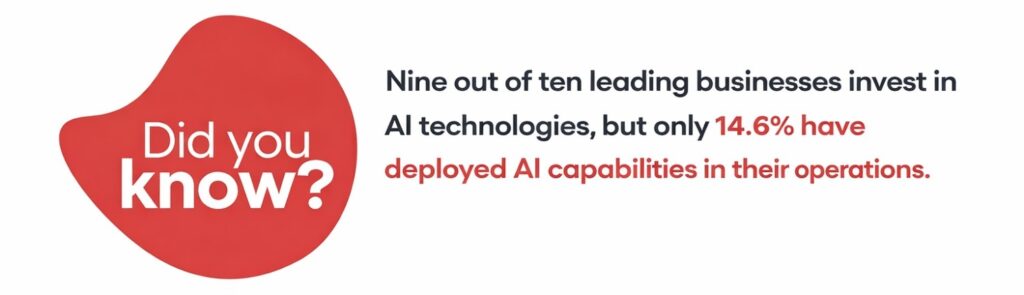
Here is the more useful frame: AI produces content that reflects the aggregate of what has already been written. It is, structurally, a regression to the mean. It draws on patterns in training data to generate outputs that are statistically likely to satisfy the surface requirements of a query. That is powerful for speed and coverage. It is weak at anything that requires a perspective formed through direct experience, a claim backed by original data, or a judgment that involves genuine trade-offs.
The content that compounds in search rankings and builds durable audience trust is not content that reads differently from AI output.
It is content that contains things AI cannot have:
- Your company’s proprietary data,
- Your team’s firsthand observations,
- Your customers’ actual language and concerns, and
- Your considered opinions on contested questions in your category.
Everything else is a production efficiency question, not a differentiation question.
The Three Differentiation Levers That Actually Work
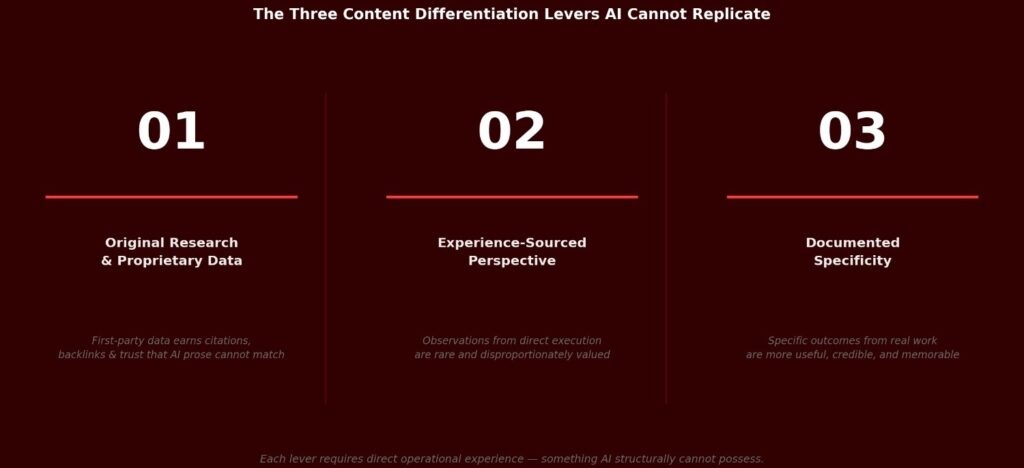
Original research and proprietary data
First-party data is the most defensible content asset a business can produce, and it is systematically underutilized because it requires operational effort rather than just writing effort.
Consider what your business observes that no one else does.
- If you run an e-commerce platform, you have data on conversion patterns, cart behavior, and seasonal demand shifts across your customer base.
- If you are a B2B SaaS company, your product usage data reveals patterns about how customers succeed or fail with your product.
- If you are a service firm, you have aggregate insights from client engagements that no outside observer can access.
Publishing this data, even selectively, creates content that earns citations, backlinks, and search visibility that purely editorial content cannot match. It also creates a trust signal that is qualitatively different from confidence-sounding prose.
Claimed expertise is easy to fake. Data from actual operations is not.
The execution requirement: You need a process for identifying, extracting, and packaging internal data for external publication. This does not require a research department. It requires a deliberate editorial decision to treat your operational observations as content assets.
Experience-sourced perspective
AI can describe what conversion rate optimization is. It can list best practices compiled from the corpus of existing content. What it cannot do is tell you that a specific CRO tactic you have seen described everywhere actually underperforms in a particular context, based on the pattern you have observed across twenty client accounts.
That kind of perspective, grounded in direct execution, is genuinely rare and disproportionately valued by the audiences who are sophisticated enough to recognize it.
The content that performs best in competitive search categories is not comprehensive in the encyclopedic sense. It is authoritative in the earned-expertise sense. Those are different things.
The practical application: When writing any piece of content, ask what your team would say about this topic that contradicts, qualifies, or adds meaningful nuance to what already exists in search results. If the honest answer is nothing, that is either a content topic not worth pursuing or a gap in your internal knowledge that needs addressing before the content can differentiate.
Documented specificity over claimed generality
Most AI-generated content errs toward confident generality. It makes statements that are broadly true, adequately sourced, and contextually thin.
The antidote is specificity that could only come from someone who has actually done the work.
This is the difference between “optimizing your product feed improves Shopping campaign performance” and “when we rebuilt the title structure for a mid-market apparel account, moving from catalog-style titles to search-intent titles, impression share on non-branded terms increased by 34% over six weeks.”
The second statement is more useful, more credible, and more memorable. It is also harder to generate without a real operational context to draw from.
In practice, this means building a documentation habit within your team.
The observations that accumulate through execution, client conversations, and experimentation are only content assets if they are captured. Most of them disappear because no one writes them down.
What AI Is Actually Good for in a Content Workflow
Framing this correctly matters because overclaiming AI’s utility wastes time and underclaiming it leaves efficiency on the table.
AI tools in content workflows earn their value in high-volume, lower-judgment tasks:
- drafting section outlines, generating first-pass structural options for a piece,
- identifying semantic coverage gaps in existing content,
- reformatting content for different channels, and
- producing variations of copy for testing.
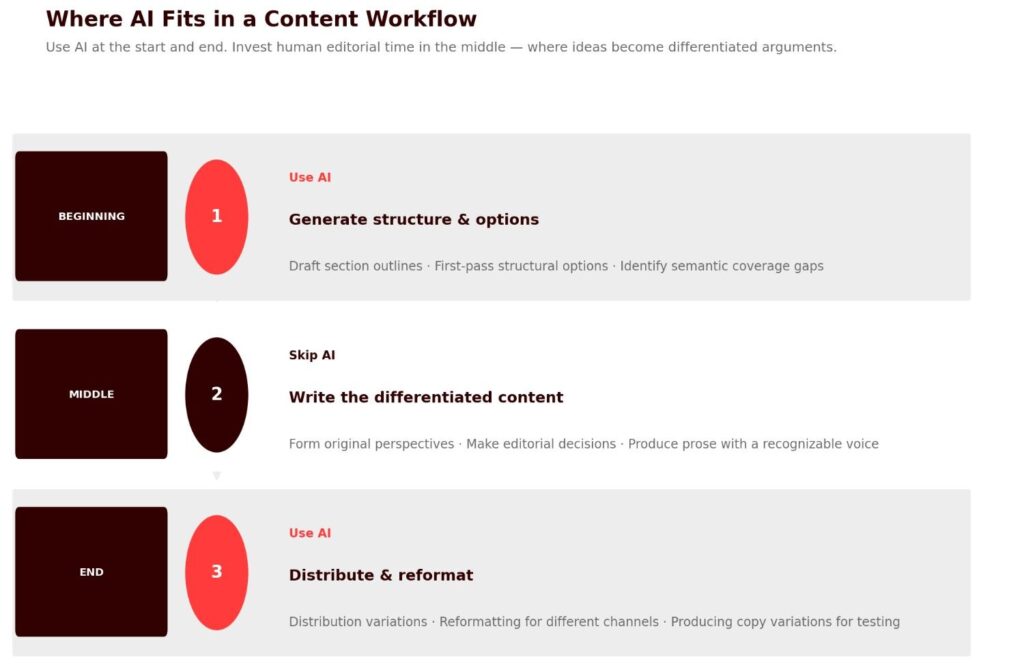
These are legitimate efficiency gains that free up human editorial capacity for the work that actually requires judgment.
Where AI consistently underperforms in content production: forming original perspectives, identifying what is genuinely interesting or surprising about a topic, making editorial decisions about what to include and what to cut, and producing prose that has a recognizable voice rather than averaging toward generic competence.
The workflow implication: AI is most valuable at the beginning and end of a content production process. Use it to generate structural options quickly, skip it for the substantive writing that requires real expertise, and use it again for distribution variations and reformatting. The middle of the process, where ideas become arguments and arguments become differentiated content, is where human editorial time is best invested.
The Role of Narrative and Personal Accounts in B2B and D2C Content
There is a body of cognitive science research behind the observation that narrative-format information is retained more reliably than factual lists.

For content strategy purposes, the practical implication is straightforward: Content that tells a coherent story about a problem, a decision, or a transformation holds attention longer and creates stronger recall than content that presents equivalent information in enumerated form.
This is not an argument for making business content feel like literature. It is an argument for structuring content around a problem-to-resolution arc rather than a features-and-benefits inventory. The brands that do this well, Airbnb’s early storytelling around the host-guest relationship, for example, are not doing it for artistic reasons. They are doing it because narrative creates the kind of emotional engagement that moves people through a consideration process.
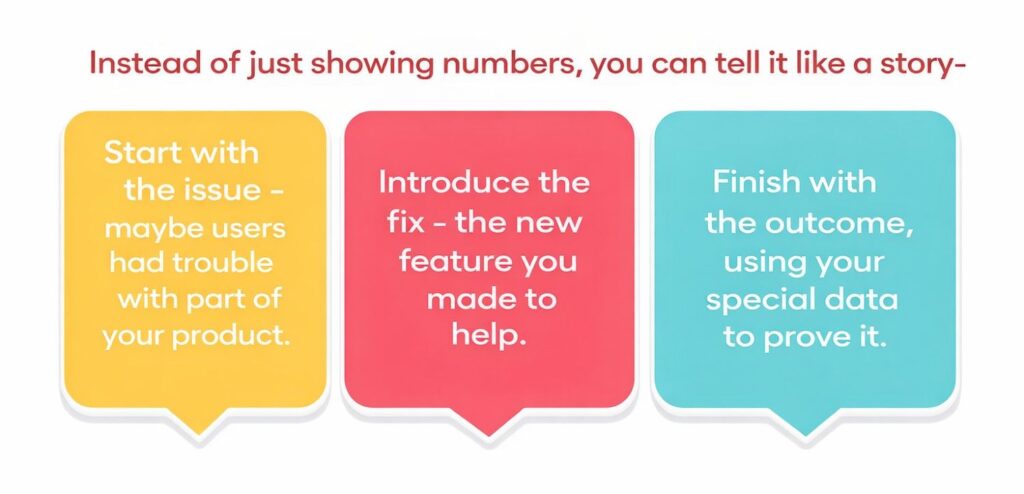
For content competing in search, narrative also serves a practical function: it increases dwell time. Pages that tell a story rather than list information tend to hold readers longer, and longer sessions are a positive engagement signal for Google, regardless of whether they directly influence ranking algorithms.
The mistake to avoid: Mistaking personal anecdote for narrative.
An unsupported founder story that functions as brand mythology is not the same as a documented customer journey with specific obstacles, specific decisions, and specific outcomes. The latter creates trust. The former often creates skepticism.
Visual Content as a Differentiation Layer, Not a Decoration
The teams treating visuals as decoration in content are leaving a meaningful competitive advantage unused. Original visual content, whether custom data visualizations, process diagrams, or documented photography from actual work, creates differentiation that AI-generated text cannot provide and that scraped stock imagery actively undermines.

The differentiation logic is the same as for written content: Images that could only come from your company’s actual operations or environment are inherently original. They signal authenticity to readers in a way that even a well-written text cannot fully replicate.
The execution challenge for most teams is not skill but process. Capturing visual documentation of work, client environments, internal processes, and product details requires building a documentation habit that most marketing teams have not operationalized.
The investment in doing so, even modestly, compounds over time as a visual library that no competitor can replicate.
Distribution and Influencer Integration, Done Strategically
One observation from content strategy work across categories: The return on original, well-produced content is dramatically higher when the distribution strategy matches the ambition of the production. Publishing a well-researched, original piece and hoping organic search picks it up is an incomplete strategy.
The most effective distribution model for content competing against AI-generated volume: Identify the specific people in your industry or customer segment who have audiences that trust their recommendations, and build relationships with them before you need them to amplify your content.
This is not influencer marketing in the transactional, campaign-driven sense. It is the longer-term practice of being genuinely useful to people who have audiences you care about reaching.

Micro-influencers with highly specific domain audiences often outperform larger generalist influencers for B2B content distribution because their audiences trust their judgment on professional topics. A recommendation from a practitioner with 8,000 followers who are all e-commerce operators carries more weight for an e-commerce-oriented piece than a mention from a general marketing account with 200,000 followers.
The commercial implication: Distribution relationships are content assets. They take longer to build than a content calendar, but they compound in a way that paid amplification does not.
Quality Control as a Competitive Moat
The final point worth making runs counter to the prevailing efficiency narrative around AI content: publishing less, better, is a more defensible strategy than publishing more, adequately.

Google’s quality systems have become more sophisticated at evaluating whether content demonstrates genuine expertise and provides information not available elsewhere. The sites that have maintained or grown organic visibility through multiple algorithm cycles share a common characteristic: Their content reflects real expertise, not just topical coverage.
Editorial review matters more than ever. Today, success is not driven by volume or backlinks alone. It depends on human judgment, i.e., whether content is truly useful, original, and differentiated before it goes live.
Treating editorial review as a bottleneck is a mistake. It is not a blocker. It is a quality filter. Strong editorial standards protect your topical authority and strengthen long-term SEO performance.
In practice: Establish a pre-publication checklist that asks the questions AI cannot answer affirmatively.
- Does this piece contain information or perspective not available on competing pages?
- Does it reflect direct experience or original data?
- Would a senior person in this field read it and learn something, or would they recognize it as a competent summary of what they already know?
If the honest answer to those questions is no, the content is not ready.
Need a Plan That Optimizes Your Content Strategy?
If you want a second opinion on whether your current content strategy is building durable search equity or just adding volume, a content audit against these criteria is a useful diagnostic. The gap between content that ranks and content that converts is almost always a differentiation problem, not a production volume problem.