
The confusion between growth marketing and demand generation is not semantic. It is organizational — and it produces real budget misallocation, team misalignment, and strategic drift.
Both terms get used loosely in planning documents and agency pitches, often interchangeably, which obscures a genuinely important distinction. Growth marketing and demand generation are not competing philosophies. They are different operating frameworks with different time horizons, different success metrics, and different organizational homes. Understanding how they relate to each other is the prerequisite for building a marketing function that compounds rather than just churns activity.
This is not a glossary article. It is an operational guide for senior marketing leaders who need to make resource allocation decisions, build or restructure teams, and set expectations with executives about what different marketing investments are actually designed to produce.
The Actual Definitions — Stripped of the Marketing Jargon
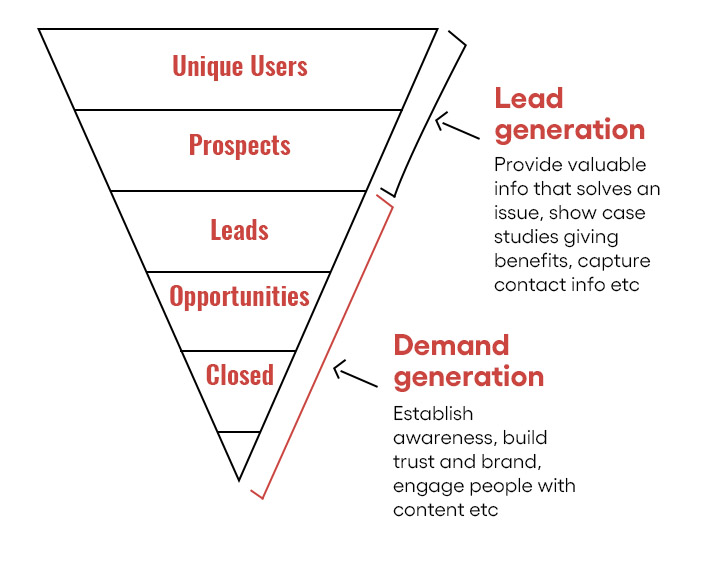
Demand generation is the discipline of creating awareness and cultivating purchase intent for your product or service among audiences who are not yet customers. It encompasses the programs, content, campaigns, and channels that move a prospective buyer from no awareness to active consideration.
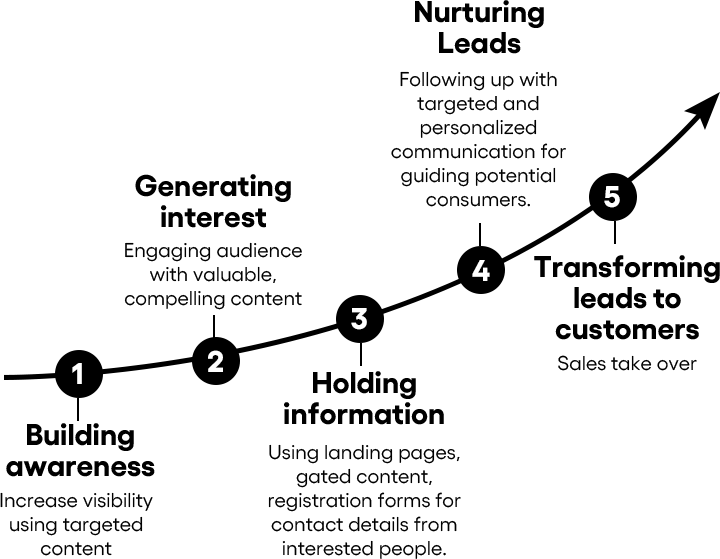
The pipeline it feeds is linear: attention, interest, consideration, conversion.
The keyword is “demand” — you are creating or accelerating desire that does not fully exist yet. This is primarily a top and mid-funnel function, and the metrics that govern it reflect that:
- lead volume,
- pipeline coverage,
- cost per qualified lead,
- marketing-attributed pipeline.

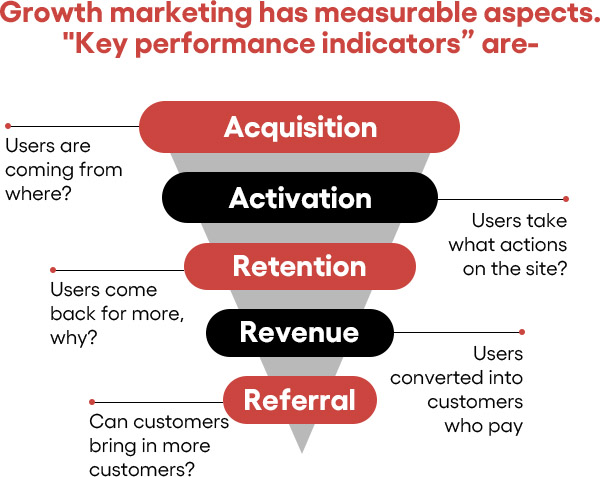
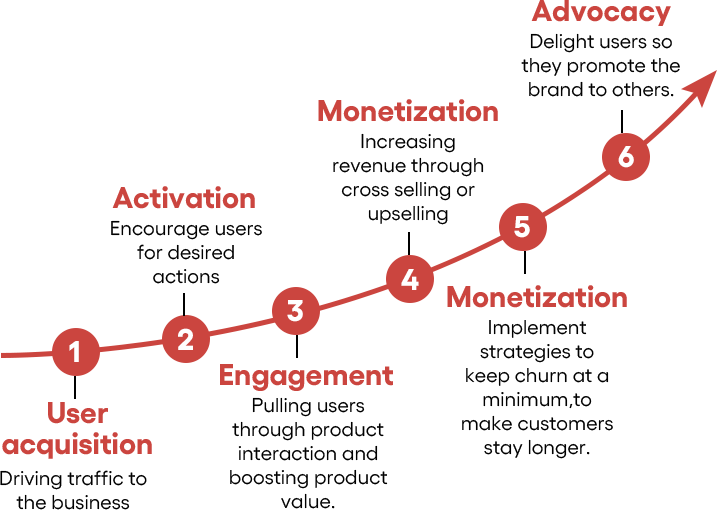
Growth marketing is a broader, full-funnel orientation that treats marketing as responsible not just for acquisition but for the entire revenue lifecycle — activation, retention, expansion, and referral. It borrows principles from product management and data science:
- hypothesis-driven experimentation,
- rapid iteration,
- behavioral analysis, and
- optimization across the complete customer journey.
The pipeline it manages is circular, not linear. Acquisition feeds activation, activation feeds retention, retention feeds expansion and referral, which eventually loops back to new acquisition through word of mouth and brand strength.
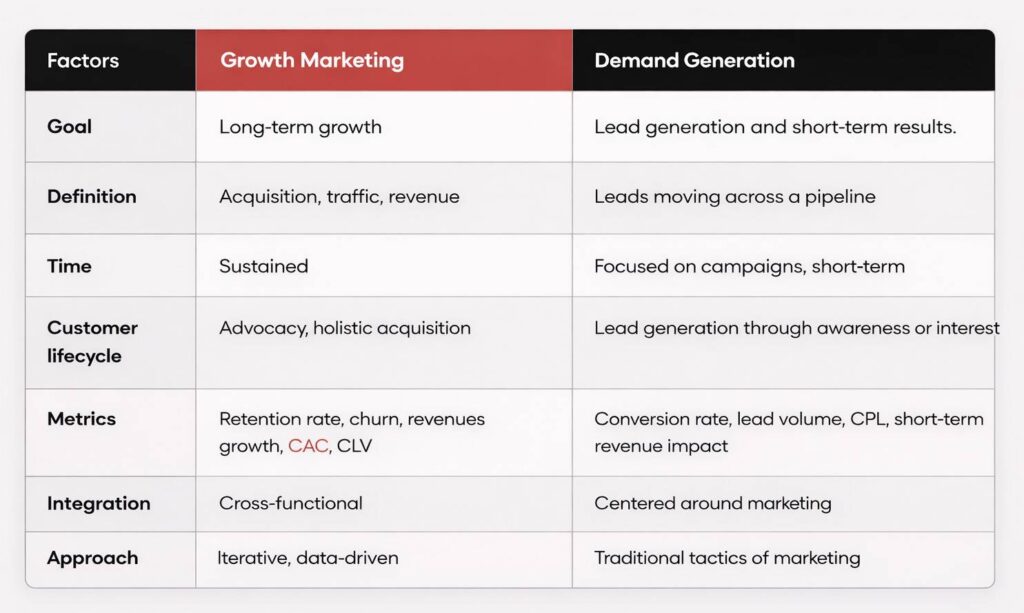
The fundamental difference is scope. Demand generation asks, “How do we create a pipeline?” Growth marketing asks, “How do we build a business that compounds?” Both questions matter. Neither one is sufficient on its own.
Why They Get Conflated, and Why It Costs You
The conflation usually happens in one of two directions.
The first is treating growth marketing as a rebranded version of demand generation. This involves using “growth” as a buzzword that signals modernity without changing the underlying operating model.
Teams that do this still measure primarily against lead volume and pipeline metrics, still optimize at the top of the funnel, and still hand off responsibility for customer success and retention to other departments. The org structure says “growth”, but the function is demand generation under a new name.
The second direction is treating demand generation as unnecessary once you have a “growth” mindset. The idea that, because growth marketing considers the full funnel, you do not need disciplined demand generation programs.
This typically manifests as underinvestment in structured lead generation and pipeline development, replaced by an amorphous commitment to experimentation. The result is a team that runs a lot of tests without building the consistent pipeline coverage that the sales org depends on.
Both misalignments have measurable consequences. The first produces good pipeline metrics and poor retention economics — you are generating demand effectively but losing customers at a rate that undermines LTV and makes CAC unsustainable. The second produces interesting growth experiments and inconsistent pipelines — you are optimizing the customer experience without reliably filling the top of the funnel.
The operational question is not which one is right. It is how to run both, in appropriate proportion, given where your business currently is.
Demand Generation: What It Is Actually Designed to Do
Demand generation works as a system, not a set of tactics. Understanding the system is more useful than cataloging the channels and formats that typically live within it.
The Demand Generation System
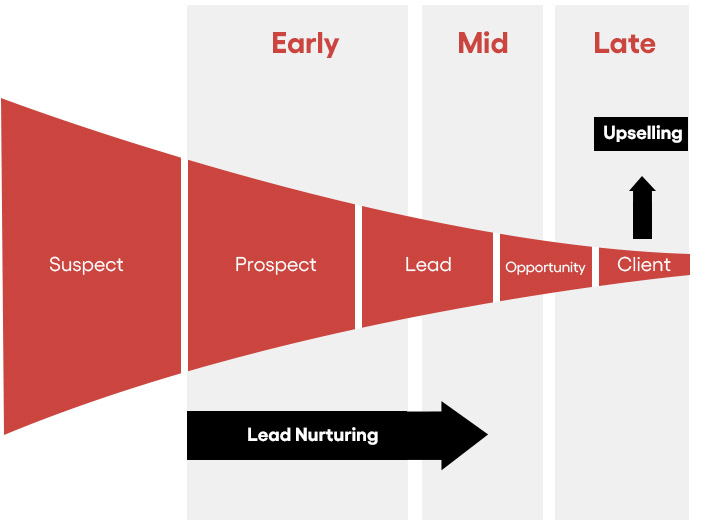
At its core, demand generation is trying to solve a sequencing problem: how do you reliably move an audience from zero awareness to active purchase consideration, at scale and at a cost that makes the unit economics work?
That sequencing involves three distinct phases that require different approaches.
Creating awareness means reaching audiences who do not yet know you exist or do not yet associate you with the problem you solve. The channels that work here are typically
- paid social (for audience-defined targeting),
- content marketing and SEO (for intent-defined reach),
- earned media — press, analyst relations, speaking, and
- other forms of third-party credibility.
The common mistake at this stage is optimizing too early for conversion; awareness programs should be evaluated on reach, engagement quality, and brand recall, not direct lead attribution.
Cultivating interest means engaging audiences who have initial awareness and converting that awareness into active consideration. Here, the operating factors are
- content strategy,
- email nurture sequences,
- retargeting programs, and
- events.
The goal is to demonstrate value and build enough credibility that a prospect self-identifies as a potential buyer. Measurement at this stage should focus on engagement depth, time with content, repeat visits, and content progression, rather than just lead form completions.
Generating pipeline means producing enough qualified, active buying intent to sustain the revenue growth rate your business needs. This is where
- marketing-to-sales handoffs matter,
- lead scoring becomes operational, and
- the quality of what was built in the awareness and interest phases gets tested.
High-volume lead generation that produces a low-quality pipeline is a common failure mode here. An example of this: The demand generation program is “working” by its own metrics, while the sales team flags that the leads are not converting.
The B2B Demand Generation Toolkit
The channels and programs that reliably drive demand in B2B contexts have evolved meaningfully in recent years. A few observations worth embedding in your planning:
Intent data has become a practical tool, not just a theoretical concept.
Third-party intent platforms (Bombora, G2, TechTarget’s Priority Engine, among others) signal which companies are actively researching solutions in your category.
Using that data to prioritize outreach, personalize content, and time paid media exposure to in-market buying cycles materially improves pipeline quality and reduces wasted spend on accounts that are not yet in buying mode.
Gated content is declining in effectiveness as a lead generation mechanism.
As the volume of gated content has increased, the willingness to exchange contact information for it has decreased — particularly among the senior buyers who are most valuable to reach.
The math has shifted: giving away your best content freely tends to produce more genuine engagement and a higher-quality pipeline than requiring a form fill that generates nominal leads with low conversion rates downstream. Evaluate what you are actually optimizing for before deciding what to gate.
Community and category-creating content builds durable demand at lower marginal cost over time.
Companies that invest in building genuine authority around the problems their buyers care about — through original research, distinctive points of view, and consistently high-quality content — develop a demand generation asset that compounds.
The audience you build becomes self-reinforcing: existing readers and subscribers share content, generate backlinks, and refer new prospects. This is a longer-cycle than campaign-based demand generation, but the cost per pipeline dollar tends to improve significantly over a two to three-year horizon.
Growth Marketing: What Makes It Structurally Different
The operational difference between growth marketing and demand generation is most visible at the organizational level. Demand generation typically sits within the marketing function and is accountable to the marketing team’s metrics. Growth marketing, done properly, operates cross-functionally — with touchpoints in product, customer success, sales, and data science, in addition to marketing.
This is not a cosmetic distinction.
The customer retention and expansion work that growth marketing encompasses requires access to product usage data, customer health metrics, and the operational systems that sit outside traditional marketing infrastructure.
A growth marketer who cannot access product analytics cannot build meaningful activation programs. A growth team that does not have a direct line to customer success cannot identify the expansion signals worth acting on.
The Full-Funnel Framework in Practice
The AARRR model — Acquisition, Activation, Retention, Revenue, Referral — is the most commonly used framework for growth marketing, and it is worth understanding what each stage actually means operationally rather than in the abstract.
Acquisition in a growth marketing context is broader than demand generation’s pipeline focus. It includes tracking which channels produce customers with the highest LTV, shortest time-to-value, and best retention characteristics, not just which channels produce the most leads or the lowest CAC. The growth team’s acquisition work feeds back into demand generation by providing more nuanced criteria for what “qualified” actually means.
Activation is the work of ensuring that a new customer reaches the moment where they experience the core value of what they purchased, quickly enough and clearly enough that they decide to stay. For SaaS businesses, this is typically defined as a specific in-product action or milestone. For service businesses, it might be the delivery of a first outcome. Activation optimization is often the highest-leverage growth lever — improving activation rates from 30% to 50% of new customers is mathematically equivalent to a 67% improvement in effective acquisition efficiency.
Retention is the stage where most traditional marketing functions have limited visibility and limited ownership. Customer churn is typically managed by customer success, not marketing. Growth marketing challenges that organizational assumption — arguing that the same rigor applied to acquisition should be applied to retention, because the cost of replacing a churned customer is substantially higher than the cost of retaining an existing one. For subscription businesses, a 5-point improvement in net revenue retention often contributes more to long-term revenue growth than an equivalent improvement in new customer acquisition.
Revenue and Referral close the loop. Revenue expansion — upsell, cross-sell, and price optimization — is often more accessible than it appears, particularly for businesses that have invested in activation and retention. Referral programs work when customers have genuinely strong experiences and when the incentive structure is aligned with the type of customer you want to attract. The most durable referral mechanisms are not coupon-based; they are reputation-based, driven by customers who recommend you because the experience was good enough to justify it.
A/B Testing and Experimentation: The Operating Discipline, not the Methodology
Growth marketing is associated with experimentation, and the association is valid — but the discipline matters more than the tooling. Running A/B tests without a structured hypothesis, sufficient sample sizes, or clear success criteria produces a log of experiments and no reliable learning.
The teams that build genuine competitive advantage through experimentation are the ones that treat it as an epistemological practice
- forming explicit hypotheses about why a change should produce a specific outcome,
- designing tests with statistical validity in mind, and
- updating strategy based on what the evidence actually shows rather than what was hoped for.
The practical starting point: Identify the two or three biggest levers in your funnel, i.e., the stages where conversion rates are lowest relative to the value at stake, and focus experimentation on those.
Spreading testing effort across every stage of the funnel simultaneously produces fragmented learning and rarely compounds.
Choosing the Right Emphasis for Your Business Right Now
The growth marketing vs. demand generation question is not permanent. The right balance shifts as a business matures, and a common failure mode is applying the wrong framework for the current stage.
Early stage (pre-product-market fit or early scaling):
Demand generation investment is premature if product-market fit is not established.
At this stage, growth marketing should focus on building tight feedback loops between the product and early users. The priority is rapid experimentation, especially around activation and retention. These insights help refine what actually delivers value.
Demand generation should remain limited and highly targeted. Use it to test which audiences, messaging, and use cases drive both conversion and long-term retention.
Scaling broad demand campaigns too soon only generates costly data about what doesn’t work. The smarter approach is to learn first, then scale with confidence.
Growth stage (established product, scaling revenue):
This is where demand generation investment becomes the priority alongside retention optimization. The business needs a consistent pipeline to fuel growth, which means demand generation programs need to be systematic and well-resourced.
At the same time, retention and expansion start to significantly impact revenue. As the customer base grows, small improvements deliver outsized returns.
For example, a 10-point increase in net revenue retention at meaningful ARR often creates more value than investing the same budget in new customer acquisition.
Mature stage (category leadership, efficient growth):
At this stage, brand building, community, and category-defining content take priority over purely campaign-driven demand generation. A recognized brand acquires customers more efficiently than an unknown challenger.
Growth marketing shifts toward revenue expansion, referral programs, and customer experience improvements. These efforts help protect and increase Net Promoter Score (NPS) while driving long-term value.
Demand generation becomes more efficient and also more competitive. Strong positioning and brand trust make the difference in sustaining performance.
Team Structure: What Each Function Requires Organizationally
The structural requirements of demand generation and growth marketing are genuinely different, which is why combining them under a single budget and a single team without clarity about which mandate takes precedence tends to produce underperformance on both.
Demand Generation Team Composition
A functional demand generation team needs:
- a strategic lead who owns pipeline targets and channel mix decisions; content and creative capability (either in-house or through reliable partners);
- paid media expertise for both search and social;
- marketing operations for lead scoring, CRM integration, and attribution; and
- analytics capability to connect program activity to pipeline outcomes.
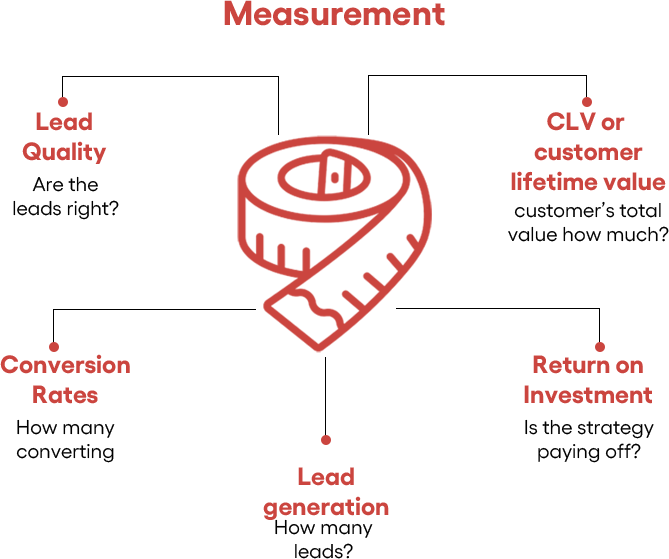
The most common structural gap: Marketing operations is treated as a back-office function rather than a strategic capability. In demand generation, the quality of your attribution infrastructure, your lead scoring logic, and your CRM hygiene directly determines whether you can make confident budget decisions.
Under-investing in marketing operations is a reliable way to produce confident-looking reports that measure the wrong things.
Growth Marketing Team Composition
Growth marketing requires a different skill mix. Growth generalists should preferably have the following skills
- can work across product, marketing, and data,
- have product analytics expertise,
- are well-versed in customer success integration, or at a minimum have a strong working relationship,
- possess engineering or technical marketing capacity for instrumentation and experiment implementation, and
- can act as a data scientist or strong analyst who can design and evaluate experiments with statistical rigor.
The most common structural gap: growth teams are built from marketing backgrounds without sufficient product and data capability.
A growth team that cannot access product analytics and cannot run statistically valid experiments is doing traditional marketing with a growth vocabulary. The organizational integrations, with product, data, and customer success, are as important as the team composition itself.
The Decision Framework
If you are trying to decide where to invest — or how to allocate an existing team’s focus — three questions cut through the complexity:
Where is your biggest bottleneck right now?
If you are generating leads but not converting them, the problem is likely the activation and sales process, not demand generation volume. If you are converting leads but losing customers quickly, the problem is retention, not acquisition. If you do not have enough leads, demand generation is the priority.
Diagnosing the actual bottleneck before investing is the prerequisite for allocating correctly.
What stage is your business in?
As outlined above, the right balance shifts with the stage.
Applying growth stage demand generation investment to an early-stage business is a common and expensive mistake. Applying early-stage experimentation habits to a growth-stage business that needs a systematic pipeline is equally costly.
What does your data actually show?
These numbers tell you where the leverage is:
- LTV by acquisition channel
- Retention rates by cohort
- Activation rates by customer segment
If you do not have them, building the measurement infrastructure to produce them should be the immediate priority, because without them, every budget decision is more of a judgment call than evidence-based.
The businesses that build durable marketing advantages are the ones that operate both frameworks — disciplined demand generation for a consistent pipeline, and rigorous growth marketing for full-funnel optimization — with clear organizational ownership, aligned metrics, and honest measurement.
Neither one alone is sufficient, and the tension between them is productive rather than a problem to resolve.
Ready to Experience What Both Can Offer Your Business
If you want to assess how your current team structure and investment mix maps to your growth stage — and where the clearest gaps and opportunities are — that conversation is worth having before the next planning cycle.