Google’s SGE is not just a new search feature. It is a structural change in how organic visibility is distributed, and most marketing teams are not yet positioned for it.
That gap is worth understanding before your competitors do.
Announced in May 2023 and powered by Google’s PaLM 2 language model, Search Generative Experience sits at the top of the search results page. It generates AI-synthesized answers to queries before a user ever sees a traditional organic listing. It does not replace the ten blue links. It filters the intent of the searcher before those links even enter the picture.
If you are running a content strategy built around informational coverage of well-trodden topics, that strategy is already under pressure. If you are producing genuine expert content that helps people make real decisions, you are better positioned than you might think.
Here is what SGE actually is, how it works, and what it changes for brands that rely on organic search as a revenue channel.
What SGE Is and What It Is Not
SGE is Google’s attempt to build a generative AI layer directly into search. Rather than returning a list of links and asking the user to synthesize information themselves, SGE generates a direct response to the query, draws from multiple authoritative sources, and surfaces those sources alongside the answer.
It also enables conversational follow-up. A user can refine, redirect, or deepen their query within the same search session without starting over.
What SGE is not: a replacement for search. It is an augmentation of the existing experience, with specific features layered on top of traditional results.
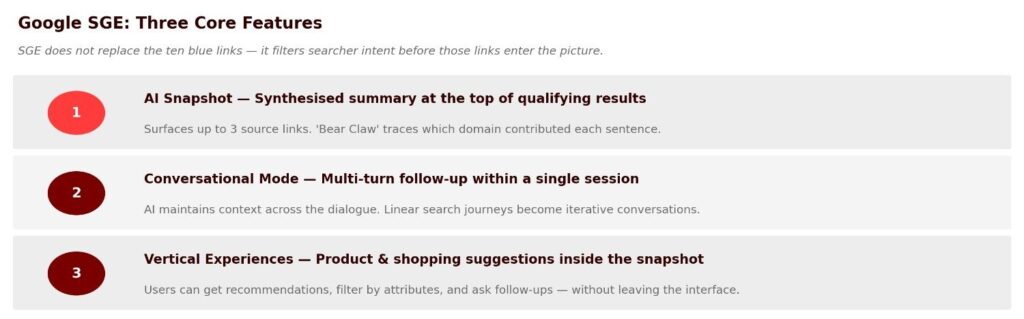
The three primary SGE features you need to understand are:
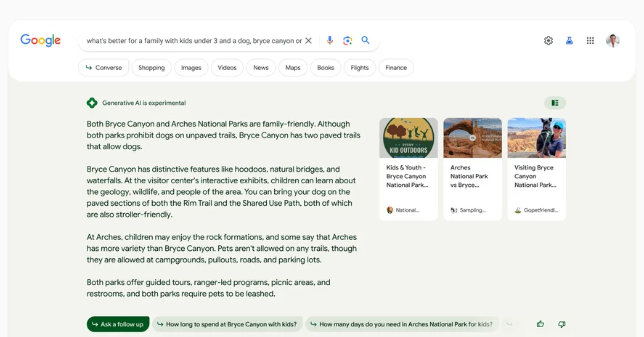
AI Snapshot
A synthesized summary response that appears at the top of qualifying search results. Each snapshot surfaces up to three source links. Google’s “Bear Claw” functionality lets users trace which source contributed each sentence in the snapshot, which has significant implications for which domains get selected as sources.
Conversational Mode
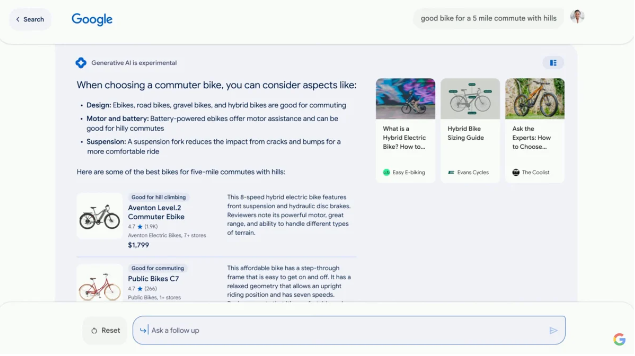
After an initial query, users can ask follow-up questions. The AI maintains context across the conversation. This changes the structure of how people research purchases and make decisions. Linear search journeys are becoming iterative, multi-turn dialogues.
Vertical Experiences
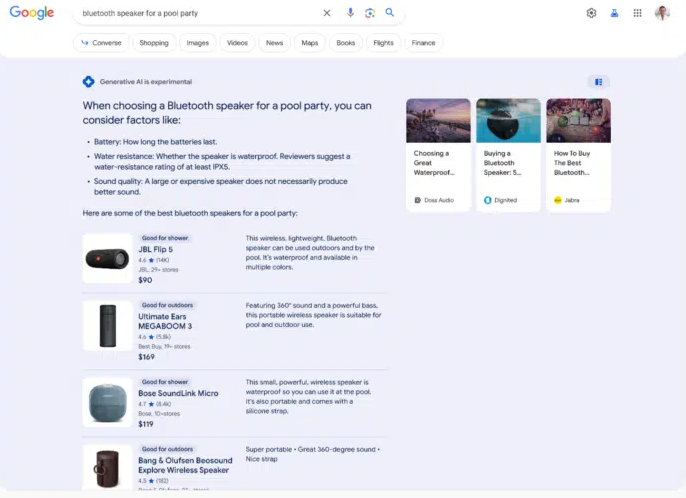
For product and shopping queries, SGE integrates purchasing suggestions directly into the AI snapshot. A user researching a mountain bike with specific features can get product recommendations, filter by attributes, and ask follow-ups, all within the generative interface.
How the Underlying Technology Works
SGE runs on PaLM 2, Google’s second-generation Pathways Language Model. The model was trained on large volumes of text and code, using a combination of supervised and semi-supervised learning approaches.
The practical implication: SGE does not retrieve information in real time the way a search query does. It generates responses based on patterns learned during training, then cites current sources to support those responses. This is why the system can be confident but also wrong, which we will come to shortly.
The distinction between generative AI and general AI is worth clarifying here, too.
General AI refers to systems capable of human-like reasoning across arbitrary domains, essentially the science fiction version of machine intelligence that does not yet exist in commercial form.
Generative AI is narrower. It is trained on existing data to produce new outputs, whether text, code, or images, within specific parameters. SGE is generative AI applied to the search context.
How SGE Handles Different Query Types
SGE does not attempt to answer everything. Understanding where it activates and where it defers to traditional results is strategically important.
Queries SGE engages:
- Informational queries seeking factual knowledge or explanations
- Navigational queries pointing toward specific destinations
- Transactional queries where the user has purchase intent
- Local queries about nearby businesses or services
- Broad queries requiring synthesis across multiple sources
Queries SGE avoids:
SGE applies caution to health, finance, and legal queries where AI-generated advice carries real risk.
A question about medication timing or tax strategy is unlikely to produce an AI snapshot. Instead, users see traditional results with established authority signals. This is deliberate. Google has no interest in liability exposure from AI-generated medical guidance.
Sensitive and controversial topics follow similar logic. Google’s usage policies require that SGE comply with the same content standards that govern traditional search results. Queries that could produce harmful, misleading, or offensive content in generative form will not trigger an AI snapshot.
The Accuracy Question: What the Data Actually Shows
SGE synthesizes information from sources Google has determined to be reliable. That is the intent. The execution is imperfect.
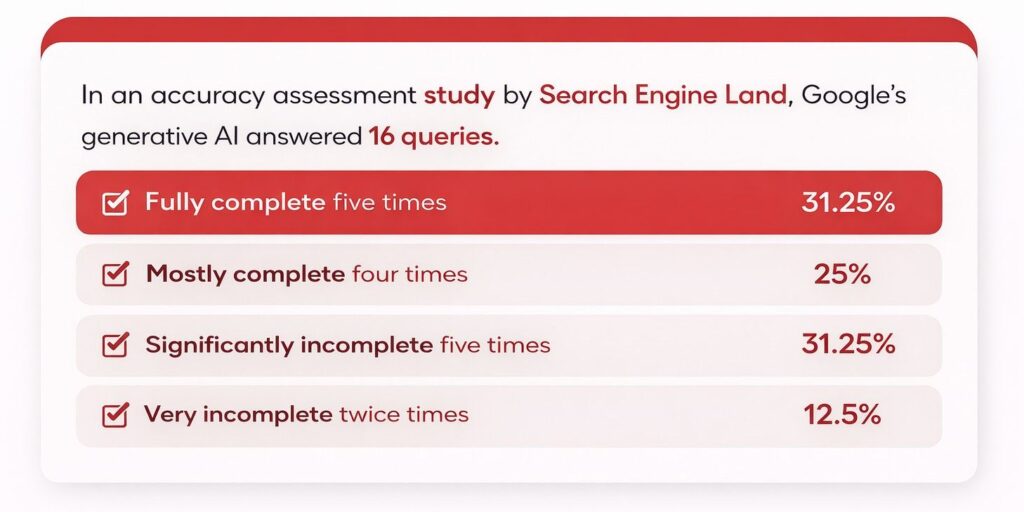
That means roughly 44% of responses had meaningful accuracy or completeness problems. For a system sitting at the top of the most-used search engine on earth, that is a material concern.
The accuracy issue is not arbitrary. It reflects the fundamental limitation of generative AI: The model produces plausible-sounding responses based on statistical patterns in training data. When the training data is strong and current, the output is often good. When the topic is nuanced, recent, or genuinely contested, the output can be confidently wrong.
This matters for your content strategy in a specific way. Generative AI performs well on commoditized information. It performs poorly on genuine expertise, recent developments, and decision-relevant nuance. If your content lives in that second category, it is harder for SGE to replace and more likely to be cited as a source.
What SGE Changes for Organic Search Strategy
This is the question that matters most for growth operators and marketing leaders. Here is the honest picture.
What changes:
Publishing generic, broadly informational content as an SEO play is increasingly a dead end. SGE can synthesize that information accurately and present it without the user ever clicking through to your site. If your content strategy is built around covering well-documented topics with competent but undifferentiated writing, that strategy is losing value.
The volume of zero-click searches will grow. Users who get their question answered in the AI snapshot have less reason to click through to source content. Impressions may hold or grow while click-through rates compress.
What does not change, or gets more valuable:
Original expert content that reflects genuine practitioner knowledge cannot be replicated by a model trained on historical data. Topics that remain difficult for generative AI to produce at quality are:
- first-person case studies,
- proprietary data,
- nuanced opinion backed by reasoning, and
- advice that helps people make specific decisions.
Content that is recent matters more. SGE does not have access to real-time information. Breaking industry news, recent research, and current events require source content that the AI cannot generate from training data alone. Publishers who cover their space with currency and depth retain visibility that commodity content cannot.
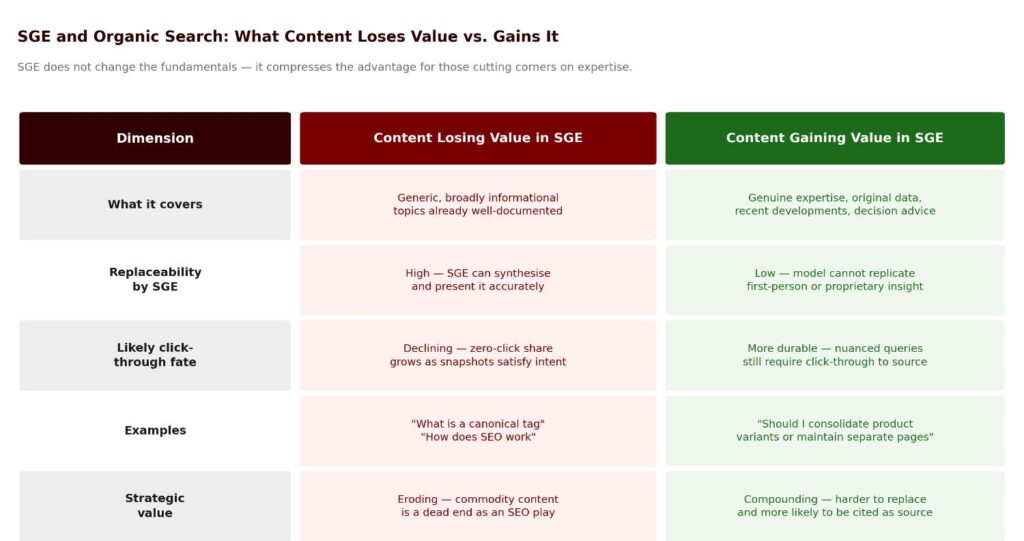
Decision-stage content is more durable than awareness-stage content. A user asking “what is a canonical tag” is likely to get a serviceable AI snapshot. A user asking “should I consolidate my e-commerce product variants under one URL or maintain separate pages” is asking a question that requires contextual judgment. That is harder for SGE to answer definitively, and more likely to drive a click-through.
What SGE Means for Search Ads
Google has indicated that generative AI will be applied to ad campaign creation and optimization. A Reuters report noted plans to deploy AI for building more sophisticated ad experiences within SGE.
For paid search, this is a watch-and-verify situation.
The commercial implication is that ad placements adjacent to AI snapshots may behave differently from traditional sponsored listings. This is particularly true for queries where the snapshot satisfies intent before the user reaches the ad.
Monitoring impression share, click-through rate, and conversion rate by query type will be important as SGE rolls out more broadly.
The Benefits Worth Acknowledging
Despite the accuracy limitations, SGE genuinely improves the search experience for many users.
Autocomplete and query refinement are more intelligent within SGE than traditional search. Suggestions are contextually relevant rather than purely frequency-based.
Contextual and personalized results reflect a user’s search history and behavior in ways that improve relevance. For users with established patterns, this reduces the effort required to find useful information.
Instant multi-turn dialogue compresses the research process. A buyer evaluating a complex purchase decision can refine their understanding faster within a single conversational session than by running multiple discrete searches.
For users, these are real improvements. For marketers, the implication is that the path from awareness to purchase intent is becoming shorter and more self-contained within Google’s interface.
The Limitations Worth Planning Around
SGE’s known limitations are not minor edge cases. They are structural.
Accuracy issues at scale are the primary concern. A system that produces significantly or very incomplete responses in nearly half of the test queries will generate user trust problems over time. Google is aware of this and actively improving the model, but the limitation will not disappear quickly.
Complex, multi-part queries still challenge the system. The more nuanced and context-dependent a question is, the more likely SGE is to produce an incomplete or imprecise response.
The absence of real-time data creates gaps for any query where recency matters. For fast-moving industries, this is a persistent structural limitation, not a temporary one.
Where Generative Search Experience (SGE) Is Headed
The trajectory of the technology suggests several likely developments over the next few years.
Natural language understanding will improve. The gap between what users mean and what the system interprets will narrow. This will make SGE more useful for complex queries and reduce the advantage that simple, direct queries currently have.
Multimodal search will expand. SGE will increasingly incorporate images, audio, and video alongside text. For brands with strong visual assets or video content, this opens new surfaces for discovery.
Personalization will deepen. As Google accumulates more interaction data from SGE sessions, the system will get better at calibrating responses to individual search patterns.
AR and VR integration, while further out, represents the logical endpoint of a search experience that moves beyond a browser window entirely.
What This Means for Your Content Investment
The brands that will hold ground in an SGE-influenced search environment share a few characteristics.
They publish content that reflects genuine expertise and cannot be easily replicated from existing web data. They cover their space with depth and recency, not just breadth. And they build content around the decisions their buyers need to make, not just the questions they ask early in the funnel.
None of that is a radical shift from a good content strategy. SGE does not change the fundamentals. It compresses the advantage for brands that were cutting corners on expertise and raises the floor for what useful organic content needs to deliver.
The brands treating organic search as a compounding revenue channel, rather than a traffic metric, will find that the SGE environment rewards the same things that always distinguished durable SEO from short-term ranking plays.
This includes real expertise, genuine utility, and content that earns a reader’s attention because it is actually worth their time.
Ready to Make the Most of SGE?
If you want to understand how your current content library is positioned for an SGE-influenced search environment, a structured content audit is the starting point. Request a teardown and find out where your organic strategy is exposed and where it is already well-defended.