Most e-commerce brands that hire the wrong SEO agency do not realize it for six to nine months. By then, they have spent a meaningful budget, their organic channel has not moved in any direction that matters, and the agency is pointing to metrics that look like activity rather than outcomes.
The off-boarding conversation is uncomfortable, the time lost is unrecoverable, and the next agency has to spend the first several months unwinding decisions the previous one made.
The selection process is where you either protect yourself from that outcome or set yourself up for it. This is a guide for doing the former.
What the Wrong Agency Actually Costs

Before the checklist, the stakes deserve clarity. E-commerce SEO done well compounds. Organic search traffic acquired at a reasonable cost per session, converting at a rate that reflects good intent alignment, with improving domain authority and category coverage over time, creates an acquisition channel that becomes more efficient each year.
The cost of the wrong agency is not just the retainer. It is the
- opportunity cost of the compounding that did not happen,
- technical debt that often gets introduced by poorly executed optimization work, and
- credibility erosion that comes from leadership watching a channel underperform for multiple quarters without a clear diagnosis or accountability.
That context should calibrate how seriously you approach the evaluation.
The Six Evaluation Criteria That Actually Matter
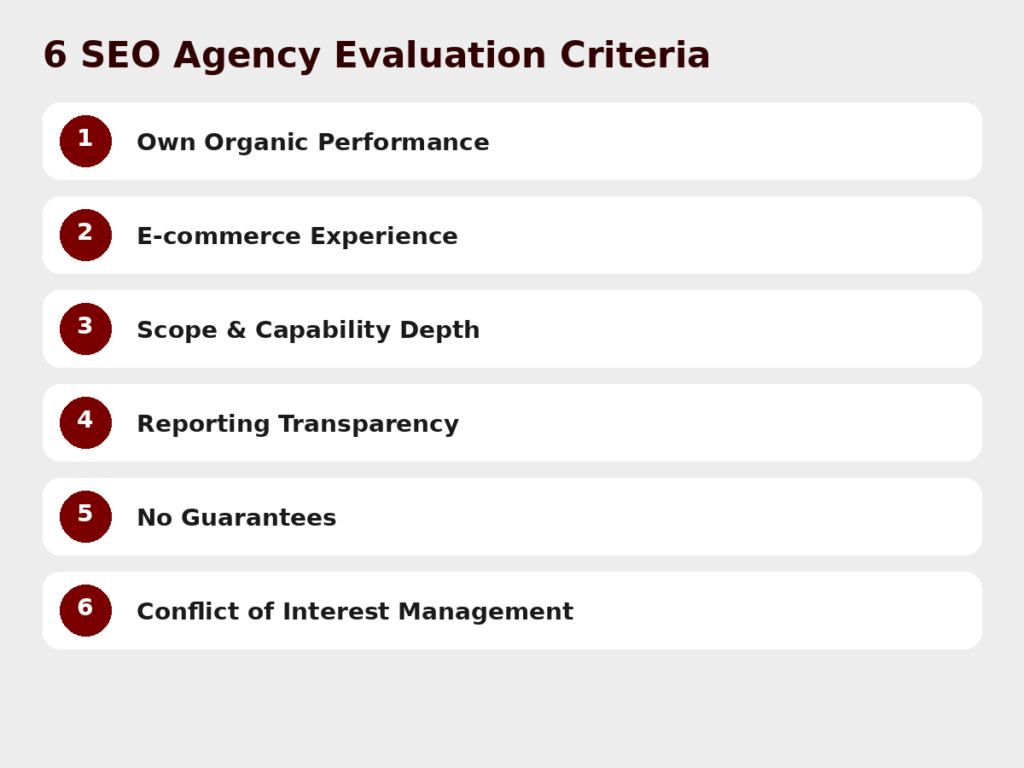
1. Their Own Organic Performance
This is the most underutilized signal in agency selection, and it is available before your first conversation.
Search for the terms an ecommerce SEO agency should own. Categories like “ecommerce SEO services,” “technical SEO for ecommerce,” and more specific terms in their claimed areas of specialization.
Where do they rank? What does their organic traffic look like based on publicly available estimates from tools like Semrush or Ahrefs? How is their site structured from a technical and content architecture standpoint?
An agency cannot credibly promise to build what they have not built for itself. This is not an absolute disqualifier if they are early-stage, but it is meaningful context. A ten-year-old agency that does not rank for its own primary category has a strategy problem or a credibility problem, neither of which you want to inherit.
Beyond rankings, look at the quality of their own content. Is it substantive and specific, or is it templated and generic? Do they publish original thinking about SEO, or do they recycle consensus positions? The content quality of their own site is a direct sample of what they will produce for yours.
What to do:
- Run their domain through a tool like Ahrefs or Semrush before the first call.
- Look at organic traffic trends, keyword distribution, and top-performing pages.
This takes fifteen minutes and will change the quality of every subsequent conversation.
2. Demonstrated Experience in E-commerce Specifically
E-commerce SEO is technically distinct from B2B or publishing SEO in ways that matter. Managing SEO for large e-commerce sites is complex. Especially with thousands of product SKUs.
Crawl management becomes a real challenge at scale. Faceted navigation can quickly create SEO issues. Product variants need the right canonical setup; otherwise, rankings get diluted. Structured data must be implemented properly for both products and reviews.
Seasonal demand adds another layer of complexity, since what works today may not work tomorrow. Category pages build authority over time. Product pages drive actual conversions. Balancing both is critical for performance.
This is where many generalist agencies fall short.
Ask for case studies from ecommerce clients specifically, ideally in categories adjacent to yours. Not testimonials. Actual documented outcomes with before-and-after metrics covering organic traffic growth, keyword ranking movement, revenue attribution to organic, and timeline.
Case studies that lack specific metrics should be probed. An agency that says “we improved organic visibility for a major retailer” without being able to share the traffic numbers, the ranking changes, or the revenue impact is either protecting a client that did not consent to disclosure or does not have the attribution infrastructure to measure what they actually produced. Neither is reassuring.
The threshold question:
Can you show me the organic traffic and revenue attribution data from a client in a comparable category, twelve months before and twelve months after the engagement?
If the answer is no, understand why before proceeding.
3. Scope and Capability Depth
SEO is not an isolated channel. For ecommerce brands, organic search performance is downstream of technical site health, content quality and architecture, link authority, and the conversion experience on the pages that organic traffic lands on.
An agency that only executes one of these well will hit a ceiling quickly.
Technical SEO covers crawl efficiency, page speed, Core Web Vitals, schema markup, canonical and redirect architecture, and the ongoing monitoring that catches regressions before they affect rankings. This work requires engineers or highly technical SEO practitioners, not generalists.
Content strategy covers category page architecture, buying guide, and informational content that captures mid-funnel search demand, and the editorial infrastructure that produces content consistently at a standard that earns organic visibility.
Link acquisition covers digital PR, editorial outreach, and the authority-building work that raises domain-level competitiveness in crowded categories.
A credible ecommerce SEO agency has genuine depth in all three.
When evaluating scope, ask specifically:
- Who on your team would own technical audits and implementation oversight for our site?
- Who manages content strategy and production?
- What does your link acquisition process look like, and what kinds of links have you earned for clients in the last twelve months?
The answers will tell you whether you are buying a coordinated capability or three disconnected services bundled under one invoice.
Watch for: Agencies that describe their content offering as “blog posts” without reference to content architecture, topic clustering, or search intent mapping. That framing suggests tactical execution without strategic thinking, which produces content that earns traffic from low-value queries and does not move organic revenue.
4. Transparency in Reporting and Communication
The question is not whether they report, but what they report and whether the reporting connects to your commercial outcomes.
An agency that reports keyword rankings and organic sessions without connecting those metrics to revenue, conversion rate, and pipeline contribution is asking you to trust that the correlation is positive without providing evidence. In ecommerce, where the revenue-to-traffic relationship is direct and measurable, there is no legitimate reason to report activity metrics without revenue context.
Ask to see an example of a client report before you sign.
Look for:
- Is the revenue attributed to organic clearly visible?
- Are conversion rates by landing page included?
- Is the trend in organic-attributed revenue going in the right direction and at a rate that reflects meaningful commercial impact?
- Is there a commentary section where the agency explains what drove changes, what they learned, and what they are adjusting?
The absence of revenue attribution in SEO reporting is one of the most reliable indicators that an agency does not have the analytical infrastructure to know whether its work is actually producing commercial outcomes. That is a significant risk.
On communication cadence: Monthly reporting is the standard, but the quality of the conversation around that report matters as much as the report itself. An agency that sends a PDF and waits for questions is operating at a lower level of partnership than one that proactively interprets the data, explains the implications, and comes with an informed point of view on what the next quarter of work should prioritize.
5. How They Handle the Guarantees Question
Any agency that guarantees specific ranking positions or a defined volume of organic traffic in a fixed timeframe is either
- misrepresenting how search algorithms work or
- structuring a reporting environment where they can make those numbers appear regardless of actual commercial impact.
Google’s ranking systems evaluate hundreds of signals, many of which are outside any agency’s control: competitor activity, algorithm updates, market demand shifts, and your own site’s commercial performance signals.
No one who understands how search works can guarantee a specific position in a competitive category by a specific date.
What legitimate agencies can commit to is process quality, reporting transparency, and a clear methodology for how work will be prioritized and evaluated. They can share reasonable performance expectations based on comparable clients in similar competitive environments, with honest caveats about the variables that affect the timeline.
The red flag is not optimism. It is the specificity that cannot be justified. An agency that tells you they will get your primary category keyword to page one within ninety days, without having audited your site or analyzed your competitive environment, does not have the basis for that claim. They are telling you what you want to hear.
The useful counter-test:
Ask the agency to walk you through a scenario where their work does not produce the expected results in the first six months. What would cause that? How would they diagnose it? What would change in the engagement?
An agency that has a thoughtful answer to that question understands the work. An agency that deflects it probably does not.
6. Conflict of Interest Management
Working simultaneously with direct competitors targeting the same keywords creates a structural conflict that most agencies will not acknowledge voluntarily. If an agency is running keyword and content strategies for two brands competing for the same category terms in the same market, at least one of those clients is receiving suboptimal strategic attention, even if the tactical execution is identical.
Ask directly: Do you currently work with any businesses in our category?
If the answer is yes, the follow-up is: How do you manage the conflict in keyword targeting and content strategy?
There are legitimate structures for managing this, like dedicated teams, category exclusivity agreements, and geographic separation in some cases. What is not legitimate is the claim that there is no conflict because “SEO best practices are the same for everyone.” Strategy is not universal. Competitive positioning, keyword prioritization, and content differentiation are, by definition, zero-sum in contested categories.
If the agency is not willing to provide a clear answer about their current client relationships in your category, that is the answer.
Questions Worth Asking in the Initial Conversation
Beyond the checklist, the quality of the initial conversation tells you a great deal.
Agencies that lead with questions about your business, your competitive position, your current organic performance, and your commercial goals before presenting their capabilities are oriented toward outcomes.
Agencies that immediately present credentials, case studies, and service offerings before understanding your situation are oriented toward closing.
A few specific questions that reveal strategic thinking:
“Where do you see the biggest technical gap on our site based on a quick audit?”
Any credible agency should have looked at your site before the meeting. If they have not, they are not serious. If they have and cannot identify specific observations, their technical capability is superficial.
“What would your content strategy focus on in the first six months, and why?”
The answer should reference your category architecture, search demand patterns, and competitive gaps, not generic best practices about publishing frequency or keyword density.
“How would you measure whether this engagement is working, and at what point would you recommend we change course if it is not?”
This question tests both their analytical rigor and their willingness to be accountable. The right answer involves specific KPIs, a defined review cadence, and an honest acknowledgment of the conditions under which the strategy would need to be revisited.
The Timeline Reality
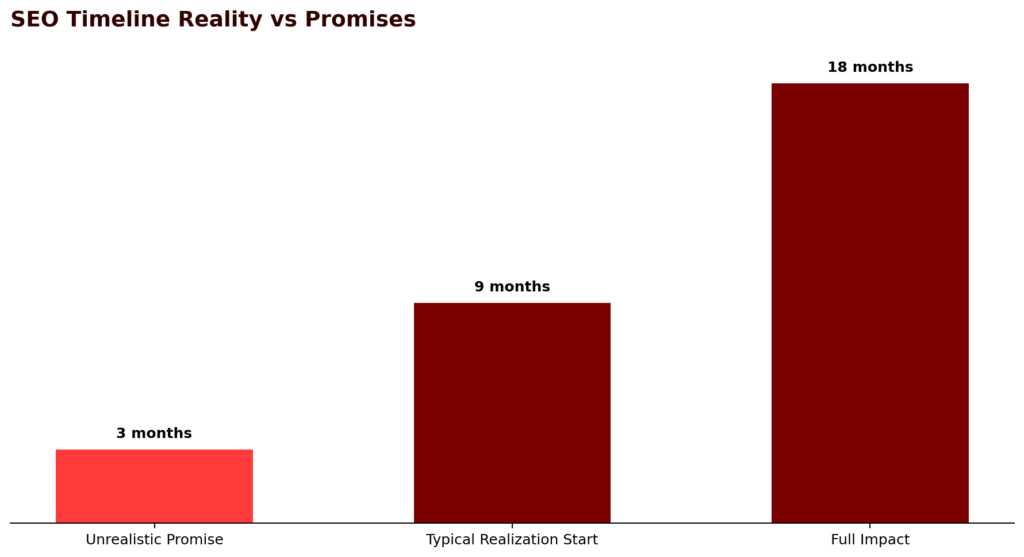
Organic SEO in competitive ecommerce categories is not a ninety-day channel.
Meaningful, sustainable organic revenue growth from a standing start or a recovery situation typically takes nine to eighteen months to fully materialize, depending on domain authority, competitive intensity, content volume, and technical starting point.
Agencies that set shorter timelines to win business are creating expectations that the work cannot meet, which means you will have a difficult conversation at the six-month mark, regardless of how well the actual work is being executed.
The right agency will give you a realistic timeline anchored in an honest assessment of your current position and the competitive environment. That conversation might be less exciting than being told you will rank for your primary terms in sixty days. It will be more useful.
Making the Decision
There is no perfect agency. There is an agency whose
- capability gaps are acceptable given your current stage,
- communication style works with your team, and
- track record in your category is credible enough to justify the investment.
The evaluation process described above is not about finding an agency with no weaknesses. It is about understanding what you are actually buying before you commit, so that the engagement starts with realistic alignment rather than a projection of expectations onto an ambiguous relationship.
Want to Know Where Your e-Commerce SEO Currently Stands?
If you want an independent view on your current organic performance, your competitive position in search, or what a credible ecommerce SEO engagement should cost and include at your stage, a site audit is the fastest way to get clarity. Request a teardown and get an honest assessment of where your organic channel currently stands and what it would take to move it.