
Most Indian startups treat SEO as a cost center that they will fund once the business is more stable. That sequencing is backwards, and it is one of the more expensive mistakes a founder or early marketing leader can make.
The reason: Organic search authority takes time to build, and that time starts from whenever you begin. Every month spent relying entirely on paid acquisition while deferring SEO investment is a month of compounding you will never recover. By the time the business is “stable enough” to invest in organic, competitors who started earlier have a lead that takes years to close.
The businesses that build the most defensible organic presence in India’s competitive startup ecosystem are the ones that started building it early, focused on the right priorities, and gave it enough time to compound. This guide covers what those priorities actually are — with the strategic reasoning, not just the checklist.
Why SEO Works Differently for Indian Startups
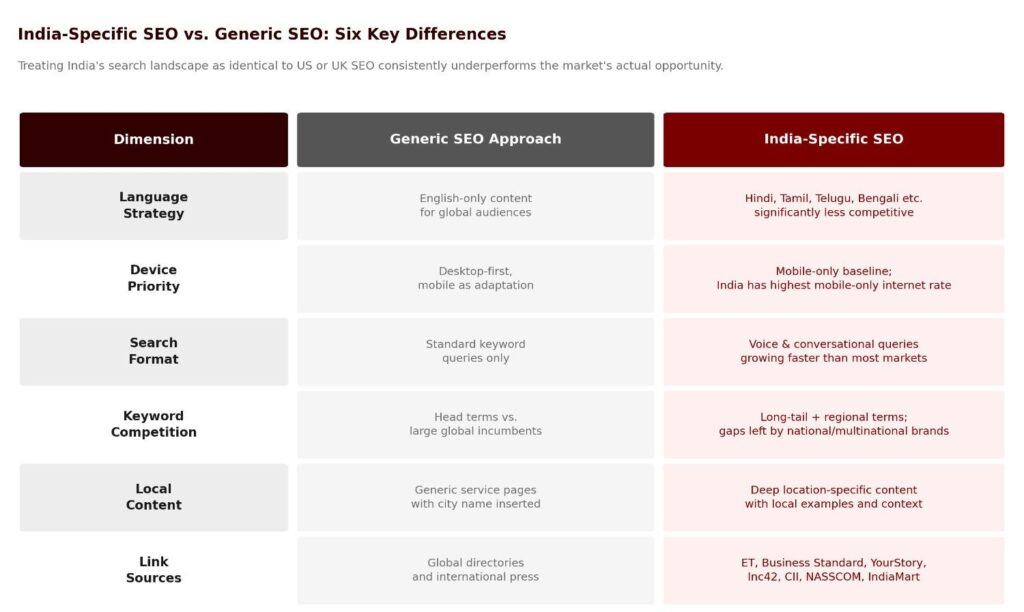
India’s search landscape has characteristics that meaningfully shape SEO strategy, and treating it as identical to US or UK SEO produces results that underperform what the market actually offers.
Language and regional diversity create underserved keyword territory.
The vast majority of SEO content targeting Indian markets is in English and optimized for urban, English-proficient audiences. Hindi, Tamil, Telugu, Bengali, Marathi, and other regional language search queries are significantly less competitive than their English equivalents, and regional intent often signals higher purchase proximity for locally-distributed products and services. For startups with regional market focus, this is an opportunity that national and multinational competitors frequently leave uncontested.
Mobile-first indexing is not a consideration — it is the baseline reality.
India has one of the world’s highest rates of mobile-only internet access. A significant portion of your target audience will never visit your website on a desktop.
Technical SEO decisions, page speed optimization, and content formatting all need to start from the mobile experience, not adapt down to it. Sites that treat mobile as a secondary concern are not just losing rankings; they are losing the majority of their potential audience.

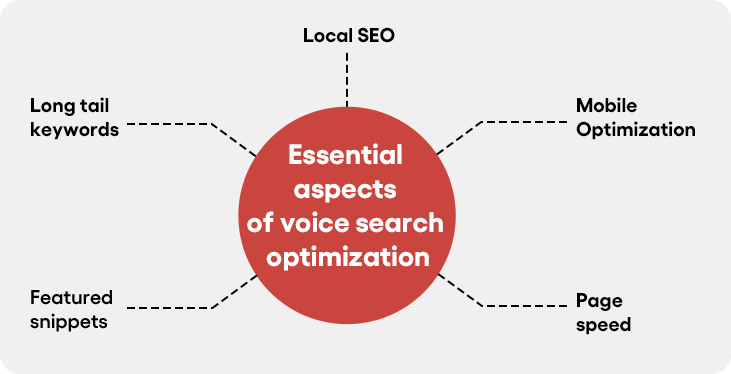
Voice search is growing faster in India than in most markets.
The combination of smartphone penetration, conversational search patterns in Indian languages, and Google Assistant and Alexa adoption in urban households means that voice-formatted queries are a meaningful and growing share of search volume.
Content optimized for question-based, conversational queries captures this traffic in ways that traditional keyword-focused content does not.
The competitive gap between funded startups and early-stage companies is real but not insurmountable.
Well-funded Indian startups in fintech, edtech, healthtech, and consumer categories have invested significantly in SEO. Their advantages in domain authority, content production capacity, and technical SEO are genuine.

But the same structural vulnerability that applies to large incumbents applies here, too. Topical depth in specific niches, long-tail keyword territories, and regional intent queries are consistently underserved by brands optimizing for scale. Focused early-stage companies can build meaningful organic positions in those spaces before the well-funded competitors prioritize them.
The Strategic Priorities: What to Do First and Why
The common mistake in early-stage startup SEO is trying to do everything simultaneously. Technical SEO, content production, link acquisition, local optimization, and voice search, when addressed in parallel with limited resources, are not done well.

The right approach is sequenced.
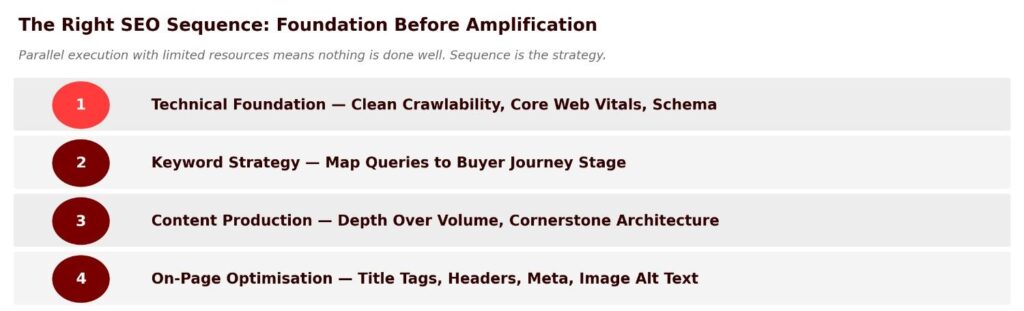
Foundation first.
Before any content investment, the technical foundation needs to be sound. A site that Google cannot crawl efficiently, index correctly, or understand structurally wastes every rupee spent on content.
The foundation checklist:
- clean crawlability and indexation (verified in Google Search Console),
- Core Web Vitals performance that meets Google’s benchmarks, particularly on mobile,
- HTTPS security,
- logical URL structure and site architecture, and
- schema markup that helps search engines interpret your content type correctly.
This is not an ongoing project — it is a one-time investment with periodic maintenance. Get it right before scaling content production.
Keyword strategy second, and built around commercial outcomes.
The goal of keyword research is not to find all the keywords in your category. It is to identify the specific queries that your target customer uses
- when they are actively researching or ready to purchase what you offer,
- where you have a realistic probability of ranking given your current domain authority, and
- where ranking would produce business value.
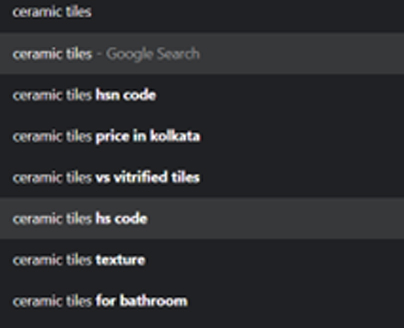
For most Indian startups, that means prioritizing mid-funnel commercial queries and specific long-tail informational queries over broad head terms.
A fintech startup cannot realistically rank for “digital payments India” in its first year against Paytm, PhonePe, and Google Pay.
But “UPI payment app for small businesses in Bangalore” or “how to accept digital payments without a POS machine” represent mid-funnel and informational queries with meaningful intent, lower competitive density, and audiences that are specifically valuable to a B2B or D2C fintech offering.
Build a keyword map organized by buyer journey stage — awareness, consideration, and decision — and prioritize the consideration-stage keywords first. These have the clearest commercial intent and the most direct path to revenue, while typically being less competitive than pure transactional terms.
Content third, built for depth rather than volume.
The output of keyword research is a content brief, not a production target. Content that genuinely serves the specific intent behind a query — comprehensive, accurate, and written with evident expertise — outperforms high-volume thin content in both rankings and conversion.
For resource-constrained startups, this means publishing less and publishing better.
A practical starting framework:
- Three to five cornerstone pieces that cover your most important topics comprehensively.
- These are to be supported by more specific pieces that go deeper into individual sub-topics or queries.
- Internal links between them signal topical coherence to search engines and help users navigate related content.
This architecture earns authority faster than the same word count spread across disconnected posts.
On-Page SEO: The Mechanics That Actually Move Rankings
On-page optimization is the practice of ensuring each page on your site clearly communicates its topic, intent, and value to search engines. For early-stage startups, getting this right across your ten most important pages is more valuable than getting it partially right across fifty.

Title tags are the most direct ranking signal.
Every page should have a unique title tag that includes the primary keyword positioned toward the front, stays under 60 characters to display cleanly in search results, and communicates the page’s value proposition clearly.
“Digital Payment Solutions for Small Businesses in India” outperforms “Home — FinPay” for both rankings and click-through rate.
Meta descriptions do not directly affect rankings, but they affect click-through rates, which do.
Write each meta description as a concise advertisement for the page — one to two sentences that tell the searcher what they will find and give them a reason to click. Include the primary keyword naturally.
Treat it as copywriting, not filing.
The header structure serves both search engines and users.
One H1 per page, incorporating the primary keyword. H2s and H3s to organize the content in a way that is genuinely useful for scanning, with related keywords embedded where they fit naturally.
The purpose of headers is content organization, not keyword insertion — forced keyword placement in headers is readable to both algorithms and human editors.
Content depth signals expertise.
Thin pages — a few hundred words that gesture at a topic without actually addressing it — rarely rank well and communicate low quality at the page and domain level. If a topic is worth targeting, it is worth covering properly.
A 1,500-word piece that genuinely answers the query comprehensively will consistently outperform five 300-word pieces covering the same topic superficially.
Image optimization is low-effort and frequently skipped.
Descriptive file names, alt text that accurately describes the image content and includes relevant terms naturally, and compression that does not compromise load speed.
For Indian audiences on variable mobile connections, image optimization has a direct impact on user experience and by extension on engagement signals that feed ranking.
Local SEO: Often the Fastest Path to Early Traction
For startups with any geographic dimension to their business — physical location, regional service area, city-specific product availability — local SEO is frequently the fastest path to meaningful organic traffic. This is also the terrain where early-stage brands can most quickly establish competitive positions.
Google Business Profile is the starting point and the highest-leverage single action.
Claim and fully optimize the listing:
- accurate and consistent business name, address, and phone number;
- complete category selection;
- detailed business description with relevant keywords;
- regular photo updates; and
- active review management.
A fully optimized Google Business Profile significantly increases visibility in Maps results and the local pack that appears in searches with local intent.
Citation consistency matters more than citation volume.
Your business name, address, and phone number should be identical across every directory listing — JustDial, Sulekha, IndiaMart, Google, and any category-specific directories relevant to your industry.
Inconsistencies create ambiguity for search engines and can suppress local rankings regardless of how well-optimized the individual listings are.
Customer reviews are a local ranking signal and a conversion driver.
Build a systematic process for requesting reviews from satisfied customers — post-service follow-up messages, in-person requests, QR codes that link directly to your review profile.
Respond to all reviews, including negative ones, promptly and professionally. The volume, recency, and rating of reviews all contribute to local search visibility.
Location-specific landing pages earn local rankings that generic pages cannot.
A page optimized for “digital marketing agency in Kolkata” will outrank a general services page for searches with Kolkata intent.
These pages need genuine, specific content — the local market context, specific local client examples, local team members or partnerships — not just a city name inserted into a template.
Zomato’s early growth illustrates the local SEO principle at scale: They built deep, location-specific content for hundreds of Indian cities and neighborhoods before building brand recognition nationally. The local content earned the local rankings, which built the user base, which built the brand. The sequence matters.
Content Strategy for the Indian Market
Content that performs in Indian search markets has a few characteristics that are worth designing around intentionally.
Regional and language-specific content is genuinely underserved.
YourStory’s success in the Indian startup media space is partly attributable to producing content specifically for Indian entrepreneurs in contexts and examples they recognize — not adapted Western content, but original work that reflects Indian business realities.
The same principle applies to startup SEO: Content that addresses specifically Indian regulatory environments, payment infrastructure, distribution challenges, and market dynamics will outperform generic content on the same topics for Indian search audiences.
Informational content builds organic authority that converts over time.
The instinct to focus exclusively on product and transactional pages is understandable but strategically limiting. The buyers who convert from organic search at the highest rates are often the ones who found the brand through informational content first
- a guide that solved a problem,
- an article that explained something they needed to understand,
- a comparison that helped them evaluate options.
Investing in genuinely useful informational content builds an audience that eventually converts, at a lower CAC than paid acquisition.
Evergreen content compounds; topical content peaks and fades.
For resource-constrained teams, the return on evergreen content — pieces built around stable queries that do not lose relevance over time — is substantially better than equivalent investment in trend-driven content.
A comprehensive guide to GST compliance for small businesses will generate organic traffic for years. An article about a specific regulatory development in 2023 will fade within months. Both have a place in a content strategy, but the allocation should favor evergreen.
Content refresh is often more efficient than new content production.
Existing content that ranked well but has since lost positions is often recoverable with targeted updates
- refreshed data,
- added depth,
- improved internal linking, and
- updated examples.
Before investing in net new content production, audit what you already have and identify the pieces where a focused update could recover or improve positions.
Link Acquisition: What Works in the Indian Market
Building backlinks in the Indian market has some specific characteristics worth understanding.
Indian media and press relationships are a high-value link source.
Economic Times, Business Standard, Mint, YourStory, Inc42, and similar publications are high-authority sources whose link value is significant.
Getting covered requires either genuine news value (product launches, funding, partnerships, original research), relationship investment with relevant journalists, or substantive expert commentary contribution.
Press coverage should be a deliberate part of the growth strategy, not just a nice-to-have, because the backlink and brand signal value are substantial.
Industry association memberships and professional directory listings provide baseline authority.
CII, NASSCOM, and sector-specific industry bodies often maintain member directories or publish member news. These are achievable links for early-stage startups and contribute baseline authority in relevant categories.
Thought leadership guest contributions earn links and audience simultaneously.
Contributing expert content to publications your target customers read — not purely for SEO, but because the audience is genuinely valuable — produces backlinks, brand recognition, and direct referral traffic.
The quality of the publication matters more than volume; three contributions to credible industry publications will outperform thirty contributions to low-quality blogs.
Do not pursue purchased links or link schemes.
This is worth stating directly because the Indian SEO market has a significant supply of vendors offering paid link placements. Google’s ability to identify and discount or penalize manipulative link profiles is real and improving.
The medium-term risk of algorithmic or manual penalty routinely outweighs the short-term ranking gain from purchased links. For a startup with limited resources, a penalty that requires months of recovery work is potentially existential.
Measuring What Actually Matters
Tracking SEO metrics is not optional, but tracking the wrong ones produces confident-looking numbers with no connection to business outcomes.
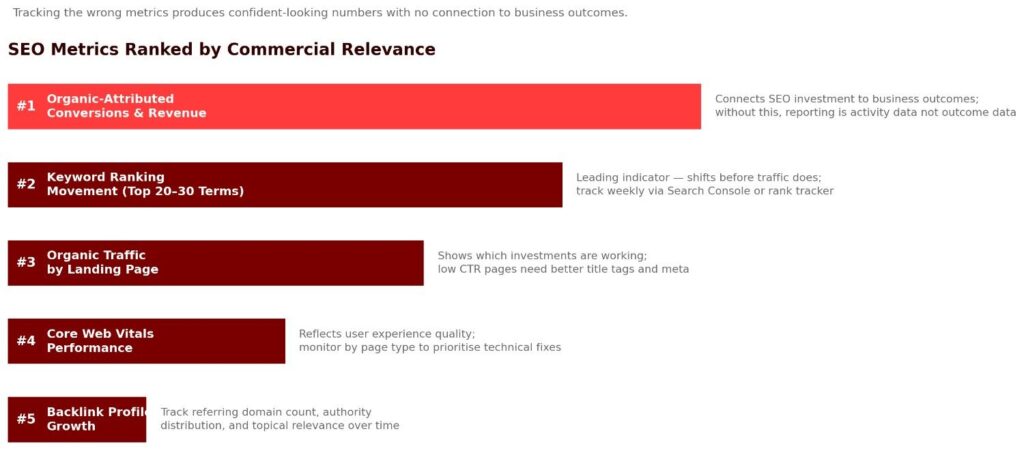
The metrics worth monitoring, in order of commercial relevance:
Organic-attributed conversions and revenue.
If your analytics setup can attribute leads, sign-ups, or revenue to organic search as a source, this is the metric that justifies SEO investment in business terms.
Set up goal tracking in Google Analytics, ensure your UTM parameters are clean, and connect organic traffic to downstream conversion events. Without this connection, SEO reporting is activity data rather than outcome data.
Keyword ranking movement on target terms.
Rankings are leading indicators — they shift before traffic does, and they give you the signal on whether optimization work is producing results before the volume changes are visible.
Track rankings weekly on your 20 to 30 most important target keywords using Search Console or a rank tracking tool.
Organic traffic by landing page.
Which pages are actually driving organic traffic, and at what volumes? This tells you where the current SEO investments are working and where they are not.
Pages with significant impressions but low click-through rates need a title tag and a meta description that works. Pages ranking on page two for high-value queries are candidates for targeted optimization efforts.
Core Web Vitals performance.
Technical health metrics from Search Console directly reflect user experience quality and feed into rankings. Monitoring Core Web Vitals by page type lets you identify and prioritize technical issues before they compound.
Backlink profile growth.
Track the quantity and quality of backlinks earned over time using Ahrefs or SEMrush. The key metrics:
- referring domain count (unique sites linking to you),
- the authority distribution of those domains, and
- topical relevance.
This tells you whether your link acquisition efforts are producing durable authority gains.
A monthly review cadence is appropriate for most early-stage startups — frequent enough to identify and respond to meaningful changes, not so frequent that you are reacting to normal ranking fluctuation.
Setting Realistic Expectations
The time horizon for SEO to become a material acquisition channel is longer than most startup growth plans account for. The early months are predominantly investment:
- technical foundation,
- initial content production, and
- early link acquisition.
Ranking movement on long-tail terms typically becomes visible within three to six months of consistent execution.
Meaningful traffic contribution from organic search typically emerges at six to twelve months.
Material pipeline contribution from organic, at a scale that competes with paid channels, typically requires twelve to twenty-four months of sustained investment.
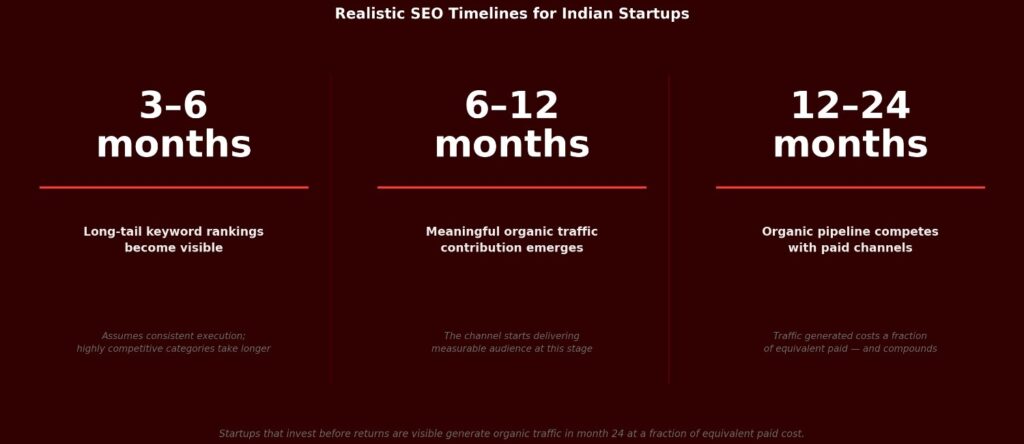
This timeline assumes consistent execution and a competitive landscape of moderate intensity. In highly competitive categories — fintech, edtech, healthtech — the timeline is longer. In less contested niches or with a strong regional focus, it can be shorter.
The startups that get the most from SEO are not the ones that find shortcuts. They are the ones who
- understand the compounding nature of organic authority,
- invest consistently before the returns are visible, and
- give the channel enough time to deliver.
The organic traffic those businesses are generating in month 24 costs a fraction of the equivalent paid traffic — and it keeps generating at that efficiency for years afterward.
Ready to Build Your SEO as a Startup?
If you are an Indian startup building your first SEO program or evaluating whether your current approach is structured to actually deliver business results, that assessment is worth making carefully before committing further resources.