
Most B2B content fails not because the subject matter is inherently dry, but because the people producing it are writing for an imaginary reader.
They are writing for a generic “business buyer” rather than for the specific person who will actually read the piece, evaluate the argument, and decide whether the company behind it is worth their time.
That distinction is where engagement lives or dies in B2B content.
The techniques that make B2B content genuinely useful and compelling are not complicated. But they require a different orientation than most content teams default to.
The shift is from “what do we want to say” to “what does this reader need to understand, believe, or be able to do after reading this.” When that shift happens, the content changes in ways that are immediately legible to readers and measurable in engagement metrics.
Here is how to actually make it happen.

1. Start With a Specific Reader, Not a Demographic Profile
Buyer personas are useful scaffolding. The mistake is treating them as the destination rather than a starting point.
A demographic profile tells you that your buyer is a VP of Operations at a mid-market manufacturing company between 40 and 55. That tells you almost nothing about what they care about on a Tuesday morning when they are looking for information about your category.
To write content that engages that person, you need to know
- what problem is keeping them from sleeping,
- what language they use internally to describe that problem,
- what solutions they have already tried and discarded, and
- what they will need to justify a change to their CFO.
That level of specificity does not come from personal workshops. It comes from sales call recordings, customer interviews, and the kind of ongoing dialogue between content and sales teams that most organizations have not formalized.
The practical process: Spend time with your sales team listening to discovery calls. Look for the language buyers use when describing their problems, not the language your marketing team uses to describe your solution. That gap is where most B2B content loses its audience.
When your content reads like it was written by someone who understands the reader’s actual situation rather than a generalized version of it, the engagement difference is significant.
Longer time on page, lower bounce rates, more shares within professional networks, and more inbound inquiries that reference the specific content.
2. Make Claims With Evidence, Not Just Assertions
B2B buyers are professional skeptics. They have been sold to hundreds of times. They are fluent in marketing language, and they discount claims made without substantiation as a matter of professional habit.
The content that earns their sustained attention is content that demonstrates rather than declares. The difference is concrete.
Declaring: “Our platform improves sales team productivity.”
Demonstrating: “After implementing the workflow changes described below, sales reps at a 200-person software company reduced their pre-call research time from 45 minutes to 12 minutes per opportunity. Here is exactly what they changed.”
The second version is engaging not because it is more enthusiastic but because it is more specific. Specificity signals that the writer has actual knowledge of what they are describing, not just marketing fluency.
For content teams building this muscle: Case studies are the most direct path, but they are also the most resource-intensive.
As a lighter-weight alternative, data-backed examples, industry research cited with context, and detailed tactical walkthroughs of how something actually works in practice all create the same effect. The common thread is specificity over generality.
Where B2B content typically fails here: Citing statistics without connecting them to the reader’s situation. A statistic alone is filler. A statistic plus the mechanism that explains it, plus the implication for the reader’s specific context is an insight.
3. Format Content by Purpose, Not Brand Habit
One of the more persistent misconceptions in B2B content is that format is primarily a branding decision. The assumption is that the company produces blog posts, so content takes that shape, with occasional variation for campaigns or events.
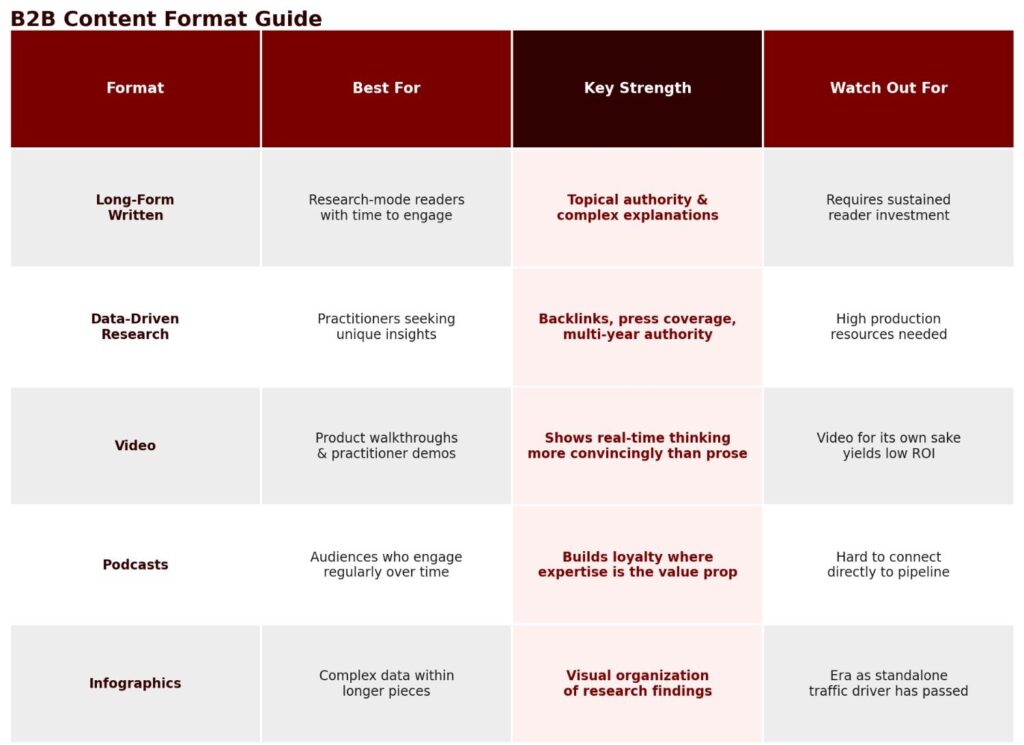
The better frame is that the format should serve the content’s purpose and the reader’s consumption context. Different formats accomplish different things.
Long-form written content is best for building topical authority, explaining complex concepts, and serving readers who are in research mode and have time to engage with depth.
This is where thought leadership lives, when it is done with genuine intellectual substance rather than opinion for its own sake.
Data-driven content and original research consistently generate backlinks, press coverage, and social sharing from B2B audiences because it gives practitioners something they cannot find elsewhere.
Publishing proprietary benchmarks, survey findings, or analysis of industry-specific data creates a category of content that serves audiences over multiple years and compounds in authority over time.
Video formats work well for product walkthroughs, practitioner interviews, and content where seeing someone think through a problem in real time is more convincing than reading their conclusions.
The use case matters: Video for video’s sake adds production cost without proportional return.

Podcasts occupy a specific niche in B2B content. They are well-suited to building an audience that engages regularly over time, particularly for brands where individual expertise and perspective are central to the value proposition.
The production and distribution overhead is non-trivial, and the metrics are harder to connect to pipeline than other formats. They are a long-play asset, not a lead generation mechanism.

Infographics remain useful for complex data that benefits from visual organization, but the era of infographics as a traffic-driving format has passed.
Use them as supporting content within longer pieces or as distribution assets for research findings.

The strategic question is not “what format should we use” but “what is this piece of content trying to accomplish, for whom, and in what context will they consume it.” Format follows from that.
4. Thought Leadership That Actually Leads Somewhere
The term “thought leadership” has been used so loosely that it has become almost meaningless. In practice, most content described as thought leadership is either an opinion piece without sufficient substance behind the opinion or a fairly uncontroversial take on an industry trend, positioned as insight because it includes a statistic.
Genuine thought leadership in B2B content has specific characteristics.
- It takes a position that is not obvious and defends it with real reasoning.
- It identifies a pattern that practitioners in the field have noticed but have not seen articulated clearly.
- It challenges an assumption that the audience holds and provides a more useful frame.
Neil Patel built a content franchise in the marketing space, not because he publishes frequently or because the content is well-produced.
This happens because his most influential work has consistently shown practitioners how to do things they did not know how to do, with enough specificity to be immediately actionable. The commercial outcome, awareness, and inbound demand for his tools and services followed from that.
The practical test for whether a piece qualifies: Would an expert in this field read this and find something they did not already know, or a frame that is more useful than what they currently have? If the honest answer is no, the piece is not thought leadership. It is content that references thought leadership.
How to build this at the team level: Invest in original research, proprietary data, and access to genuine practitioners. If your content team is synthesizing publicly available information, they are competing on the same surface as dozens of other publications with similar approaches. Differentiation requires inputs that others do not have.
5. Expert Collaboration as an Authority Signal
The credibility mechanics of B2B content benefit from external validation in a way that B2C content typically does not. B2B buyers are making decisions that affect their organizations and often their careers. The bar for trusting a source is higher, and signals of institutional and peer credibility matter.
Collaborating with recognized practitioners, researchers, and specialists in your content does two things:
- It improves the actual quality of the content by adding perspectives that are harder for an internal team to generate.
- It signals to readers that the source has standing in the professional community.
This does not require elaborate arrangements. Expert roundup contributions, where multiple practitioners respond to a single well-framed question, can be organized efficiently and produce content that is more interesting than any single perspective. Co-authored research, guest editorial contributions, and practitioner interviews all serve similar functions.
The vetting question matters more than the volume of contributors. One genuinely recognized expert with substantive things to say is worth more than twelve quotes from marginal voices. The reader can tell the difference.
6. Structure That Respects the Reader’s Time
B2B readers are time-constrained. This is not a reason to write short content. It is a reason to write structured content that enables readers to extract value quickly and then go deeper if the subject warrants it.
Practical structural principles that hold consistently:
Lead each section with the key point, not the buildup to it. If the section is about why content calendars improve team alignment, say that in the first sentence. Readers who are scanning can extract value. Readers who are engaged can read the supporting argument.
Headers should communicate substance, not just label sections. “Distribution channels” is a label. “Why LinkedIn consistently outperforms other channels for B2B lead generation” is a point. The latter gives readers a reason to continue.
The optimal paragraph length for web reading is generally two to four sentences. Longer blocks create friction. This is not a stylistic preference; it is a usability consideration that affects how much of the content gets read.
Structured content also performs better in search. Logical header hierarchies, clear topical segmentation, and content that answers specific questions in a findable way all contribute to search visibility in ways that unstructured prose does not.
7. Distribution: The Missing Piece in B2B Content
A common and costly mistake: Treating content publication as the end of the process rather than the beginning. The majority of content value in B2B is generated not from organic search in the first weeks after publication but from ongoing distribution, reuse, and amplification over a longer window.
LinkedIn is the single highest-return distribution channel for most B2B content categories. The context is professional, and so is the audience mindset.
What people share reflects their identity. That raises the stakes. The algorithm rewards real conversations.
Not just passive engagement. Together, this drives stronger engagement and generates higher-quality leads.
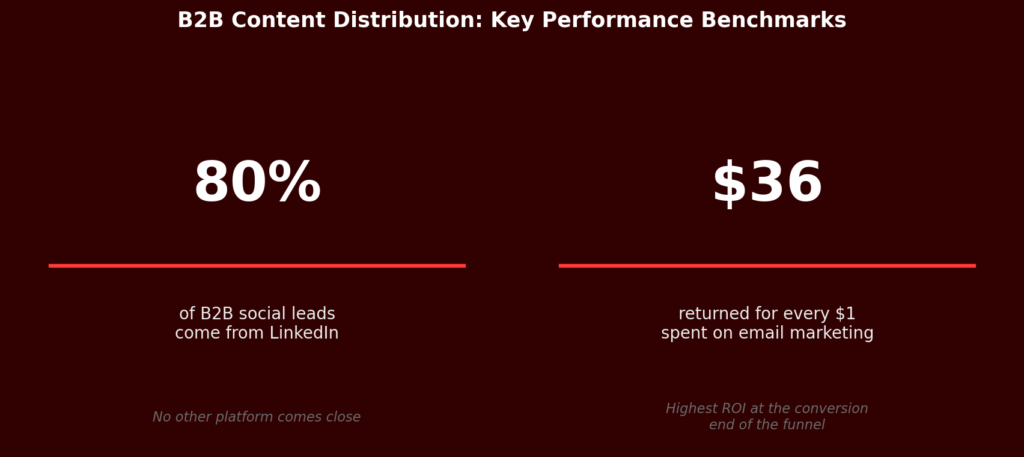
Few platforms match this for B2B. In fact, around 80% of B2B social leads come from LinkedIn. The gap with other platforms isn’t even close.
Email marketing remains the most reliable channel for deepening engagement with an existing audience. For content programs, this means a subscriber list treated as an asset worth building deliberately, not a broadcast mechanism for press releases.
The ROI on email, roughly $36 for every $1 spent in aggregate industry data, reflects its efficiency at the conversion end of the funnel, particularly.
Webinars function well as a conversion mechanism for mid-funnel content. The registration requirement creates natural lead capture, and the live format enables the kind of direct dialogue with prospects that static content cannot replicate.
The content can be repurposed into video clips, blog posts, and social distribution after the live event, which extends the return on the production investment.
Guest publishing and press placements serve authority-building functions that owned channels cannot.
Being featured or cited in publications your buyers already read creates credibility transfer that is more convincing than any self-published claim about expertise.
The strategic question for distribution is not which channels to use but how to build a repeatable system for ensuring that every significant piece of content reaches its potential audience rather than publishing and going quiet.
8. Rethinking the Content Calendar as Strategy
A content calendar is only as useful as the thinking that goes into it. A calendar that captures publication dates and assigned writers is a production schedule. A content calendar that captures audience, intent, funnel stage, distribution plan, and success metrics for each piece is a strategic document.
The difference in outcomes between these two versions of the same tool is significant.
- Content produced against a strategic calendar has defined objectives and measurable success criteria.
- Content produced against a publication schedule is evaluated on output volume rather than impact.
Building a useful content calendar requires decisions to be made upfront about what each piece is trying to accomplish:
- awareness for a specific audience segment,
- support for a specific sales motion,
- SEO coverage for a specific topic cluster, or
- consideration-stage content for a known pipeline gap.
Those decisions shape the brief, which shapes the output.
Review cadence matters as much as planning cadence. A quarterly content review that looks at what was published, how it performed against its objectives, and what should be adjusted for the next quarter is the feedback loop that converts a content calendar from a production tool into a learning system.
9. Measurement That Drives Business Outcomes
The metrics that matter for B2B content are not traffic metrics in isolation. Traffic is a leading indicator of potential. The commercial outcomes are pipeline contribution, sales cycle acceleration, and customer retention effects, where content plays a post-sale role.
Setting up this measurement requires three things most content teams do not have by default:
- agreement with sales and revenue operations on what “content-influenced pipeline” means,
- integration between content engagement data and CRM opportunity records, and
- a measurement model that accounts for content’s role across the full buyer journey rather than attributing everything to last touch.
For teams at earlier stages: Start with what you can measure now and build toward the fuller model. Tracking which content pieces are
- being referenced by sales in their outreach,
- appearing most frequently in deals that close, and
- generating the most qualified inbound inquiries, provides a directional signal even before the full attribution infrastructure is in place.
The most common measurement mistake: Evaluating content by page views and then being surprised that leadership does not increase the content budget. Leadership increases budgets for things that demonstrably contribute to revenue. Build the data that makes that case.
10. The Compounding Advantage of Consistency
B2B content that engages does not do so because of a single well-crafted piece. It does so because a sustained program of high-quality, specifically targeted content builds the kind of brand trust and topical authority that makes buyers default to that source when they have relevant questions.
That compounding effect is the real return on B2B content investment, and it is only available to organizations that have built the operational infrastructure to sustain quality over time.
The buyer who reads five useful pieces from your team over six months is not evaluating each piece individually. They are forming a judgment about the organization behind the content, and that judgment influences how they behave when they are ready to buy.
The implication: Engagement is not the goal in itself. Engagement that builds the kind of ongoing relationship with the right buyers that eventually converts into commercial outcomes is the goal. A content strategy built around that north star makes different decisions than a content strategy built around traffic, shares, or rankings in isolation.
Curious If Your B2B Content Strategy is Up to the Mark?
If you want a clear read on where your current B2B content program is leaving engagement and pipeline on the table, a structured content audit is the most efficient way to find out. Request a program assessment to understand what is working, what is not, and what changes would have the highest commercial impact.