
Paid acquisition gives you control over volume. SEO gives you control over cost structure.
For a startup, the distinction matters more than most founders realize until their CAC starts climbing and their paid channels stop scaling efficiently.
The companies that eventually build defensible organic growth channels almost always started earlier than they thought they needed to. Not because SEO is slow by nature, though it often is, but because the compounding effect only works if there is enough time for it to compound.
Brands that treat organic search as a later-stage problem consistently find themselves paying for traffic they could have earned.
This guide is for marketing leads and founders at early and growth-stage startups who want a practical, honest view of what SEO can realistically deliver with limited resources, what the right sequence of investments looks like, and where most start-ups waste time and money trying to do it.
It does not cover every tactic in the playbook. It covers the ones that produce meaningful returns at a constrained scale.
Why SEO Is a Capital Efficiency Argument, Not Just a Traffic Argument
The way most startup teams think about SEO undersells it. They frame it as a channel for awareness or a way to reduce reliance on paid media. Both are true, but neither captures the financial logic that makes organic search genuinely strategic for a capital-constrained business.
Paid traffic has a linear cost structure. You stop spending, traffic stops.
The conversion economics are visible and immediate, which is why most startups over-invest in paid acquisition early, but the cost per acquisition compounds upward over time as channels saturate and auction prices increase. You own nothing when you stop.
Organic traffic has an inverted cost curve.
The investment is front-loaded, the results are delayed, and the payback period is longer. But once a page ranks, it generates traffic without ongoing media spend.
A blog post that ranks for a high-intent keyword in month eight continues to generate qualified visitors in month twenty-four, at zero marginal cost. That dynamic is what makes SEO a capital efficiency argument: you are converting early operational investment into a long-duration traffic asset.
A SaaS company that ranks organically for its five highest-intent keywords and converts at the same rate as its paid campaigns is effectively running a paid channel at zero ongoing cost per click. The comparison that matters is not organic vs. paid traffic volume. It is the fully-loaded cost of customer acquisition across both channels at maturity.
That framing also helps set realistic expectations with investors and leadership. SEO is not free. It requires time, editorial investment, and technical work.
But the ROI calculation over a 24 to 36-month horizon is typically compelling, and the asset does not depreciate the way an ad campaign does.
What Startup SEO Actually Looks Like vs. Enterprise SEO
Enterprise SEO and startup SEO use the same underlying principles but differ significantly in execution priorities. The distinction matters because applying enterprise-scale thinking to a resource-constrained startup is one of the most reliable ways to waste both time and money.
| Enterprise SEO Priority | Startup SEO Priority |
| Comprehensive site audits across thousands of pages | Fix the 5 highest-impact technical issues first |
| Broad keyword portfolio coverage | Targeted long-tail keywords with clear buyer intent |
| Domain authority campaigns at scale | Selective backlink acquisition from relevant sources |
| Dedicated SEO team and toolstack | One generalist with 2-3 focused tools |
| 18-month content roadmaps | Publish, measure, iterate in 90-day cycles |
| Brand keyword volume and share of voice | Conversion rate and cost per acquisition from organic |
The practical implication is that startups should resist the instinct to build comprehensive SEO programs from the start.
The goal in the first 12 months is to establish the foundations, identify the highest-return keyword clusters, and build enough content and authority to generate a measurable organic pipeline. Breadth comes later.
The Four Foundations You Cannot Skip
Four areas consistently determine whether a startup SEO program builds momentum or stalls. None of them require significant budget. All of them require consistent attention.
Technical Health: The Floor, Not the Ceiling
Technical SEO is not glamorous, but it is foundational. A site with excellent content and poor technical health will consistently underperform. The good news for startups is that technical SEO at an early scale is not complicated. The most common issues that cost early-stage sites’ ranking performance are slow load times on mobile, pages that are not properly indexed, duplicate content from URL parameter variations, and broken internal links.
Tools like Google Search Console, PageSpeed Insights, and Screaming Frog (free up to 500 URLs) cover most of what you need to diagnose at an early scale.
Run a crawl, fix the obvious errors, and monitor Search Console weekly for coverage issues. This is not a one-time exercise. Sites break over time as new pages are added and templates change.
One common mistake is treating technical SEO as a launch-phase task that can be deprioritized once the site is live. In practice, technical issues tend to accumulate quietly and only become visible when a meaningful ranking drops.
Keyword Strategy: Specificity Over Volume
Most startup keyword strategies fail at the same point: they target keywords with impressive search volumes that belong to established competitors who will be impossible to displace in any reasonable timeframe.
The result is content that ranks on page four for competitive terms, generates no meaningful traffic, and produces no evidence that SEO is working.
The productive alternative is to build a keyword strategy around specificity and buyer intent rather than raw volume. Long-tail keywords, typically three words or longer, convert better because they attract searchers who are further into a decision process. They are also significantly easier to rank for because the competition is lower and the content requirement is more achievable.
A human resources SaaS that targets “attendance tracking software for small teams” rather than “HR software” is not settling for a smaller prize. It is targeting a query with clearer purchase intent, lower competition, and a higher probability of conversion. That is a better use of limited content resources.
The research workflow does not require expensive tooling. Google Keyword Planner, the autocomplete suggestions in Google Search, People Also Ask results, and community forums in your category are sufficient to map the initial opportunity.
The goal is to identify 20 to 30 long-tail keywords that represent real buyer intent and that your site could plausibly rank for within 6 to 12 months.
Content: Quality Over Cadence
Early-stage startups frequently make the mistake of publishing content at a cadence their team cannot sustain, at a quality level that does not serve the reader well enough to rank. The result is a content library that is large but thin, which does not build authority and does not generate traffic.
A more productive approach is to publish less and invest more depth in each piece.
One thoroughly researched, well-structured piece that genuinely addresses the full intent behind a target keyword will outperform five shallow posts targeting the same cluster. It will also build more topical authority, which matters for how AI-generated summaries and AI Overviews evaluate your site.
The content brief should start with the question: What does someone searching this query actually need to resolve their situation? Not what keywords do we need to include, but what does a useful, complete answer look like?
Structuring content around that question produces work that satisfies reader intent, which is what search algorithms have been moving toward for years.
Backlinks: Earned, Not Purchased
Backlinks remain a meaningful ranking signal, and startups need them. The mistake is trying to acquire them in ways that either do not work or actively cause harm.
Purchasing link packages from low-quality directories and link farms is a reliable way to incur a Google penalty. The links look cheap because they are, and the sites linking to you have no real authority to pass. Guest posting on genuinely relevant industry publications, contributing expert commentary through services like HARO and Qwoted, earning coverage through newsworthy announcements, and building relationships with publishers in adjacent categories are all slower but durable approaches.
Startups with limited PR resources should focus on being genuinely useful to journalists and editors rather than pitching self-promotional content.
A founder who regularly provides clear, specific commentary on industry topics will accumulate media mentions over time. Those mentions build both brand authority and link equity.
Where to Focus in Each Phase
Trying to do everything at once is the single most common reason early SEO programs fail to gain momentum. A clearer sequencing prevents that.
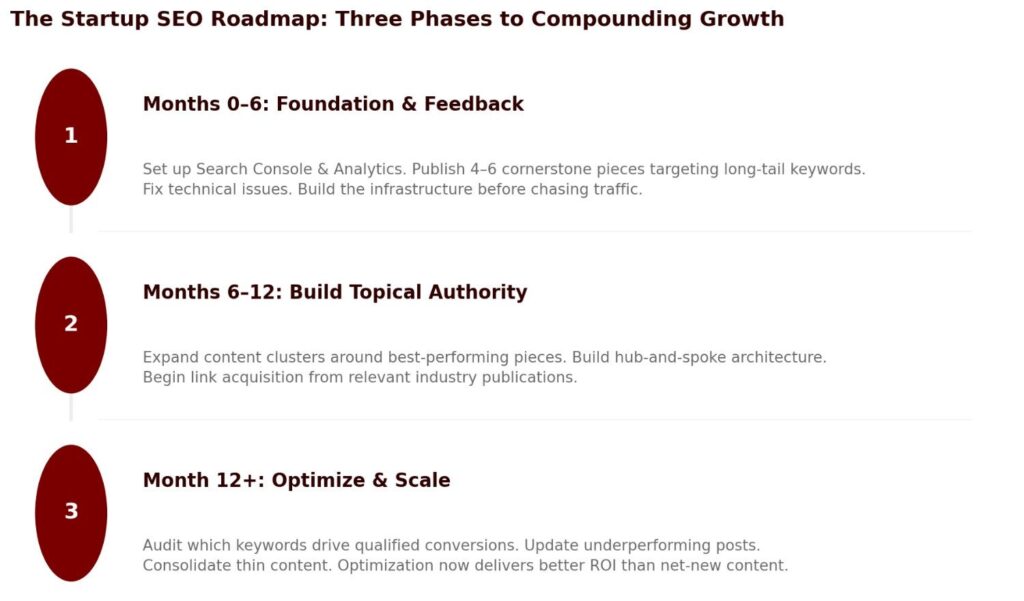
Months 0 to 6: Foundation and Feedback
The priority in the first six months is establishing the technical foundation, identifying your initial keyword clusters, and publishing a small number of high-quality cornerstone pieces. The goal is not to generate significant traffic yet. It is to create the infrastructure that will produce results and to get enough pages indexed to generate initial data about what is working.
Set up Google Search Console and Google Analytics before you publish anything. The data you collect from day one is the baseline against which you will measure everything. Without it, you are optimizing blind.
Publish four to six substantial pieces targeting your highest-priority long-tail keywords. Optimize the key pages of your site, i.e., homepage, product or service pages, and any existing high-traffic content. Fix the technical issues identified in your initial crawl.
Months 6 to 12: Build Topical Authority
Once your foundation is in place and you have initial data on which content and keywords are gaining traction, the focus shifts to building topical authority. This means expanding the content clusters around your best-performing initial pieces, internally linking them to create semantic networks, and beginning link acquisition in earnest.
A hub-and-spoke content architecture is the most efficient structure for this phase. A pillar page covers the broad topic; cluster pages address specific subtopics and buyer questions. The internal links between them signal to search engines that your site has comprehensive authority on the topic, which accelerates ranking performance for the entire cluster rather than individual pages.
Month 12 and Beyond: Optimize and Scale
After 12 months, you should have enough data to make clear decisions about where to concentrate resources. Which keywords are generating qualified traffic and conversions? Which content pieces are underperforming their ranking potential? What are competitors ranking for that you are not?
The optimization work at this stage is as important as new content production. Updating existing posts to improve their depth and relevance, consolidating thin content into stronger pieces, and fixing conversion paths on high-traffic pages consistently deliver better ROI than publishing more net-new content.
If you want a clear view of where your startup’s organic opportunity sits and what the right sequencing looks like for your specific situation, a focused SEO audit will surface the answers quickly. Get a second opinion on your current approach.
The Mistakes That Consistently Cost Startups Time and Money
Targeting Keywords You Cannot Win
Ambition is not a keyword strategy. A seed-stage startup targeting “project management software” against Asana and Monday.com is not being bold.
It is allocating editorial resources to content that will never rank and will never generate traffic.
The competitive keyword set is worth understanding so you can map the realistic timeline to compete there, but it should not be the near-term focus.
The practical test: if the first page of results for a target keyword is dominated by brands with domain authority scores above 70 and content libraries of thousands of pages, that keyword is not in your addressable market yet. Build authority in adjacent, more specific clusters first.
Inconsistent Publishing That Breaks Momentum
Search algorithms reward consistent signals over time. A startup that publishes aggressively for three months and then goes quiet for two sends a weaker authority signal than one that publishes one high-quality piece per month consistently for twelve months.
The inconsistency usually comes from setting a cadence that assumes the team has more capacity than it does.
Set a publishing cadence that is sustainable without heroic effort. One genuinely good piece per month is better than six mediocre pieces followed by silence. The quality threshold matters more than the frequency, within reason.
Ignoring the Content That Already Exists
Most startups with content libraries of 20 or more posts have at least a handful of pieces that are generating some traffic but could be generating significantly more with targeted optimization. Updating an existing post to improve its depth, fix its structure, add relevant internal links, and align it more precisely with search intent is typically faster and higher-return than publishing new content.
A health technology startup that updated three underperforming blog posts, improved the content depth, and added proper internal linking saw organic traffic to those posts double within six weeks.
No new content, no link acquisition campaign. Just optimization of what was already there.
Treating SEO as a Set-and-Forget Channel
Rankings are not permanent. A competitor publishes a better piece, Google updates its quality criteria, or a technical issue accumulates quietly.
SEO programs that produce results are actively maintained.
That does not mean constant major interventions. However, it does mean weekly monitoring of Search Console, quarterly content audits, and a consistent process for identifying and fixing issues before they compound.
What the Compounding Effect Looks Like in Practice
A B2B SaaS startup in the HR technology space began an SEO program in month three after launch.
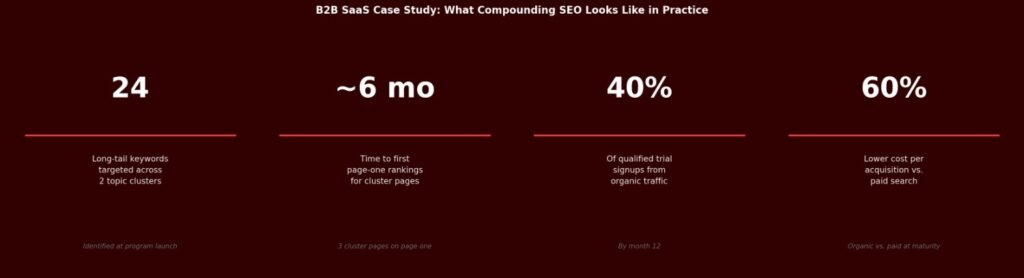
They identified 24 long-tail keywords across two topic clusters, published one substantial pillar piece and four cluster pieces in the first quarter, and focused their link acquisition on two industry publications that accepted guest contributions.
By month six, three of their cluster pages were ranking on page one for their target keywords.
By month twelve, those pages were collectively generating around 40% of their total qualified trial signups from organic traffic, at a cost per acquisition approximately 60% lower than their paid search campaigns.
The investment was not trivial. It required a consistent editorial process and about 10 to 12 hours per month of focused SEO work. But the compounding effect was visible: as each piece ranked and attracted links, the adjacent cluster pages benefited from the rising authority, which accelerated ranking for the next batch of content.
That dynamic, incremental investment producing accelerating returns, is what makes SEO a capital efficiency argument rather than just a marketing channel choice.
Measuring What Actually Matters
Keyword rankings are a leading indicator, not the outcome. The metrics that tell you whether your SEO program is actually working as a business lever are further down the funnel.
Organic traffic to pages that serve commercial or transactional intent is more meaningful than total organic sessions. A blog post that drives 5,000 monthly visits from people researching a broad informational topic and converts none of them to trial or contact is a different asset from a page that drives 400 visits from people with purchase intent and converts 8%.
Track organic-attributed pipeline and organic-attributed revenue alongside traffic metrics. This requires an attribution setup that connects Google Analytics data to your CRM, which is a straightforward integration with most modern toolstacks.
Without it, you cannot make a credible case to leadership or investors that SEO is contributing to growth.
Useful metrics at the program level include organic traffic to commercial intent pages, trial or demo requests attributed to organic, cost per organically acquired customer versus paid channels, and the percentage of your keyword targets where you hold a page one position. Together, these tell a complete story about whether the investment is working.
When to Bring in External Help
Most early-stage startups can make meaningful SEO progress with internal resources if the approach is focused and the execution is disciplined. The case for bringing in external expertise typically arises at one of three points.
First, when you have published content consistently for six or more months and are not seeing ranking movement for any target keywords, despite having correctly diagnosed the technical foundation. This usually indicates either a keyword strategy problem or a content quality problem that benefits from an outside diagnostic.
Second, when technical complexity increases, typically when a site migration, a significant architecture change, or a new market expansion is planned. Technical SEO errors during major site changes can have significant and prolonged ranking consequences. The cost of getting it wrong is almost always higher than the cost of external review.
Third, when the team has the right instincts but not enough time to execute consistently. An external partner who can handle the execution layer while the internal team maintains strategic oversight is often a better model than expecting a generalist marketing hire to carry both.
The honest caveat is that external SEO support varies significantly in quality. Plus, the most important screening criteria are not the agency’s ranking claims but their diagnostic process and their willingness to tie their work to revenue outcomes rather than traffic metrics.
Explore What a Focused Startup SEO Program Would Look Like for Your Team
The startups that build durable organic growth channels are not the ones with the biggest content budgets. They are the ones who sequence their SEO investments correctly and measure against the right outcomes from the start. If you want a clear picture of where your organic opportunity sits and what the first 90 days of a focused program should look like, that conversation is worth having before you spend another dollar on paid acquisition.
→ Request a startup SEO audit and growth roadmap