
Most link-building strategies require you to create something new, pitch something cold, or spend money you would rather deploy elsewhere. This one required none of that.
What it required was a routine backlink audit, a competitor’s oversight, and a willingness to act on what we found.
The result: 1,287 leads from a single campaign. No new content. No ad spend. No shortcuts that would come back to bite us.
Here is exactly how it happened, and how you can replicate it.
The Discovery: 3,000+ Links Pointing at Nothing
During a competitive research session, we were auditing the backlink profile of a brand operating in our space. Standard practice. We were looking for patterns, opportunities, and gaps.
Using Ahrefs, we pulled their full backlink profile and filtered for broken URLs. That is when we found it.
An old pricing page on their site was returning a 404 error. The page had been deleted at some point, presumably without a redirect.
What made this significant was not the broken link itself. It was the number of domains still pointing to it.
Over 3,000 referring domains.
Three thousand websites, linking to a page that no longer existed. Not spam sites either. Active blogs, industry resource pages, partner directories, and review platforms. Sites with real traffic and genuine domain authority.
Every one of those links was delivering a dead end to anyone who clicked through. The equity those links carried was dissolving into nothing.
The question became obvious: What if we offered those sites something worth linking to instead?
The Strategy: Broken Link Building at Competitive Scale
Broken link building is not a new tactic. But most practitioners use it reactively, finding random dead links across the web and pitching loosely relevant content.
What we did differently was target a competitor’s specific broken asset. That meant the linking sites already had demonstrated intent. They had chosen to link to content about pricing, comparisons, and product information in our space. The topical alignment was built in.
We called this approach competitor backlink hijacking. The name is deliberately pointed. But the execution is entirely above board, and we will come to that.
Step-by-Step: How the Campaign Ran
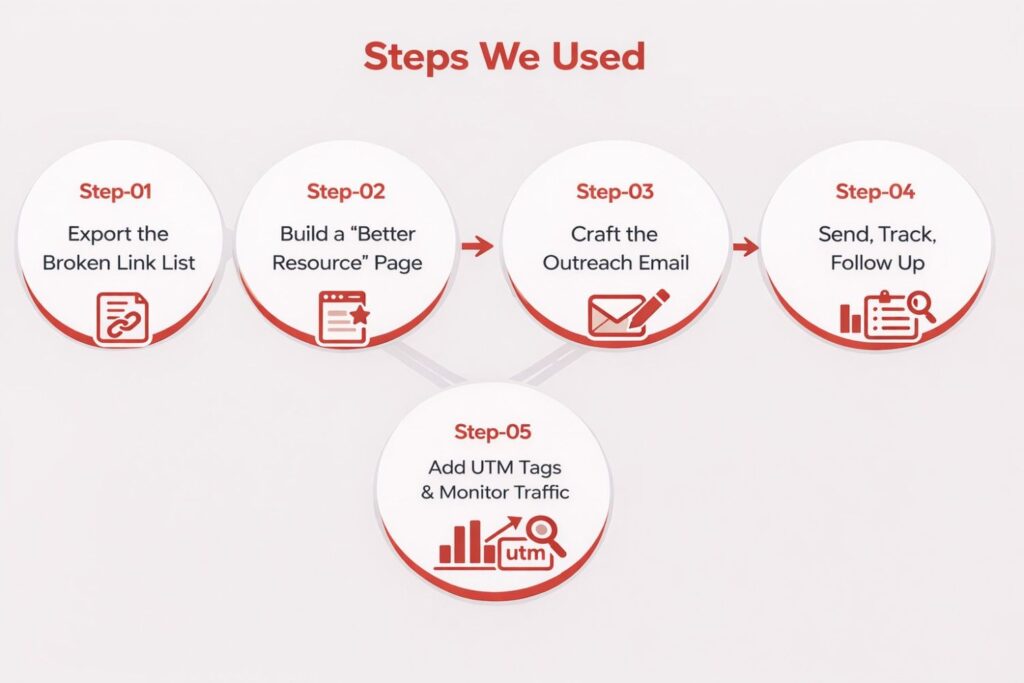
Step 1: Export and Clean the Broken Link List
We exported every referring domain from the competitor’s broken URL using Ahrefs. The same process works with Semrush or Majestic if that is your toolset.
From the raw export, we cleaned aggressively:
- Removed duplicate domains
- Filtered for Domain Rating of 20 and above
- Prioritized blogs, news outlets, educational institutions, and directories
- Verified contact details, either email addresses or contact forms
After filtering, we had 1,109 qualified domains. That became our outreach list.
Common mistake: Skipping the filtering step and mass-emailing every domain on the export. Low-quality outreach to irrelevant sites produces low response rates and can damage your sender reputation. Quality over volume here is not just a principle; it is what drives results.
Step 2: Build a Resource Worth Linking To
Before sending a single email, we built the replacement page.
This matters more than most practitioners acknowledge. You are not just asking someone to swap a URL. You are asking them to vouch for your content with their link. If the page you are offering is weaker than what they linked to originally, the conversion rate suffers.
Our replacement page covered the same ground as the competitor’s original pricing page, but went further:
- An updated pricing and features table
- A side-by-side comparison with the competitor’s offering
- Customer testimonials and social proof
- An FAQ section addressing the questions their old page left unanswered
The goal was a page that was genuinely more useful to anyone researching this decision. Not a placeholder. Not a redirect bait. A real resource.
Step 3: Write an Outreach Email That Solves a Problem
The email template we used was deliberately simple:
Subject: Broken Link on Your Site
Hi [Name],
I was browsing your site and noticed you are linking to [broken URL] on this page: [their page URL].
That link now leads to a 404. If you are looking to replace it, we have a relevant alternative here: [our URL].
Hope that helps.
[Your Name]
Three things made this work.
- First, it was short. No preamble, no context-setting, no paragraphs about who we are.
- Second, it identified a specific problem on their specific page. This signals that the email was written for them, not broadcast to a list.
- Third, it framed the offer as a solution to their problem, not a pitch for ours.
Every email was personalized with the recipient’s name, their page URL, and the broken link URL. No generic variables. That personalization is operationally time-consuming relative to a bulk blast, but the conversion rate reflects it.
Step 4: Send in Batches, Track Everything
We used GMass for mail merge and sending. Batches of 100 emails per day kept us clear of spam filters.
The results:
- Open rate: 59%
- Link replacement rate: 28% of those contacted replaced the broken link with ours
- New backlinks secured: 311
311 backlinks from domains with real authority and topical relevance. Many came from review sites, educational pages, and industry directories. Not link farm profiles. Legitimate placements.
Step 5: Tag the URL and Measure What Actually Matters
We added UTM parameters to the URL we shared in every outreach email. This lets us track referral traffic from each new link placement with precision.
Within 30 days:
- 6,300+ visitors to the landing page
- 1,287 form submissions
- Bounce rate below 35%
That bounce rate matters. It tells you the traffic was qualified. People were arriving with intent, reading the page, and engaging. This was not inflated traffic from irrelevant referrers.
What Those 1,287 Leads Actually Represented
The lead number is the headline. But the downstream effects were equally significant.
Organic traffic growth
Because the new backlinks were from topically relevant sites, Google treated them as strong authority signals. Organic traffic to the resource page increased by over 220% within three months. Rankings for related keywords improved not just on that page, but across the domain.
Pipeline contribution
The page was built for bottom-of-funnel intent. Pricing, comparisons, feature breakdowns. The visitors arriving from these links were actively evaluating options. The conversion rate reflected that. Marketing-qualified leads and sales-qualified leads flowed consistently from this single campaign for months afterward.
Authority compounding
Link building is consistently ranked as one of the top three organic ranking factors. The domain authority lift from 311 high-quality, relevant placements had residual effects across pages that had nothing to do with the original campaign.
Relationship development
Several of the sites we contacted went beyond swapping the link. They later featured us in round-up posts, referenced us in new content, and in a few cases opened conversations about deeper partnerships. The outreach that looked like a one-time campaign became a recurring relationship channel.
Is This Ethical?
Worth addressing directly, because the framing of “hijacking” a competitor’s links sounds more aggressive than the actual execution.
The links we targeted were not the competitor’s property. They were links on other people’s websites. Those site owners created those links voluntarily and can change or remove them at any time.
We did not misrepresent ourselves. Every email was transparent about who we were and what we were offering.
We flagged a genuine problem. A broken link is a bad user experience for anyone visiting that site. Pointing it out was a legitimate service.
We offered a genuinely useful replacement. If the page we were pitching had been low quality, the 28% conversion rate would not have held.
This is competitive intelligence applied to outreach. Finding inefficiencies in the market and filling them with something better is how most good businesses operate. This is the same logic applied to link acquisition.
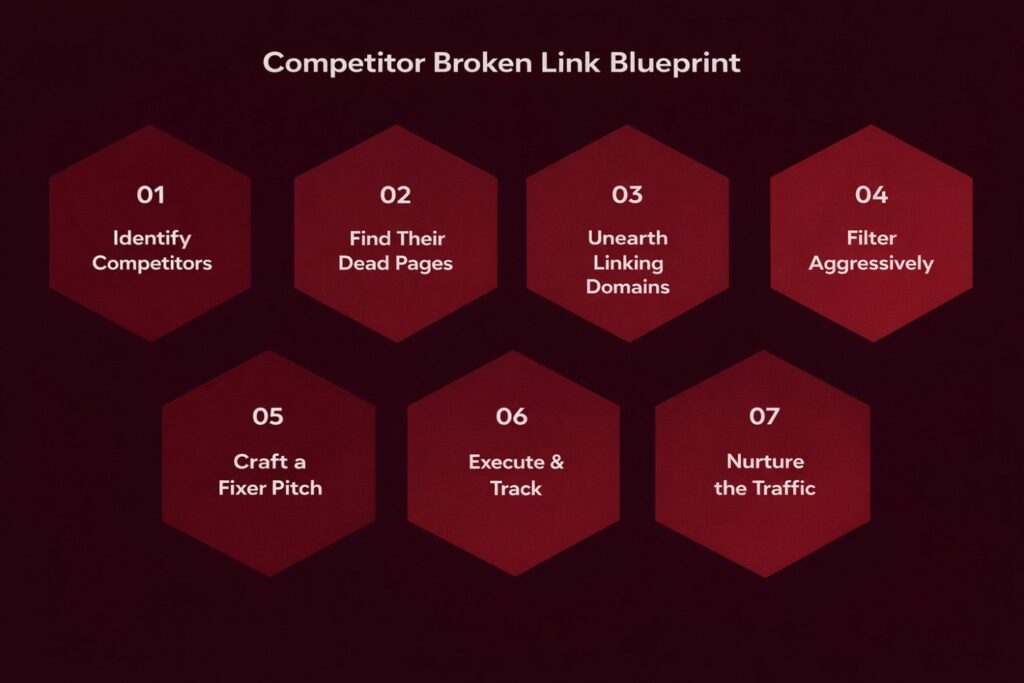
The Repeatable Blueprint
This was not a one-off. The mechanics are repeatable for any brand willing to invest the time in proper execution.
Identify your primary competitors.
Focus on those operating in your exact niche, not adjacent markets.
Audit their backlink profiles for broken URLs.
Ahrefs and Semrush both have dedicated broken backlink reports. Look for dead pages with significant referring domain counts. Old product pages, pricing pages, and popular blog posts are the most common candidates.
Export and filter the referring domains.
Remove spam and low-authority sites. Verify the links are still live on the referring site and still pointing to the broken URL.
Build a replacement resource that earns the link.
This is not optional. The quality of what you offer determines whether site owners follow through. A mediocre page produces a mediocre response rate.
Personalize outreach at scale.
Use mail merge tools but treat personalization as non-negotiable. Name, specific page URL, specific broken link. Every email should feel written for that recipient.
Add tracking parameters and measure outcomes that matter.
Not just link placements. Referral traffic, bounce rate, form submissions, and downstream pipeline contribution.
Optimize the landing page for conversion.
Traffic without conversion infrastructure is wasted. Make sure the page receiving all this new traffic has clear CTAs, compelling social proof, and a logical next step.
Why Most Brands Miss This Entirely
Broken link building gets applied narrowly. Most practitioners look for random broken links across the web, pitch loosely relevant content, and accept low response rates as the cost of the tactic.
The shift that makes this campaign different is specificity. By anchoring to a competitor’s specific broken asset, you start with an audience that already demonstrated intent to engage with content like yours. The outreach pitch almost writes itself.
The other reason brands miss this is that competitive backlink monitoring is typically reactive. Teams look at their own broken links. They rarely build a systematic process for auditing competitor link profiles for decay and opportunity.
That asymmetry is where the advantage lives.
The Long-Term Value
Every link secured through this campaign continues to deliver. Referral traffic compounds over time. Domain authority improvements persist. Rankings built on a stronger link profile are more durable than those built on thin technical optimizations alone.
Several of the domains we reached out to during this campaign became recurring referrers. The outreach created relationships that have driven traffic and leads well beyond the original 30-day window.
A single campaign. A competitor’s forgotten page. The returns are still coming in.
Ready to See If Your Strategy Works for Your Business?
If you want to identify whether your competitors have broken backlink opportunities worth targeting, a focused audit of their link profile is the starting point. Request a competitive backlink teardown and find out what is sitting dormant in your market.