What Google’s expanding SERP features are doing to organic visibility — and the strategic response that actually works.
Ranking first for a high-intent keyword and still watching traffic decline is not a data anomaly. It is increasingly the norm. And if you haven’t audited your live SERPs recently, there’s a reasonable chance it’s already happening to you.
The problem isn’t your page. It isn’t your backlinks or your technical setup. It’s that Google has fundamentally restructured what the top of a search results page looks like — and the rankings your team celebrates in reporting tools tell you almost nothing about actual SERP visibility.
This article breaks down what’s causing the disconnect, and how we diagnosed and reversed a 41% traffic drop for a D2C skincare brand. It also outlines the framework we now apply across ecommerce clients operating in competitive, feature-heavy SERPs.
The Anatomy of a Modern Ecommerce SERP
Search for a high-intent product keyword right now. Don’t use a rank tracker. Open an incognito window and actually look at the page.
What you’ll likely see, before any organic result, is some combination of:
- Four Google Shopping ads (product image, price, brand, rating)
- One to three paid text ads
- A People Also Ask box with expandable FAQs
- A Featured Snippet or informational carousel
- Possibly a local pack or video results, depending on query type
Your #1 organic listing appears after all of that. On a standard laptop screen, it often sits entirely below the fold. Mobile users may need to scroll past six or seven modules before reaching it.
This is what we call the SERP Squeeze. Not a penalty. Not an algorithm change. A structural shift in how Google monetizes and controls its results page, executed gradually over several years, is now reaching a tipping point in competitive verticals.
The phrase matters less than the business implication: your SEO investment is delivering less visible output than your rank position suggests.
Rank position measures where your page sits in Google’s index. SERP visibility measures how many users actually see it. In feature-heavy SERPs, the gap between the two is now material.
What We Found Inside a 41% Traffic Drop
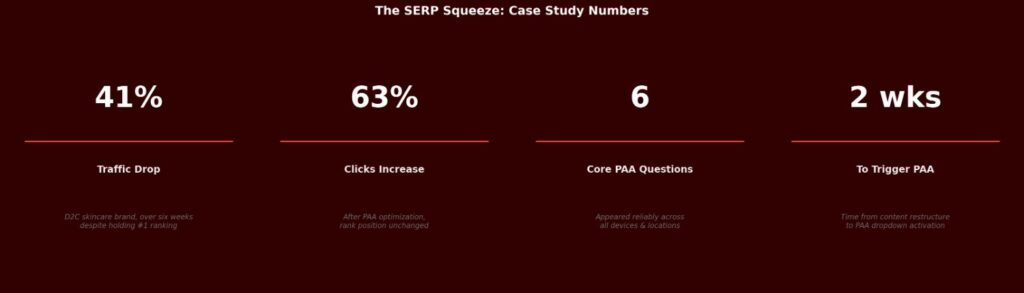
A D2C skincare brand came to us after noticing that traffic to their core product page had fallen sharply over six weeks.
Their rank tracker still showed them in the first position for their primary keyword. No technical issues. No backlink losses. No manual penalties.
We opened the live SERP on multiple devices and in different locations. Here’s what sat above their #1 organic result:
- Four Google Shopping units (paid product ads with images and prices)
- One paid text ad from a direct competitor
- A People Also Ask box containing four questions
- An informational snippet pulled from a health and beauty editorial
Their #1 ranking was effectively the fifth visible element on the page. CTR had collapsed not because their page was less relevant, but because it had become less reachable in the actual user experience.
This is a meaningful distinction. The standard SEO playbook treats rank position as the primary performance lever. But when the page between you and the user is Google itself, you need a different model.
Why This Is Happening and Where It Goes Next
Google’s commercial incentive is to keep users on Google longer and route more intent toward paid inventory.
- SERP features serve both goals.
- Shopping ads generate direct revenue.
- PAA boxes increase engagement time on the results page.
- Featured Snippets reduce the need to click through at all.
The trend line is not ambiguous.
Commercial keywords, particularly in categories like skincare, supplements, fitness equipment, and consumer electronics, now have some of the most feature-heavy SERPs on the web. Category research keywords aren’t far behind.
What’s less discussed is that Google also pulls organic content into these features. The PAA box, in particular, is populated by organic pages. That’s the strategic opening most e-commerce brands are completely ignoring.
If you can’t push the features down, the more productive question is whether you can get your content inside them.
The PAA Opportunity: Getting Above Your Own Ranking
People Also Ask boxes appear above the first organic result in a significant proportion of commercial SERPs. They display expandable questions, and each answer includes a link to the source page.
Here’s what makes PAA strategically interesting for e-commerce: it’s organic, it’s above the fold on most devices, and most product pages make no attempt to earn placement in it. That creates real competitive whitespace.
For the skincare brand, our hypothesis was direct.
If we could engineer their product page to trigger PAA answers, they’d gain a second entry point in the SERP sitting above the organic position they already held. Double exposure, no additional ad spends.
The test worked.
Within two weeks, the product page was triggering PAA dropdowns. Over the following month, clicks increased by 63% despite the rank position remaining unchanged.
Curious whether your product pages have PAA opportunities? A live SERP audit takes about 20 minutes to reveal the gaps.
How to Build for PAA Placement: The Operational Detail
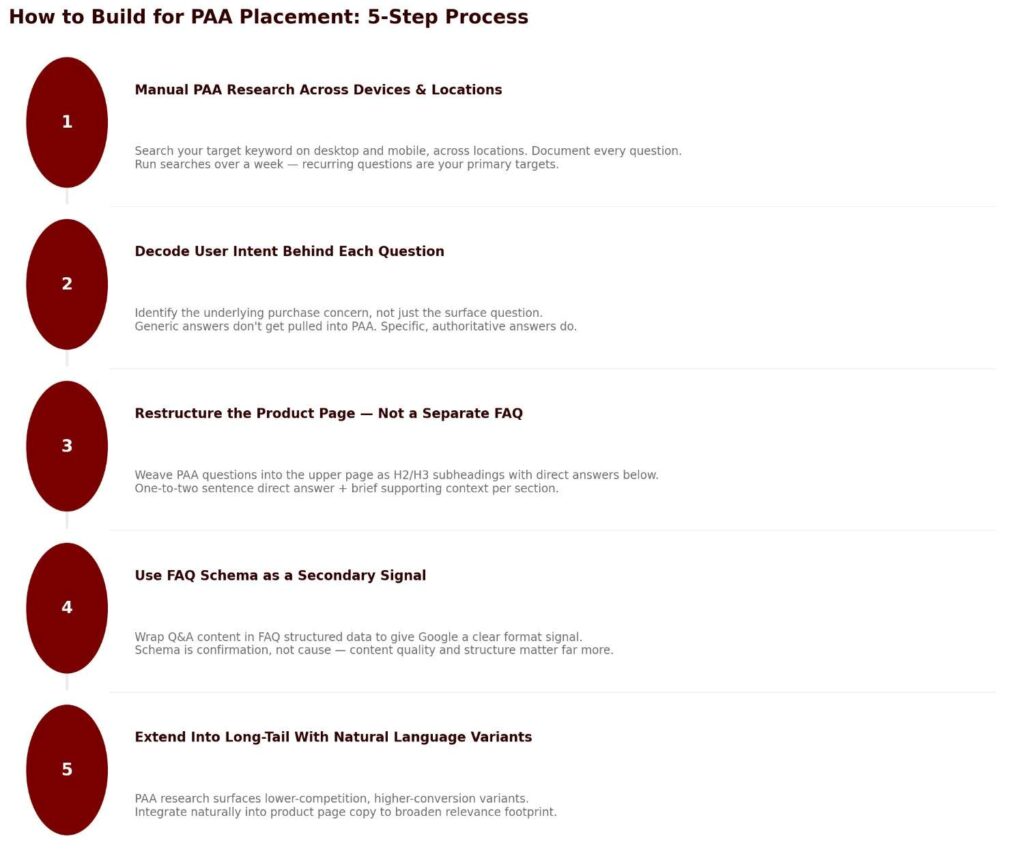
This isn’t a theoretical framework. Here’s the process we applied, with enough specificity to act on.
1. Manual PAA Research Across Devices and Locations
Don’t rely on keyword tools for this step. Open your target keyword in Google directly, on desktop and mobile, across different geographic locations, if your audience is national or international. PAA boxes are dynamic and can surface different questions depending on these variables.
- Document every question that appears.
- Run the same search at different times over a week.
- Note which questions appear consistently, which rotate, and which surface only in specific contexts.
- Recurring questions are your primary targets.
For the skincare keyword, we identified over 20 distinct PAA questions across sessions, with six appearing reliably across all conditions.
Those six became the foundation of the content restructure.
2. Decode User Intent Behind the Question
The question text is a starting point. The intent behind it is what your content needs to address.
“Can vitamin C serum irritate your skin?” is not a curiosity question. It’s a pre-purchase anxiety question.
The user is trying to decide whether this product category is safe for them.
Content that answers it well needs to acknowledge the concern directly, explain the relevant product differentiation, and provide enough ingredient-level detail to be credible.
Mapping the underlying intent before you write changes the quality of the output substantially. Generic answers don’t get pulled into PAA. Specific, authoritative answers do.
3. Restructure the Product Page, Not a Separate FAQ Page
The most common mistake we see is brands building a standalone FAQ section at the bottom of the page, disconnected from the primary product narrative.
Google often doesn’t weight these sections appropriately, and users rarely scroll to them.
Instead, weave the high-value PAA questions into the upper portion of the product page as actual subheadings (H2 or H3 tags), with direct answers immediately below.
The structure looks like editorial content, reads like product education, and is formatted in the way Google’s extraction logic prefers.
One approach that worked well: each PAA-targeted section opened with a one or two-sentence direct answer, followed by a brief paragraph of supporting context or ingredient detail.
This gives Google the extractable snippet while giving users enough to make an informed decision.
4. Use FAQ Schema, But Don’t Depend on It
Wrapping Q&A content in FAQ structured data gives Google a clear signal about the format and purpose of the content. In some cases, it also triggers a rich result that displays the FAQ block directly below the page title in organic results.
It’s a secondary lever, not the primary one. The content quality and page structure matter far more than the schema alone.
We’ve seen pages without schema appear in PAA, and pages with schema that never do. Think of schema as confirmation, not cause.
5. Extend into Long-Tail with Natural Language Variants
PAA research surfaces dozens of question variants that often represent lower-competition, higher-conversion search queries on their own. For the skincare brand, questions like “best vitamin C serum for rosacea” and “vitamin C serum for beginners” pointed to distinct audience segments with specific purchase anxieties.
Integrating these phrases naturally into the broader product page copy, without forcing them, broadened the page’s relevance footprint without any structural changes.
Several of these long-tail variants started driving incremental traffic within four weeks of the rewrite.
The Three-Layer Response to SERP Squeeze
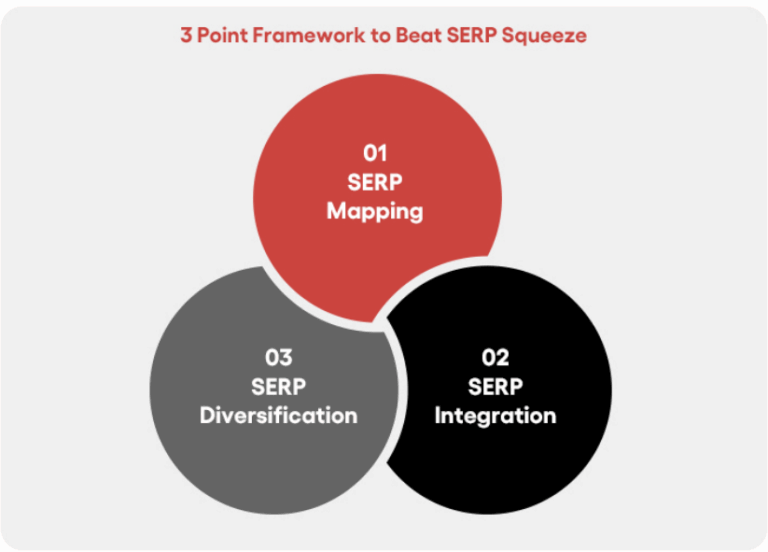
PAA optimization is a high-leverage tactic, but the broader strategic response has three components. Think of them as sequenced layers.
Layer 1: SERP Mapping
Before optimizing anything, you need to know what you’re dealing with. Pull your top 20 organic keywords and manually audit the live SERP for each one. Record every feature appearing above the first organic result: shopping ads, PAA, snippets, local packs, and video carousels.
Rank each keyword by what we’d call “effective SERP position” — the actual position of your organic listing when you count all features above it.
A keyword where you rank #1 with five features above it is effectively position six. A keyword where you rank #3 with no features is effectively position three.
Your optimization priorities change when you map it this way.
Layer 2: SERP Integration
For each feature type appearing in your priority SERPs, build content designed to appear inside it.
- PAA optimization is one route.
- Video content targeting video carousels is another.
- Structured data tuned for featured snippets is a third.
The goal is not to game the system. It’s to make your content the most useful and clearly structured answer available, in the format Google is actively surfacing.
That’s not manipulation — it’s alignment.
Layer 3: SERP Diversification
Don’t concentrate your organic visibility on a single page per keyword.
Supporting content, like buying guides, ingredient deep-dives, and comparison posts, can rank for the same keyword family and pull clicks from multiple positions in the same SERP.
If a buyer searches “best vitamin C serum for sensitive skin” and sees your brand appearing in a PAA answer, the organic #1 result, and a buying guide in position #4, your share of that SERP’s traffic is substantially larger than what any single ranking can deliver.
This is a topical authority operating as a commercial strategy, not just a content marketing objective.
The brands winning on organic search in 2025 are not necessarily the ones ranking highest. They’re the ones occupying the most SERP real estate across features and positions.
That’s a structural content strategy, not a rankings optimization.
What This Means for How You Allocate SEO Resources
Most SEO reporting is rank-centric. Rankings go up, the channel looks healthy. Rankings hold steady, the channel looks stable.
But if SERP features are expanding and your click share is declining despite stable rankings, your report is hiding a real problem.
The more useful metric to track alongside rankings is organic click-through rate by keyword, pulled from Google Search Console. When you see CTR declining on keywords where position hasn’t changed, you’re likely watching the SERP Squeeze in real time.
That data point should trigger a live SERP audit, not a content refresh. The problem is usually structural, not copy-related.
From a resource allocation perspective, this shifts some SEO investment from pure keyword targeting to SERP feature strategy. That means:
- Time spent auditing live SERPs, not just rank tracking dashboards
- Content briefs that specify PAA questions as primary subheadings, not afterthoughts
- Product page templates designed to earn feature placement, not just organic position
- Supporting content strategies that build category authority across keyword clusters
None of this is dramatically more expensive than conventional SEO. It’s a different emphasis, one that is significantly more defensible as Google continues to evolve its SERP layout.
Realistic Expectations and Trade-offs
PAA placement is not guaranteed. Google determines what appears in PAA boxes algorithmically, and that determination can change.
We’ve seen brands maintain placement for months; we’ve also seen placements drop when a competitor published a better-structured answer.
The work is ongoing, not a one-time fix. Treat PAA as a competitive position you have to maintain, the same way you maintain an organic ranking.
There are also keywords where this strategy is less applicable.
Highly transactional queries with minimal PAA activity, or SERPs dominated by Shopping ads with no PAA box, require a different response. SERP mapping (Layer 1) tells you which keywords merit the PAA approach versus which need a different play.
Finally, this does not replace paid search.
For high-intent keywords with heavy Shopping ad coverage, paid visibility may still be the most efficient route to top-of-fold placement. The question is whether you’re making that decision deliberately or by default.
What to Do Next
Start with a live SERP audit of your top 20 keywords. Take 30 minutes, open an incognito browser, and document what sits above your organic listings.
If you find more than two or three features consistently appearing before your result, you have a SERP Squeeze problem worth addressing.
From there, the response is straightforward. Map the features, build content designed to appear inside them, and develop the supporting content architecture that puts your brand into multiple SERP positions for the same keyword families.
The brands that get this right compound their organic advantage over time. The ones that don’t will keep celebrating #1 rankings while watching traffic trend downward.
Get Ready to Bounce Back From the SERP Squeeze
If you’d like a second opinion on how SERP features are affecting your organic click share, we’re happy to do a teardown. No deliverables, no pitch — just a clear read of what’s happening in your SERPs and where the gaps are.