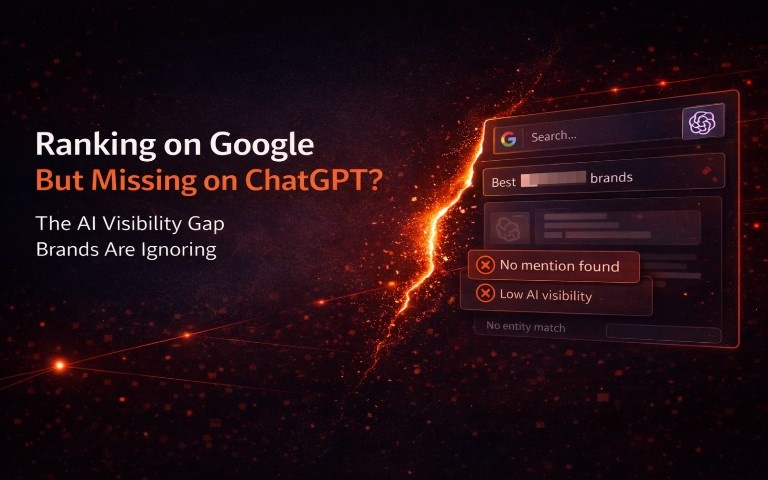

A founder friend of mine recently told me a story that had stuck in my head. He typed his brand name into Google, and there it was. Position 1, clean and proud.
Then he opened ChatGPT and asked, “Which is the best eco-friendly cleaning brand in the US?”
Silence. No mention of his brand. Not even a tiny hint. He tried a keyword for which they had dominated for years.
Still nothing.
He looked at me and said,
“How am I winning on Google, but invisible on ChatGPT?”
That was the moment I knew we were entering a new era. the era of the AI Search Gap.
And most brands don’t even realize they’re falling into it.
This blog breaks down exactly what the AI Search Gap is, why it happens, and what smart brands are doing to fix it before they get erased from the future of search.
- How am I winning on Google, but invisible on ChatGPT? why it happens, and what smart brands are doing to fix ?
- How am I winning on Google, but invisible on ChatGPT?
- How am I winning on Google, but invisible on ChatGPT?
This blog breaks down exactly what the AI Search Gap is, why it happens, and what smart brands are doing to fix it before they get erased from the future of search.
What is the AI Search Gap?
he AI Search Gap is the growing difference between how brands rank on Google and how they show up,
if they show up at all, in AI-generated answers on platforms like ChatGPT, Gemini, Claude, and even Google’s own AI Overviews.
A brand might be ranking in the top 3 positions on Google, getting steady organic traffic and ranking for all their target keywords. Yet still might be completely missing or replaced by competitors in AI responses.
And the reason this happens because AI tools don’t rely on traditional SEO signals. They look for broader brand authority, structured data, citations, and trustworthy mentions across the web. As a result, many strong Google performers become invisible in AI-generated recommendations, lists, and buying guides.
This is happening everywhere, from SaaS to e-commerce, D2C, consulting, healthcare, and even local service businesses.
And here’s the scary part.
AI answers are becoming the new first point of search, and they are even replacing Google’s traditional result pages.
Google knows this, which is why it launched AI Overviews.
OpenAI knows this too, ChatGPT launched Browse, Search, and GPT-based answers.
If Google dominated the last 20 years of search…AI will dominate the next 20.
And this shift is already visible.
Why Google and AI Don’t Work the Same Way?
Most people assume that “If I’m ranking on Google, AI tools should pick me up too.” But this is wrong.
AI search doesn’t work like Google search. And here’s a simple explanation.
Google ranks pages, while AI models rank entities (brands, products, companies).
Google focuses on keywords, backlinks, content quality and technical optimization. AI cares more about brand authority, structured data and how well your brand is represented across the internet.
Google crawls live webpages; AI learns from large datasets.
Google constantly updates its index based on fresh content. AI is trained on snapshots of the web, plus sources like Wikipedia, news sites, reviews and public databases. If your brand isn’t present in these high-trust sources, AI simply doesn’t “learn” enough about you.
Google crawls live webpages; AI learns from large datasets.
Even if you rank #8 on Google, users can still see you. AI tools provide a single recommendation or a short list. If you’re not included, you’re invisible. No second chance.
Google rewards keyword optimization; AI rewards consistent brand signals.
AI tools look for mentions, citations, structured profiles and third-party validation, not just well-written website content. This makes AI visibility a different game entirely.
Why AI Makes Some Brands “Disappear”?
Even if a brand is doing everything “right” for Google, AI tools often treat it very differently. Here are the biggest reasons why many brands seem to vanish inside AI-generated answers.
1. No Structured Information About the Brand
AI models rely a lot on structured and factual data to understand and confidently recommend a brand. This also includes information from places like Wikidata, Wikipedia, Crunchbase, business directories and high-authority listings.
If your brand isn’t in structured data sources, AI won’t recognize it.
When a brand doesn’t exist in these structured sources, or the information is incomplete or inconsistent, AI tools struggle to “recognize” it as a credible entity. As a result, even strong websites get ignored because the brand lacks the clean, machine-readable signals AI models depend on.
2. Weak Brand Mentions Across the Web
Google might reward your on-page optimization, but AI relies more on how often your brand is mentioned and validated by external sources. If most of your online footprint comes only from your own website, AI sees it as biased and incomplete.
What matters for AI is being referenced in credible articles, expert roundups, industry discussions, PR coverage and reputable third-party content.
Without this broader digital footprint, AI models simply do not view the brand as trustworthy or well-known enough to include in recommendations.
3. No PR or Digital Footprint
Public visibility plays a huge role in AI-driven recommendations. Brands that have interviews, media features, press releases and thought-leadership content create a trail of trusted information across the web. AI models pick up on these signals and treat the brand as established and reliable.
When a brand lacks PR or any external coverage, AI finds very few authoritative sources to learn from. This creates a credibility gap that often results in the brand being excluded entirely from AI-generated answers.
4. Product/Service Data Not AI-Friendly
Many brands still describe their products or services in marketing-heavy, unstructured formats that AI struggles to interpret. AI models prefer information that’s
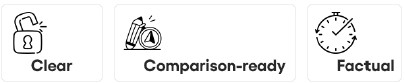
like feature lists, pricing breakdowns, technical specs, and FAQ-style explanations.
If your product pages aren’t structured this way, AI can’t confidently position you against competitors. It won’t include you in comparison queries simply because it doesn’t understand your offerings well enough.
5. Lack of Topical Authority Outside Your Own Website
AI tools don’t just analyze your website…they look for confirmation across the wider web. If nobody else talks about your brand, your expertise, your products, or the problems you solve, AI assumes you’re not influential or relevant within your category.
To AI, authority comes from third-party validation. Like to AI, authority comes from third-party validation, like Brands that rely solely on their own site lose out, because AI views them as isolated rather than authoritative.