

Most businesses treat website maintenance as an internal responsibility by default. That default costs more than they realize, in time, money, and missed SEO opportunities.
A website is not a finished product. It is an ongoing operational system that requires security updates, performance monitoring, content management, plugin maintenance, backup management, and regular technical audits.
Done properly, it is a part-time job at minimum. For growing businesses with complex sites, it is a full-time function.
The question is not whether this work needs to happen. It is who should be doing it.
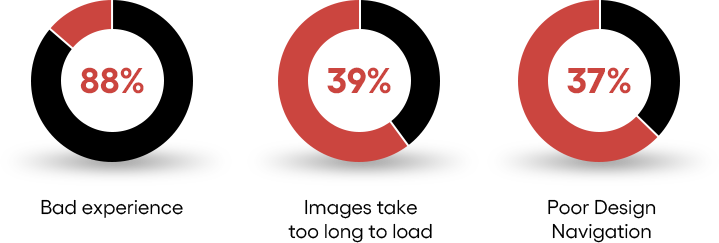
What Website Maintenance Actually Involves
Before making the outsourcing case, the scope deserves clarity.
Website maintenance is the collective work that keeps a site secure, functional, fast, and visible in search. It includes:
- Updating CMS software, plugins, and integrations
- Monitoring and patching security vulnerabilities
- Performing regular backups and testing recovery procedures
- Fixing broken links, crawl errors, and technical issues
- Reviewing performance metrics and identifying anomalies
- Ensuring mobile responsiveness and page speed standards are met
- Adding and updating content to keep the site current
None of these tasks is individually complex. Collectively, they require consistent attention and technical competence that most internal teams are not resourced to provide alongside their primary responsibilities.
Outsourcing Website Maintenance: Is It Worth It?

1. The True Cost of In-House Maintenance Is Higher Than It Appears
The in-house option looks straightforward on paper. Someone on the team handles website updates. In practice, it rarely works that way.
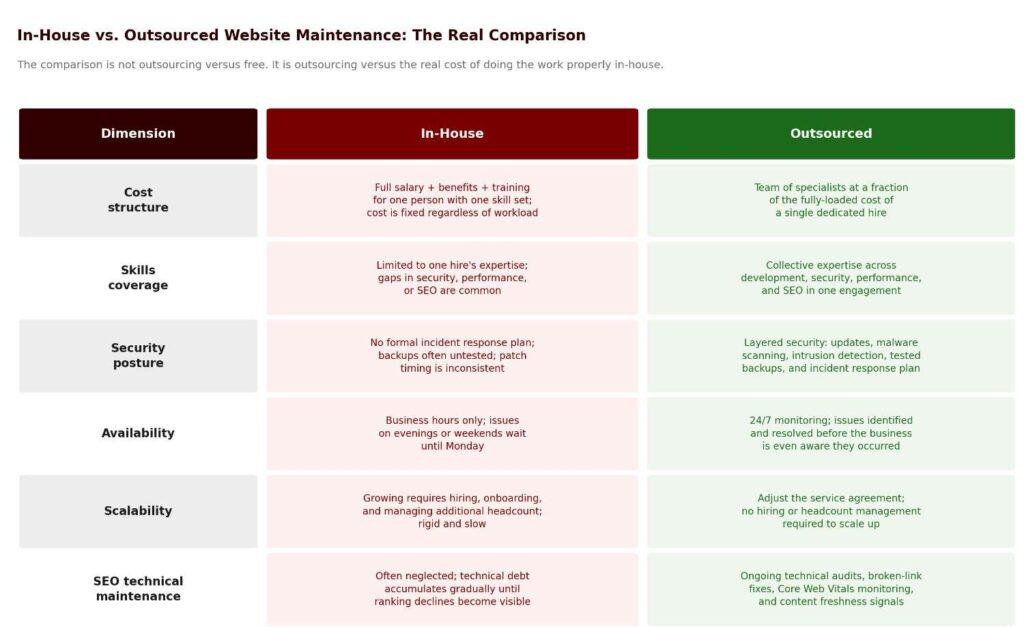
Dedicated in-house website maintenance requires hiring someone with the right skills, paying a full salary and benefits, investing in their ongoing training, and accepting that their capacity is fixed. When issues arise outside business hours, coverage becomes a problem.
Outsourcing replaces that structure with a team of specialists accessible at a fraction of the fully-loaded cost of a single hire.
You are not paying for one person with one skill set. You are paying for a team with collective expertise across development, security, performance, and SEO.
The comparison is not outsourcing versus free. It is outsourcing versus the real cost of doing the work properly in-house. When that comparison is made honestly, outsourcing typically wins on economics.
2. Access to Current Tools and Expertise Without the Learning Curve
The technical requirements of website maintenance evolve continuously. Security protocols change. Performance standards shift. Browser updates create compatibility issues. Google’s Core Web Vitals introduce new performance benchmarks.
Professional website maintenance providers stay current with these changes as a core part of their business model. It is their responsibility to know when a major WordPress update introduces compatibility risks, or when a new security vulnerability requires immediate patching across client sites.
Building and maintaining that level of current expertise internally is a significant investment. Many established businesses outsource website maintenance precisely because they want access to current knowledge without the overhead of maintaining it themselves.
3. Security Is Not a Part-Time Responsibility
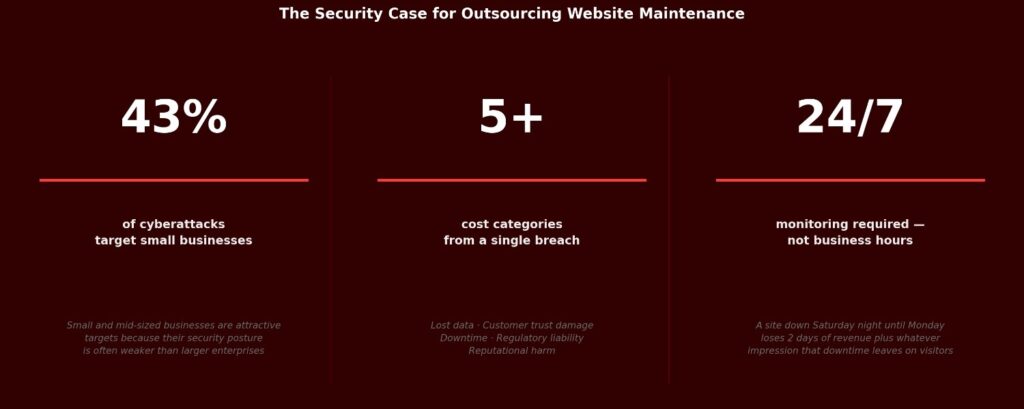
43% of cyberattacks target small businesses. That figure is worth sitting with. Small and mid-sized businesses are attractive targets precisely because their security posture is often weaker than larger enterprises.
A security breach carries costs that extend well beyond the immediate incident: lost data, customer trust damage, downtime, potential regulatory liability, and the reputational harm of being publicly compromised.
Professional website maintenance providers implement layered security:
- regular software updates,
- malware scanning,
- intrusion detection, and
- tested backup and recovery procedures.
When an incident occurs, they have a response plan. Most in-house teams do not.
Regular, tested backups deserve specific mention. A backup that has never been tested is not a backup. It is an assumption. Outsourced providers maintain backup schedules and verify recovery processes so that if something goes wrong, recovery is fast and reliable.
4. Round-the-Clock Support That Matches How the Internet Actually Works
Websites do not observe business hours. Traffic arrives from multiple time zones. Issues arise on evenings and weekends.
A site that goes down on a Saturday night and stays down until Monday morning loses two days of potential revenue and whatever impression that downtime leaves on visitors who encountered it.
Outsourced maintenance providers typically offer 24/7 monitoring and support.
Issues are identified and addressed before most businesses would even know they had occurred. For businesses with significant e-commerce revenue or global audiences, this availability is not a luxury. It is a commercial necessity.
5. Scalability Without Structural Reorganization
A business that doubles its website content, launches new product categories, or expands into new markets needs more maintenance capacity to match.
Scaling an in-house team to meet that demand means hiring, onboarding, and managing additional headcount.
Outsourced providers scale their service delivery with your requirements. You are not managing a team. You are adjusting a service agreement. That flexibility has real operational value, particularly for businesses growing through phases where resource requirements are difficult to predict.
The SEO Dimension Most Businesses Underweight
Website maintenance is not just a stability function. It is an active contributor to organic search performance.
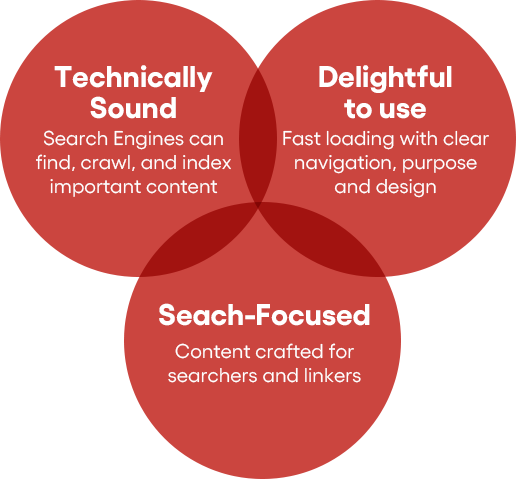
Google’s ranking algorithms incorporate page speed, mobile-friendliness, crawlability, security (HTTPS), and technical health as direct or indirect ranking factors. A site that accumulates technical debt, slow load times, broken internal links, and outdated code gradually loses organic visibility. Often slowly enough that the connection between maintenance neglect and ranking decline is not obvious until significant ground has been lost.
Professional maintenance keeps the technical foundation clean. Clean code is easier for search engines to crawl and index efficiently. Fast load times support both rankings and conversion rates. Regular content updates signal freshness to search algorithms.
The brands that maintain strong organic visibility over time are almost always the ones treating technical site health as an ongoing priority. The ones that allow technical debt to accumulate tend to see their SEO performance erode in ways that are expensive to recover from.
What to Look For in a Website Maintenance Provider
Not all providers deliver the same quality of service. Choosing the wrong one is worse than the status quo. Here is a practical evaluation framework.
Track record and verifiable experience
Ask for case studies and references from clients with similar site complexity and business type. A provider’s history with sites like yours is more relevant than general credentials.
Service scope alignment
Be specific about what you need: security monitoring, performance optimization, content updates, SEO technical maintenance, backup management. Confirm the provider covers all of it, not just the elements they prefer to sell.

Response time commitments
Downtime costs money. What is the provider’s guaranteed response time for critical issues? How is urgency defined and handled? These are questions to ask before signing, not after a problem occurs.
Security protocols and backup practices
How frequently are backups performed? Where are they stored? How are they tested? What is the incident response process if a breach occurs? A provider that cannot answer these questions clearly is not a provider worth trusting with your site’s security.
Communication and reporting
Regular reporting on site health, uptime, performance metrics, and completed maintenance tasks is the minimum expectation. You should know what is being done, how often, and what the outcomes are.
The Business Logic Is Straightforward
Your team’s time is finite. The skills required to maintain a website well are specialized and evolving. The consequences of doing it poorly are commercial, ranging from lost SEO rankings to security breaches to customer-facing downtime.
Outsourcing website maintenance is not a cost. It is a risk management and operational efficiency decision. The businesses that recognize this early tend to maintain better-performing sites, suffer fewer disruptions, and compound their SEO advantages over time rather than repeatedly recovering from preventable technical problems.
Peter Drucker’s framing holds: do what you do best, and outsource the rest. Website maintenance fits that logic cleanly for the large majority of businesses.
Curious About Whether Or Not You Too Can Benefit From Outsourcing Website Maintenance?
If you are unsure whether your current website maintenance is covering the right bases, a technical audit is the clearest way to find out. Request a site health review and see exactly where your maintenance gaps are before they become ranking or revenue problems.