
The gap between how AI in e-commerce is discussed and how it actually performs is significant. Most coverage either overpromises transformative outcomes or reduces the topic to chatbots and product recommendations.
The reality is more specific and more useful: AI delivers measurable commercial returns in a defined set of e-commerce applications, and the brands capturing those returns are the ones that have matched the technology to the right business problem rather than deploying it broadly as a capability signal.
This guide covers the AI applications that have demonstrated real impact on e-commerce revenue metrics, how each mechanism works in practice, and where the implementation pitfalls are most likely to erode returns.
The Commercial Logic Behind AI in E-Commerce
Before getting into specific applications, the framing that makes AI investment decisions clearer: AI in e-commerce creates value by either increasing revenue from the same traffic or reducing the cost of generating the same revenue. That is the only commercially relevant test.
Increased revenue from existing traffic happens through better personalization, reduced friction at key conversion points, and more relevant search and discovery experiences.
Reduced acquisition and retention costs happen through better targeting, smarter inventory management, and more efficient customer service operations.
Every AI application worth investing in usually connects to one of those two outcomes. Deploying AI because competitors are doing it, or because the technology is interesting, produces adoption without returns.
Personalized Recommendations That Work
Personalized product recommendations are the AI application with the longest track record in e-commerce and the clearest ROI profile. The mechanism is established: AI analyzes individual browsing history, purchase behavior, and patterns across similar customer cohorts to surface products a specific user is most likely to engage with or purchase. That relevance improvement drives measurable increases in average order value, session depth, and repeat purchase rate.
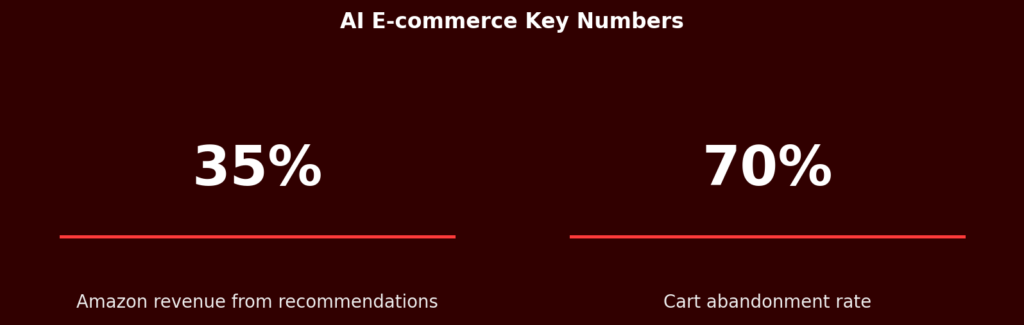
Amazon’s attribution of 35% of its revenue to its recommendation engine is the oft-cited benchmark, though the exact figure varies by source, and the attribution methodology involves assumptions about counterfactual behavior. The directional finding is consistent across the industry: well-implemented personalized recommendations outperform generic bestseller or category-based displays by meaningful margins.
The practical implementation for most e-commerce businesses does not require building proprietary recommendation infrastructure. Shopify, WooCommerce, and most major platforms have native or plugin-based recommendation engines that deploy these capabilities without custom development.
The variable that determines performance is data quality and volume: recommendation algorithms improve as more behavioral data accumulates. Newer stores with thin transaction history will see lower lift from recommendations than established stores with rich customer data.
A common mistake is treating recommendations as a one-time implementation. The placement, format, and algorithm weighting of recommendations all affect performance, and A/B testing different approaches produces ongoing improvement that compounds over time. Many brands implement recommendations, see modest initial lift, and leave performance on the table by not optimizing further.
Advanced application:
Cross-sell recommendations in the post-purchase confirmation flow and in post-purchase email sequences consistently outperform on-site recommendations in conversion rate, because the customer has just completed a purchase and their attention is close. This placement is underutilized relative to its performance potential.
Search Optimization: Where E-Commerce Loses Revenue
The search function on most e-commerce sites is a meaningful source of revenue leakage that brands routinely underestimate. Customers who use site search convert at two to three times the rate of non-search visitors because they have expressed explicit purchase intent.

An internal search function that fails to surface the right products, or that returns zero results for queries that should match available inventory, loses conversions that were already close to happening.
Traditional keyword-based search fails in predictable ways:
- it cannot handle natural language queries,
- it misses misspellings,
- it does not account for synonyms, and
- it cannot interpret contextual cues in the query.
A customer searching for “something to wear to a beach wedding” may have no match in a keyword-indexed catalog even if the store carries exactly the right products.
AI-powered search understands intent, not just string matching. It can process natural language queries, account for semantic similarity between terms, learn from collective search behavior on the site to surface what customers actually want when they search particular terms, and personalize results based on individual history.
For stores with more than a few hundred SKUs, the investment in AI-enhanced search pays for itself relatively quickly because the conversion rate improvement on search traffic is both significant and immediate.
Tools like Algolia, Searchanise, and Klevu integrate with major e-commerce platforms and provide this capability without custom development.
The measurement approach: Most analytics platforms allow segmentation by whether a session included site search. Compare conversion rates, AOV, and bounce rates between search and non-search sessions. That gap is your opportunity size.
Cart Abandonment: Why It Happens (and What to Fix)
Approximately 70% of online shopping carts are abandoned before purchase. That figure is consistent across industry data and represents the single largest revenue gap in most e-commerce operations. The challenge is that cart abandonment has multiple causes, and treating them all with the same recovery mechanism produces mediocre results.
AI contributes to cart abandonment recovery in two ways: diagnosis and personalized recovery.

Diagnosis uses behavioral data to classify abandonment causes.
- A customer who added to cart and immediately left may have been price comparison shopping, found a product issue, or simply been interrupted.
- A customer who reached the payment page and stopped may have encountered a trust concern, a payment friction, or an unexpected cost.
AI can classify sessions by abandonment pattern and route them to different recovery flows with much higher precision than generic “you left something in your cart” email sequences.
Personalized recovery takes this further by tailoring the recovery message to the specific abandonment signal and the specific customer context.
A customer with a history of price sensitivity who abandoned at checkout gets a different message than a first-time visitor who abandoned at the product page.
The price-sensitive customer gets a targeted offer. The first-time visitor gets a trust-building sequence with social proof and a simplified re-engagement path.

The technical enablement includes social login options, which reduce the account creation friction that drives abandonment among unauthenticated visitors, and guest checkout with post-purchase account creation prompts, which separate the conversion moment from the friction of account setup.
What most brands underinvest in is the speed of recovery outreach. Research consistently shows that recovery email sequences sent within one hour of abandonment convert at significantly higher rates than sequences sent 24 hours later. AI-triggered workflows that send the first recovery touchpoint within minutes of session end outperform batch-and-blast daily recovery emails.
AI Customer Service: What Works (and What Doesn’t)
Chatbots and AI-assisted customer service are the most visible AI applications in e-commerce, and also the most frequently implemented poorly. The honest assessment of where AI chatbots add commercial value and where they damage it is more nuanced than vendor marketing suggests.

AI chatbots handle well-defined, high-frequency queries efficiently and around the clock: order status, delivery time estimates, return policy, basic product specifications, and account-related requests. These queries follow predictable patterns, have consistent correct answers, and do not require contextual judgment.
Automating them
- reduces support team workload,
- improves response speed, and
- handles after-hours volume that would otherwise wait until business hours.
Where AI chatbots create problems is in edge cases, emotionally charged situations, and queries that require judgment. A customer with a damaged product who receives an automated scripted response rather than an empathetic human interaction is likely to leave that interaction more frustrated than before they reached out.
The escalation protocol, specifically how quickly and smoothly a chatbot transfers to a human when the situation requires it, determines whether a chatbot improves or worsens customer experience for complex situations.
The implementation principle: Deploy AI chatbots with clear scope boundaries, transparent escalation paths, and human availability during peak hours for high-stakes interactions. Do not present a chatbot as a human agent. Do not use AI chatbots as a mechanism to reduce human support staffing below the level needed to handle genuinely complex interactions.
Advanced application: AI-assisted customer service, where AI provides the human agent with relevant information, suggested responses, and customer context during the interaction, typically outperforms fully automated chatbots in satisfaction scores while delivering meaningful time savings per interaction. This hybrid model is more appropriate for high-AOV categories where relationship quality in service interactions affects LTV.
Voice and Visual Search: The Future of Discovery

Voice search and visual search represent behavioral shifts in how customers discover products that are still developing but have reached sufficient scale to warrant attention.
Voice search via Google Assistant, Alexa, and Siri affects e-commerce primarily through the discovery phase: Customers researching products through voice queries, not completing transactions through voice, which remains uncommon.
The optimization implication is primarily SEO-focused since voice queries are longer, more conversational, and often question-format. Product and category pages optimized for natural language queries capture voice-driven discovery.

Visual search allows customers to find products by uploading an image rather than typing a query. Pinterest Lens, Google Lens, and platform-specific tools like ASOS’s style search have demonstrated genuine adoption in fashion, home goods, and lifestyle categories where customers frequently see a product they want without knowing how to describe it in text. For e-commerce brands in those categories, AI-powered visual search integration, whether through a platform plugin or a custom implementation, serves a real customer need.
The practical priority: Invest in making your visual content indexable first.
High-quality product images with accurate alt text and structured data allow platforms like Google Lens to surface your products in visual search results, capturing demand without requiring custom visual search infrastructure.
Dynamic Pricing: The Opportunity and the Risk
Amazon reprices products millions of times daily. That figure is accurate and also somewhat misleading as a benchmark for most e-commerce businesses, because Amazon’s pricing strategy is sophisticated, resource-intensive, and context-specific in ways that do not translate directly to smaller operations.

AI-driven dynamic pricing analyzes competitor pricing, demand signals, inventory levels, and customer segment data to optimize prices in real time or near-real time.
The commercial case is straightforward: Pricing above what the market will bear reduces conversion, while pricing below what customers would pay leaves margin on the table. Dynamic pricing narrows both gaps.
The implementation reality for most e-commerce businesses: Meaningful dynamic pricing requires reliable competitor price feeds, demand signal tracking, and sufficient transaction volume for the algorithm to learn from. For stores with high SKU counts in price-competitive categories, AI pricing tools from vendors like Prisync or Omnia Retail are worth evaluating. For stores with lower SKU counts or category-specific pricing power, manual price reviews against competitor benchmarks may deliver 80% of the benefit at a fraction of the complexity.
The risk to manage: Visible price volatility can damage customer trust in categories where customers comparison shop or where repeat purchase behavior means they notice price changes. The dynamic pricing logic should include guardrails preventing pricing below margin floors and excessive price variance within short windows that customers would recognize as inconsistent.
Better Forecasting, Better Business Outcomes
Inventory management is the AI application that most directly affects both unit economics and customer experience, and it is systematically underinvested in relative to customer-facing AI applications.
The business problem it addresses: Overstocking ties up working capital and drives markdown events that compress margin. Understocking causes stockouts, which damage customer experience and push revenue to competitors. Both outcomes are costly, and both are more preventable than most e-commerce operators realize.
AI demand forecasting uses historical sales data, seasonality patterns, external signals including search trend data and competitor activity, and leading indicators to generate more accurate inventory projections than manual forecasting or simple moving average approaches.
For businesses with meaningful seasonal variation, this can meaningfully reduce both overstock and stockout frequency.
The practical implementation path: Most modern e-commerce platforms have native or integrated demand forecasting capabilities. For businesses on Shopify Plus, tools like Inventory Planner or Brightpearl provide this capability without custom development. The prerequisite is clean historical data: garbage-in-garbage-out applies directly to forecasting models.
The connection to customer experience is direct. A business with better inventory forecasting has products in stock when customers want them, which increases conversion rate and reduces the proportion of traffic that bounces due to unavailability. The ROI calculation should include both the working capital benefit of reduced overstock and the revenue benefit of reduced stockouts.
Authenticity Matters: Detecting Fakes at Scale
Two AI applications that protect the commercial foundation of the e-commerce business rather than directly driving revenue deserve mention.

For marketplace operators and platforms hosting third-party sellers, AI-powered counterfeit detection analyzes product listings, images, pricing patterns, and seller behavior to identify likely counterfeit products before they damage brand relationships and customer trust. The technology can identify image manipulation, detect listings that match known counterfeit patterns, and flag sellers whose behavior is inconsistent with legitimate operations.
For review integrity, AI systems can distinguish authentic purchase-verified reviews from inauthentic ones by analyzing writing patterns, account behavior, and timing signals. Maintaining review integrity is commercially significant because customer reviews are a primary trust signal in purchase decisions, and visible fake reviews damage credibility in ways that are difficult to recover from.

Both applications are more relevant for larger marketplace operators than for single-brand D2C stores, where these risks are lower. For D2C brands, the review integrity concern is more likely to manifest as managing and responding to negative reviews efficiently, which AI can assist with through sentiment analysis and routing.
Sales Prediction: Better Data, Better Decisions
AI-generated sales forecasting extends beyond inventory management to support marketing budget allocation, promotional planning, and operational capacity planning.
The mechanism:
First, AI analyzes historical sales patterns, traffic trends, promotional response rates, competitive signals, and external factors to generate probabilistic sales projections across product categories, time periods, and customer segments.
Then, these projections inform decisions about where to invest marketing spend, which promotions to run, and what operational capacity to prepare.
The commercial value is in decision quality improvement. A marketing team allocating seasonal campaign budget based on AI-generated demand forecasts makes better allocation decisions than one relying on prior year actuals alone, particularly in categories where market conditions have shifted. The value compounds when forecasting is used to coordinate across marketing, inventory, and operations rather than functioning as a standalone marketing planning tool.
The honest constraint: AI forecasting improves with data volume and quality. Businesses with less than two to three years of consistent transaction data and stable operations will find AI forecasting less reliable than established operations. The technology is not a substitute for business judgment in low-data-density situations.
A Prioritization Framework for AI Investment Decisions
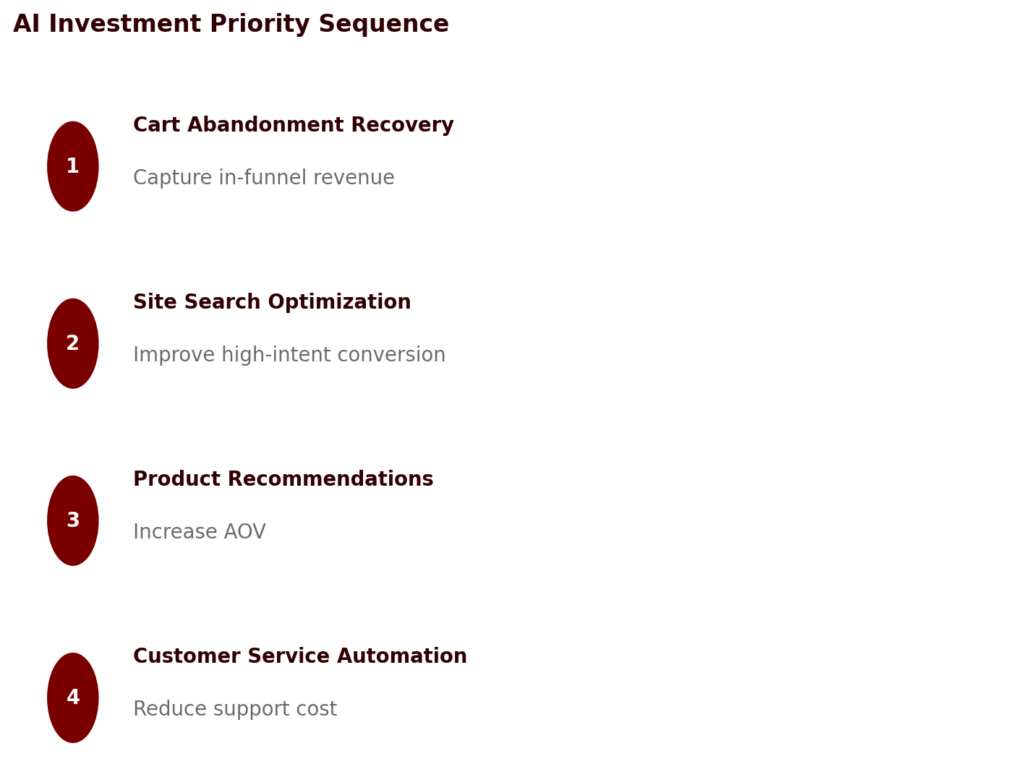
Given the range of AI applications available, the question of where to invest first has a practical answer: start where the return is most certain and closest to the core conversion moment.
For most e-commerce businesses, the priority sequence is:
- cart abandonment recovery infrastructure first, because it captures revenue that is already in the funnel;
- site search improvement second, because it converts already-interested visitors more effectively;
- personalized product recommendations third, because the platform integration is straightforward and the lift compounds over time; and
- customer service automation fourth, scoped to well-defined high-frequency queries.
More capital-intensive applications like dynamic pricing, advanced demand forecasting, and counterfeit detection make sense once the core conversion infrastructure is optimized and the business has sufficient data and margin to absorb implementation complexity.
The evaluation question for any AI tool investment: can you measure the specific conversion or cost metric it is designed to move, and is there a clear baseline to compare against?
If the answer is no to either, the investment decision is premature regardless of how compelling the technology demonstration looks.
Ready to Assess the Position of E-commerce Operation?
If you want to assess where your current e-commerce operation has the highest-leverage AI opportunities and what realistic return targets look like for your category and stage, that diagnostic is worth doing before committing to specific tool investments.