
The cost argument for outsourcing digital marketing to India is real, but companies that make the decision purely on cost usually get exactly what they paid for. The more useful frame is capability access: what level of digital marketing expertise can you reliably access, at what cost, and with what operational constraints, compared to the alternatives.
India has built a genuinely deep talent base in digital marketing, SEO, content, paid media, and web development over two decades.
The depth didn’t happen by accident. It was driven by real demand. Global companies, including multinationals and tech firms, created that demand. Growth-stage businesses from the US, UK, Australia, and Europe played a role, too.
They consistently outsourced digital work to India over many years. This built long-term experience in the market, not just short-term capability. Multiple generations of professionals evolved who specialized in different areas. Strong operational systems were also developed, all focused on serving international clients.
Whether that ecosystem is the right fit for your business depends on factors that are more nuanced than a cost comparison. Here is what those factors actually are.

Why Global Brands Outsource Digital Work to India
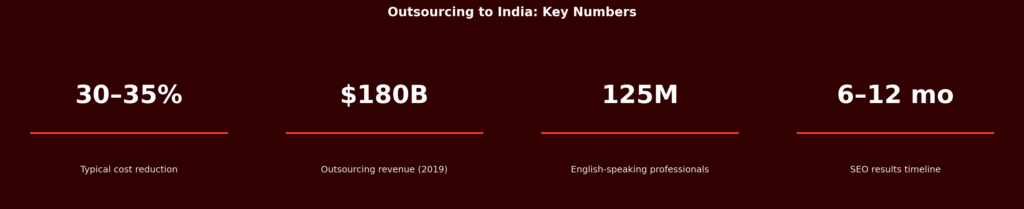
India’s outsourcing industry did not grow to its current scale because of geography or government policy alone. It grew because the output quality, at the right price points, cleared the bar for a wide enough range of clients that the sector compounded. Revenue from outsourcing in India reached approximately $180 billion in 2019, and the digital services portion of that number has grown substantially since.
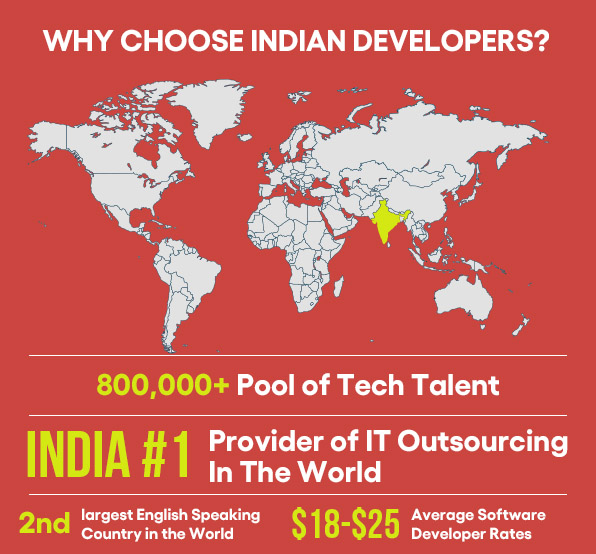
The talent pool is a genuine structural advantage. India’s university system produces a large volume of English-fluent graduates in technical and communications disciplines each year.
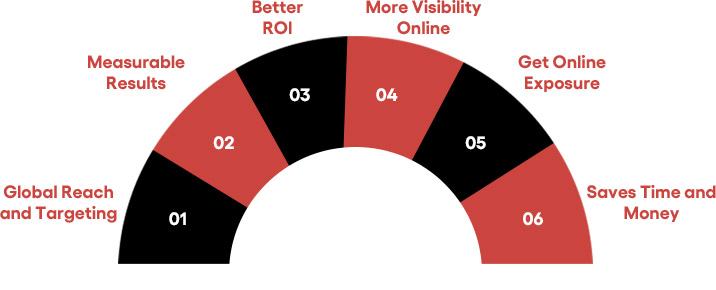
The concentration of that talent in a competitive outsourcing market has created agencies and teams that have processed the kind of volume and variety of work that builds operational sophistication. This is not universally true across every provider, but the best Indian digital agencies have client rosters, process maturity, and tool proficiency that benchmark favorably against comparable firms in higher-cost markets.
English proficiency deserves more precision than it usually gets in outsourcing discussions. India has the second-largest English-speaking population in the world by absolute numbers, with roughly 125 million people using English professionally.
For client-facing work, reporting, strategic consultation, and content creation targeting English-language markets, this removes a friction that is genuinely significant when outsourcing to other lower-cost markets.
The Real Cost Advantage, Accurately Described
The commonly cited cost reduction from outsourcing digital marketing to India is 30 to 35 percent compared to equivalent capability in North America or Western Europe. That figure is broadly accurate for agency retainer comparisons, but it needs context.

What you save on: The direct labour cost of execution.
Designers, developers, SEO specialists, content writers, paid media managers, and analytics practitioners at Indian agencies operate at salary structures that reflect local market rates, which are substantially lower than US, UK, or Australian equivalents. Those savings flow through to agency pricing.
What you do not save on: Strategic thinking, client management, and quality oversight at the senior level.
The best Indian agencies charge senior-level rates that are competitive with global market rates for genuinely experienced practitioners. If an agency is quoting unusually low rates across the board, the savings are coming from somewhere, and they are usually coming from the seniority level of those who are actually doing the work.
What to factor in that most comparisons omit: Coordination overhead.
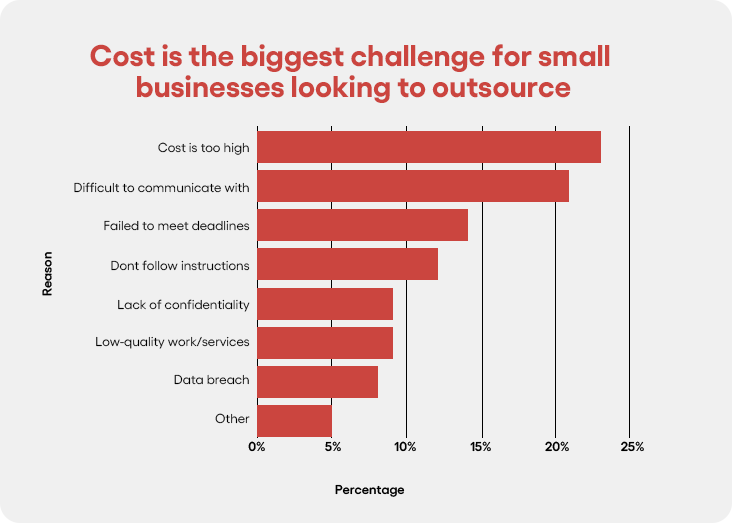
Time zone differences, communication latency, briefing quality requirements, and revision cycles all add cost that does not show up in the rate card but shows up in the total time investment from your side of the engagement.
For well-structured ongoing programs with clear processes, this overhead is manageable. For work that requires intensive real-time collaboration or rapid iteration, it can be a genuine constraint.

The net cost advantage is real. It is just not as simple as multiplying hours by a lower rate.
Time Zone as a Strategic Asset, With Caveats
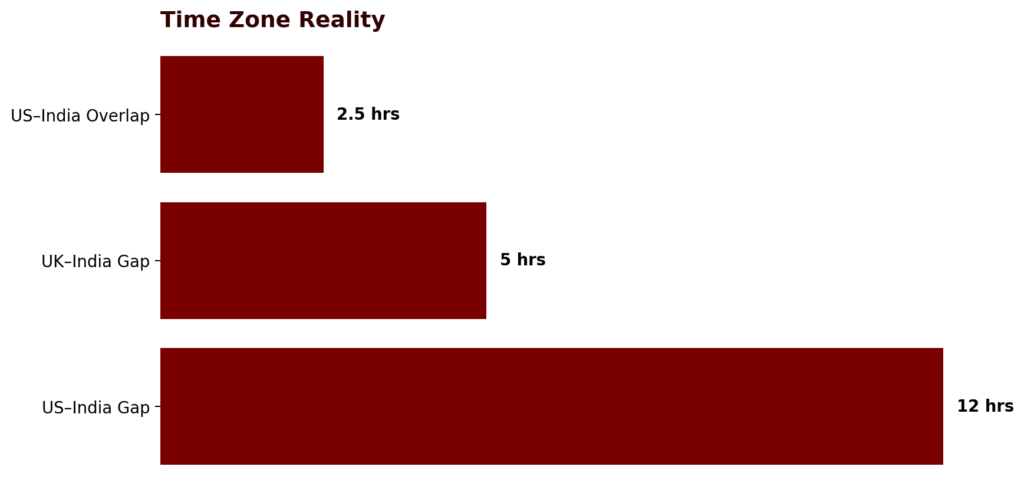
India Standard Time runs approximately 9.5 to 12.5 hours ahead of US time zones, and 4.5 to 5.5 hours ahead of the UK. This is typically presented as a pure advantage: your team works while you sleep, and work is ready when you start your day.
In practice, the advantage is real for work that can be clearly specified, executed, and delivered asynchronously. If you send a brief at the end of your business day and need a deliverable ready at the start of the next, a well-run Indian team can deliver that. Many companies with mature outsourcing relationships treat this cycle as a structural productivity advantage, and it genuinely is one for execution-heavy work.
The caveat is strategic work. If you need your agency partner in the room or on the call for decisions that require real-time dialogue, the time zone overlap is limited.
- US companies typically have a two to three-hour window of overlap with Indian business hours.
- UK companies have slightly more.
For weekly check-ins and structured reviews, this is workable. For businesses that expect deep day-to-day integration with their agency, deliberate process design should not become a friction point.
The companies that get the most from the time zone advantage are those that have built a clear separation between what gets decided collaboratively and what gets executed autonomously. The former happens in the overlap window. The latter runs overnight and is ready for review in the morning.
What the Talent Pool Actually Covers
The breadth of digital marketing capability available through Indian agencies and professionals is wider than most international clients realize when they start evaluating.
SEO and organic search are areas of particular depth.
India’s outsourcing sector has developed significant expertise here because SEO work lends itself well to the model: it is process-driven, measurable, executable in clearly defined workstreams, and the output is verifiable.
Technical SEO audits, content production at scale, link-building programs, and analytics implementation are all areas where Indian teams have built mature delivery capabilities.
Paid media management across Google Ads, Meta, and programmatic platforms is broadly available at a strong execution quality.
The caveat is strategic oversight: Media strategy that requires a deep understanding of a specific local market or highly nuanced audience psychology benefits from practitioners with direct market experience. Execution of well-designed campaigns is different from designing the strategy from scratch.
Content and copywriting for English-language markets are available across a wide range of capability levels.
- At the top of the market, there are excellent writers producing content that competes with anything from higher-cost markets.
- At the lower end, there are significant quality gaps that manifest in voice, cultural nuance, and the kind of subtle incorrectness that is hard to catch without close editorial review.
For content that represents your brand directly, particularly thought leadership, long-form editorial, and customer-facing copy, quality filtering and editorial standards matter more than they do for technical or operational content types.
Web development and design have significant depth and are where India’s outsourcing reputation was originally built.
For development work with clear specifications, the quality and cost advantage is consistently strong. For design work requiring original creative direction, the same caveat about quality filtering applies.
How India Compares to Other Outsourcing Markets
The most common alternatives to India for digital marketing outsourcing are Eastern Europe (particularly Poland, Ukraine, and Romania), Southeast Asia (Philippines, Vietnam, Indonesia), and Latin America (Mexico, Colombia, Brazil).
Each market has distinct characteristics that make it more or less suited to specific types of work:
Eastern Europe offers strong technical talent, particularly in development and data analytics, and operates in closer time zones for European clients.
The cost advantage over India has narrowed in some markets as demand has increased. English proficiency varies more than in India, and the talent pool is smaller in absolute terms.
Southeast Asia, particularly the Philippines, has strong English proficiency and a well-established services outsourcing industry.
Filipino professionals have built particular depth in content, customer support, and social media management for US markets. The digital marketing specialization is less broad than India’s.
Latin America offers near-time-zone alignment for US companies, which is the primary structural advantage.
For businesses that need real-time collaboration or want a team in a similar business day, the time zone alignment has operational value that offsets the smaller cost differential compared to India or Southeast Asia.

The honest comparison: India’s combination of talent volume, English proficiency, cost structure, and accumulated institutional expertise in digital services makes it the strongest single market for digital marketing outsourcing across most dimensions for most clients. The cases where other markets outperform India tend to be specific to particular capability areas, time zone requirements, or cultural proximity needs.
The Difference Between Good and Bad Outsourcing
The difference between outsourcing that delivers measurable value and outsourcing that generates cost and frustration is almost never about the market or the price. It is about how the relationship is structured.
Specificity of brief.
Offshore teams cannot supplement vague direction with an implicit understanding of your business, your customers, or your internal standards. The quality of the brief directly determines the quality of the output.
This happens more so than in an in-house relationship, where context can be absorbed informally over time. Investing in clear, detailed briefs for every workstream is not overhead. It is the primary lever on output quality.
Defined quality standards.
For content, design, and anything that represents your brand externally, explicit quality standards with examples matter. What does good look like? What does not meet the bar?
Without this reference framework, quality is evaluated subjectively by both sides, and the gap between expectations never closes.
Senior-level access on both sides.
The most common failure pattern in outsourcing relationships: The client interacts primarily with account management, and the people doing the strategic work are not in the room.
For engagements that require genuine strategic contribution rather than just execution, the senior practitioners need to be directly accessible, and both parties need to invest in those relationships.
Performance measurement that both sides understand.
Outsourcing relationships that are evaluated purely on output volume (how many pieces, how many hours) rather than commercial outcomes tend to drift toward activity optimization.
Define the metrics that matter, which are commercial outcomes like traffic quality, conversion rates, and pipeline influence, and build reporting around those from the start of the engagement.
A realistic timeline for value generation.
Organic search and content programs compound over time. The first three months of an outsourced SEO engagement are foundation-building: technical audit and remediation, content architecture, and initial content production.
Measurable organic lift typically takes six to twelve months for competitive categories. If you expect that an outsourced team will produce measurable search results in ninety days, you are setting the relationship up to fail based on a misunderstanding of how the channel works.
The Decision Framework
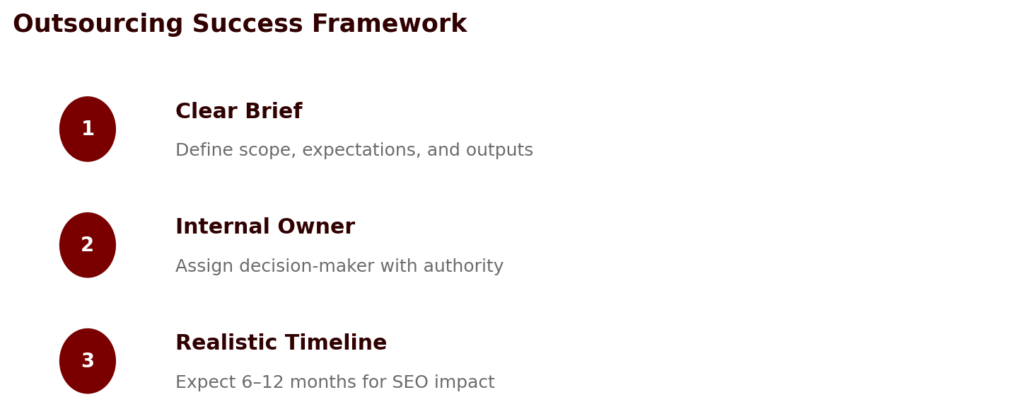
For most businesses evaluating digital marketing outsourcing to India, the decision is not whether the capability exists. It does. The decision is whether your business is structured to use it effectively.
The organizations that get the highest return from outsourced digital marketing tend to have three things in place:
- a clear brief for what they need,
- an internal owner who has the context and authority to direct the work and
- make decisions quickly, and a realistic timeline for value generation tied to the right metrics.
Organizations that are still working out what they need, or that expect the agency to define the strategy without meaningful client input, or that evaluate success on thirty-day cycles, tend to cycle through agencies and attribute the failure to the market or the partner rather than the structural conditions.
If your organization has the internal clarity to make an outsourcing relationship work, India is a strong market to access that capability. If that clarity is still being developed, the right first step is usually internal, not external.
Interested In Learning What a Solid Digital Marketing Strategy Spells For You?
If you want to understand what a well-structured digital marketing engagement would look like for your specific business situation, and what to expect from an outsourced partnership versus building internal capability, a structured conversation is a better starting point than an RFP. Request an initial assessment and get a clear view of what your current marketing infrastructure needs and how to prioritize getting there.