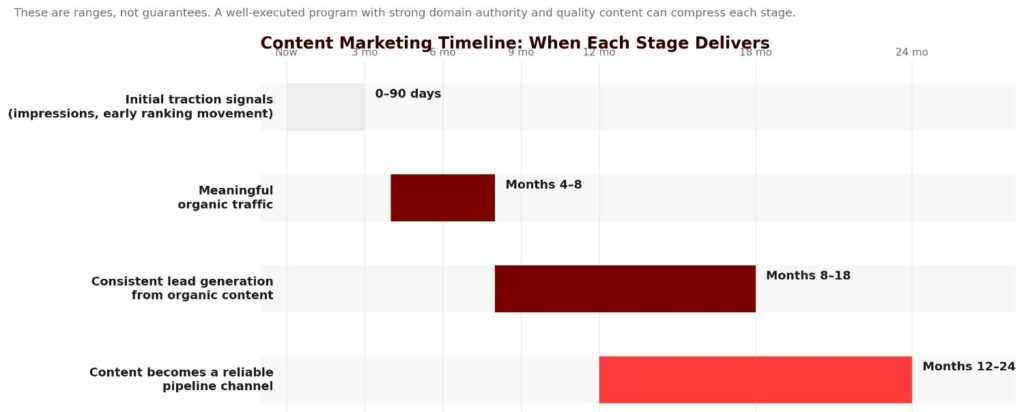
The honest answer is six to twelve months before meaningful organic traction, and twelve to twenty-four months before content becomes a reliable pipeline channel. That timeline makes most marketing leaders uncomfortable, which is why so many content programs get cut before they compound.
The uncomfortable follow-on truth: the timeline is not fixed. It varies based on domain authority, competitive density, publishing cadence, content quality, technical SEO health, and how well the content strategy is aligned to actual search demand. A program that does the fundamentals well can see meaningful movement in four to six months. A program that publishes frequently but without strategic direction can produce flat results for two years.
Before anyone commits a budget to content marketing, they should understand what influences that timeline and what they can control. That is what this piece addresses.
Why the Timeline Question Misses the Point
Most people asking “how long does content marketing take” are really asking one of two things: either “is this worth the investment,” or “how do I justify this to my leadership while we wait.”
Both are legitimate questions. But the timeline framing tends to produce the wrong decisions.
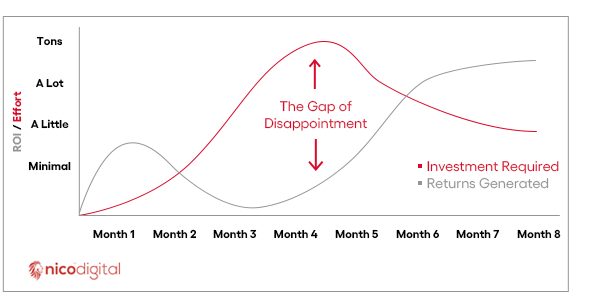
Organizations that give content a fixed internal deadline of three or four months and then evaluate success against traffic metrics will almost always conclude it is not working. This happens because three to four months is typically not enough time for the organic search channel to show what it can do.
The better frame: Content marketing is a compounding asset, not a linear spend. The return on a piece of content that ranks and converts does not stop when you stop paying for it, unlike paid media.
The second year of a well-built content program costs less per qualified lead than the first, because the existing asset base keeps producing.
That compounding dynamic is what makes content worth the patience it requires, and it is also why the investment thesis needs to be established before you start, not revisited at the four-month mark.
What the Research Actually Says About Timeline
Ahrefs data on content performance consistently shows that the average top-ten ranking page is over two years old. New content, regardless of quality, typically takes three to six months to achieve stable ranking positions as Google evaluates the page’s behavioral signals, link acquisition, and contextual authority.
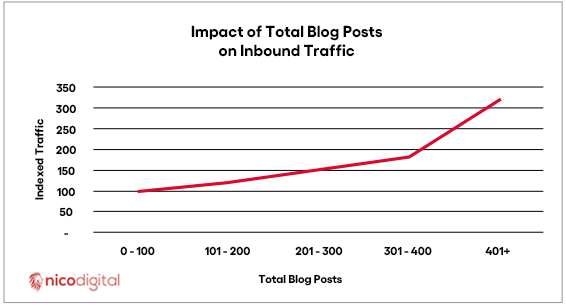
HubSpot’s benchmark data shows that publishing volume correlates with traffic, but volume without quality hits a ceiling quickly. Companies with high-quality content libraries of four hundred or more posts generate significantly more leads than those with smaller libraries, but this correlation reflects years of compounding output, not a shortcut for new programs to hit that number fast.
The more useful data point for planning purposes:
- Most content programs see initial traction signals (indexed pages gaining impressions, some early ranking movement on lower-competition queries) within ninety days.
- Meaningful organic traffic typically appears between months four and eight.
- Consistent lead generation from organic content usually emerges between months eight and eighteen, depending on competitive intensity and publishing cadence.
These are ranges, not guarantees. The variables that pull the timeline earlier are the same ones that define a well-executed program.
The Variables That Control Your Timeline
Domain Authority and Starting Position
A site with existing domain authority in a category will see content perform faster than a new domain or a domain that has never built an organic presence in a specific topic area. Authority is not a permanent asset; it erodes if content stops, and it accelerates results when it exists.
If you are entering a new topic area on an established domain, expect a lag as Google calibrates your relevance for the new subject matter. A topic cluster strategy, where you build interconnected content around a core subject rather than isolated posts, accelerates that calibration.
Competitive Density of Target Keywords
A B2B SaaS company targeting long-tail purchase-intent queries in a niche vertical can see meaningful ranking movement in months. A financial services firm trying to rank for broad personal finance queries is competing against institutional publishers with decades of authority.
The timeline for the latter is measured in years, not quarters.
This is why keyword strategy and competitive landscape analysis should precede any content investment decision. The expected timeline is a direct output of competitive analysis, not a generic industry average.
Publishing Cadence and Content Quality
Frequency without quality produces diminishing returns quickly. The content that tends to build organic authority is specific, genuinely useful, and written to answer real questions that a defined audience is actively searching for.
What “quality” means in SEO terms: Content that satisfies search intent completely enough that users do not immediately return to the search results looking for a better answer. Google measures this through behavioral signals, dwell time, pogo-sticking, and return visit rates, and uses those signals to calibrate ranking. A single well-executed piece of content that fully satisfies a specific query will outperform ten pieces of thin content targeting the same topic.
Common mistake: Treating publishing frequency as the primary lever. For most B2B programs, two to three deeply researched, genuinely useful pieces per week outperform daily publishing of surface-level content. The former builds authority. The latter creates index bloat and dilutes topical signals.
Technical SEO Foundation
Content built on a technically broken site will underperform regardless of quality. Crawl issues, slow load times, poor mobile experience, thin or duplicate pages, and unresolved indexing problems all create friction that suppresses ranking velocity.
Before investing in content production at scale, audit the technical foundation.
The most common technical issues that suppress content performance are:
- crawl budget waste from unimportant pages competing for indexation with your content,
- Core Web Vitals failures that degrade user experience signals, and
- internal linking gaps that prevent authority from flowing to content pages.
A technical audit before scaling content is not optional. It is the difference between content that compounds and content that sits.
Setting Meaningful Goals Against a Realistic Timeline
Rand Fishkin’s concept of the “SEO slog” is worth understanding properly. It describes the gap between the moment you begin content investment and the moment performance starts visibly improving, and it exists because organic search results are delayed reflections of work done months earlier.
The slog is not evidence that the strategy is wrong. It is the normal experience of building organic equity. The teams that survive it are the ones that have set expectations correctly with stakeholders in advance.
The goal-setting framework that works best in this context separates leading indicators from lagging ones.
Leading indicators (visible within ninety days):
- number of indexed pages,
- impression volume in Google Search Console,
- crawl coverage,
- backlinks acquired, and
- average position trends on target queries.
Lagging indicators (visible in months six through eighteen):
- organic traffic,
- keyword ranking positions,
- conversion from organic,
- pipeline influenced by content.
If you are only tracking lagging indicators, you will consistently feel like the program is not working during the exact period when the foundation is being built.
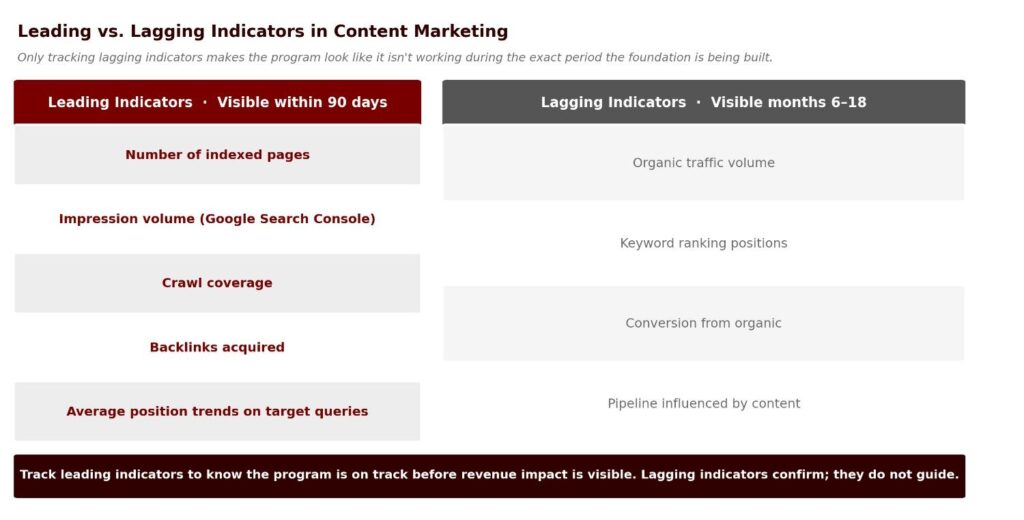
Tracking leading indicators gives you a signal that the program is on track before the revenue impact is visible.
SMART goals applied to content: Not “increase our content output by thirty percent” but “achieve page one visibility for eight target queries in our primary product category within nine months, as measured by Google Search Console average position.” Specific. Measurable. Connected to a business outcome.
Why Content Programs Fail Before They Compound
Understanding the failure modes is as useful as understanding what works. Most content programs that get cut or plateau before they deliver returns fail for one of the following reasons.
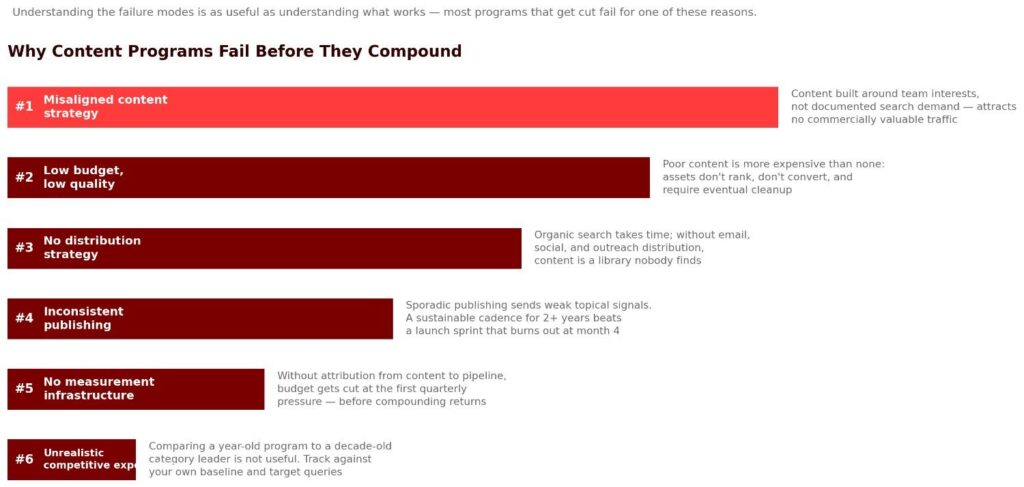
Misaligned content strategy.
Content created around topics the team finds interesting, rather than queries the target audience is actively searching.
This produces content that is technically correct but commercially inert. It does not attract the right traffic because it is not built around documented search demand.
Low budget, low quality.
Content marketing done poorly is more expensive than not doing it, because it produces assets that do not rank, do not convert, and require eventual cleanup. The content that wins in competitive categories is genuinely better than what is already ranking.
Producing that quality requires investment in research, editorial standards, and the expertise to actually answer the question being asked.
No distribution strategy.
Content without promotion is a library that no one knows exists. Organic search is the long-term distribution channel, but it takes time to mature.
In the interim, content needs to reach its intended audience through email, social, paid amplification, and outreach. The programs that see faster traction combine organic content investment with deliberate distribution.
Inconsistent publishing.
Sporadic publishing sends weak topical signals to search engines and does not build the content depth that creates topical authority.
A sustainable cadence that the organization can maintain for two-plus years is more valuable than an aggressive launch schedule that burns out at month four.
No measurement infrastructure.
Content that cannot be measured cannot be managed. Programs without clear attribution, from content consumption to lead to the pipeline, cannot make defensible investment decisions.
The inevitable result is budget reduction at the first sign of quarterly pressure, before the compounding returns have materialized.
Unrealistic competitive expectations.
Comparing a year-old content program’s performance to a category leader with a decade of domain authority is not a useful diagnostic.
Track your performance against your own historical baseline and against the specific queries you are targeting, not against aggregate traffic metrics of established competitors.
What to Do While You Wait
The months between starting a content program and seeing organic search traction are not wasted time. They are the period when the foundation that determines long-term performance is being built.
Invest in content depth over breadth.
Rather than covering twenty topics shallowly, build comprehensive coverage of your five to eight highest-priority topic areas.
Topical authority accrues to sites that cover a subject completely, not to sites that have one page on every subject.
Develop a promotion system.
Every piece of content should have a distribution plan: which email segments see it, which social channels carry it, which outreach targets might link to it, and whether paid amplification makes sense for high-value pieces.
Treat distribution as a production step, not an afterthought.
Build your internal linking architecture.
New content earns authority faster when it is properly linked from existing site content and from category-level hub pages. Internal linking is one of the highest-leverage, lowest-cost actions available to improve content performance. It is also one of the most consistently neglected.
Establish baseline metrics now.
Document your current organic impressions, average position, indexed pages, and organic traffic before the program scales.
Without a baseline, you cannot demonstrate progress to stakeholders, and you cannot identify whether specific content investments are outperforming expectations.
Audit what you already have.
Most organizations with existing websites have more content than they think, and more of it is underperforming than they realize.
A content audit frequently surfaces high-potential pages that need technical fixes, consolidation opportunities that reduce index bloat, and existing content that can be improved rather than replaced.
The Compounding Dynamic That Makes the Wait Worth It
Here is the commercial case stated plainly. A piece of content that ranks for a commercial query, earns consistent organic traffic, and converts at even a modest rate is an asset that generates leads indefinitely. The marginal cost of that lead approaches zero over time.
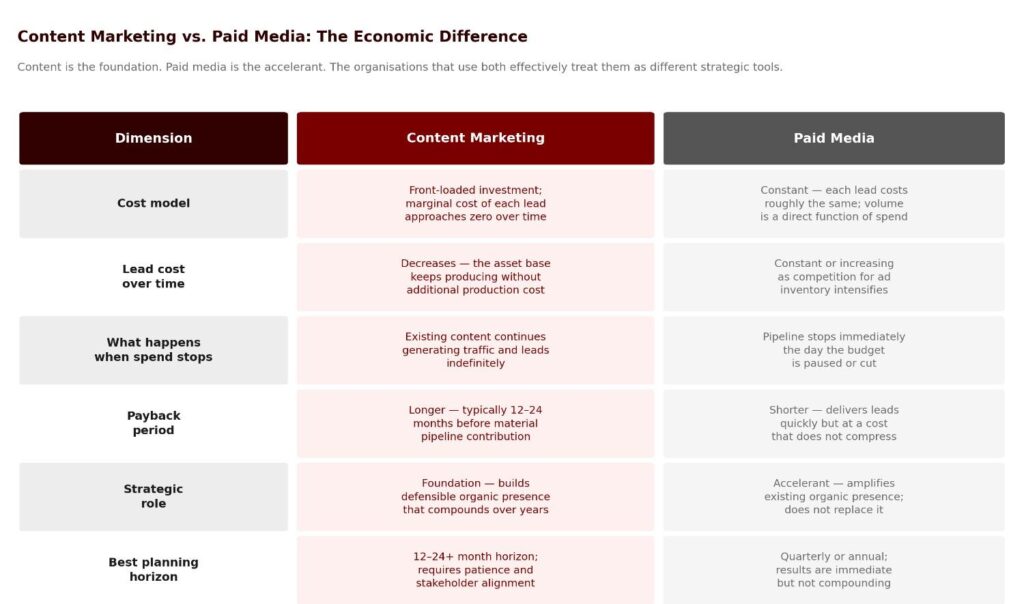
Compare that to paid search, where the lead cost is constant, and the pipeline stops the day the budget stops. Paid media is a volume dial. Content is a compounding asset. The two serve different strategic functions, and the organizations that use both effectively treat content as the foundation and paid as the accelerant.
The practical implication: The payback period for content investment is longer than for paid, but the long-term CAC impact is materially lower.
For organizations with twelve-to-twenty-four-month planning horizons and an appetite for building defensible organic presence, content marketing consistently delivers.
For organizations that need a pipeline in the next ninety days, content is the wrong tool to lean on exclusively.
Understanding that distinction is what separates a well-structured content investment decision from an unrealistic expectation that ends in early program cuts.
Want to Know Which Content Marketing Timeline Works for Your Business?
If you are trying to set realistic timelines for your content program, benchmark against competitors, or understand where your current strategy has structural gaps, a content and SEO audit will surface the answers faster than internal review. Request a program assessment to get an honest read on timeline expectations, competitive dynamics, and where the highest-leverage improvements are.