
Indian real estate does not behave like most markets. The sales cycles are longer, the trust deficit runs deeper, and the decision involves more stakeholders than almost any other purchase a household will ever make.
Generic digital marketing advice, most of which is built on assumptions about Western consumer behavior, fails here more visibly than in almost any other sector.
If you are a developer, broker, or real estate brand trying to build a digital marketing program that actually generates qualified inquiries and moves inventory, you need a strategy designed around how Indian buyers research, evaluate, and commit to property decisions.
Not a checklist of tactics. A coherent program.
This is what that looks like.
The Commercial Reality of Indian Real Estate Marketing
India’s real estate market is one of the largest and most contested in the world. The sector contributes significantly to GDP, involves enormous capital flows, and operates across a wildly heterogeneous geography where buyer behavior in Mumbai differs materially from buyer behavior in Tier 2 cities.

The competitive pressure is real. Developers spend heavily on print, hoardings, and television in ways that would be considered disproportionate in most other industries. And yet, despite that traditional advertising spend, most serious property inquiries now begin online.
Prospective buyers spend weeks, sometimes months, researching before they contact a sales team. They compare projects across multiple portals. They read reviews. They watch walkthrough videos. They ask questions in WhatsApp groups and housing forums.
The implication is straightforward. If your digital presence is not present and credible at every stage of that research process, your advertising investment, including the traditional spend, is working less hard than it should be. You are generating awareness for a brand that disappears when someone actually tries to investigate it.
The structural problem most real estate brands have: Their digital marketing is designed for conversion, not for the research phase that precedes conversion. They invest in lead capture forms and paid search ads while neglecting the educational content, social proof infrastructure, and search visibility that build the trust required for someone to actually submit that form.
Build Your Audience Map Before You Touch a Platform
Real estate in India does not have one buyer. It has several, and they behave very differently.
A first-time homebuyer in their early thirties in Bengaluru, evaluating a 2BHK in an emerging micro-market, is driven by
- EMI affordability,
- possession timeline,
- builder reputation, and
- proximity to their workplace.
A non-resident Indian investor evaluating a luxury residential project in Hyderabad is driven by
- rental yield,
- capital appreciation,
- legal title clarity, and
- ease of remote transaction management.
A mid-size developer selling plots in a Tier 2 city is dealing with a buyer who is likely
- more emotionally anchored,
- more influenced by local social networks, and
- more skeptical of digital-first brands.
These are not the same marketing problems. Collapsing them into a single strategy produces content that resonates with nobody particularly well.
Effective audience segmentation for Indian real estate should be structured around:
- project type and price point,
- buyer stage in the decision journey (early research versus active shortlisting versus ready to book), and
- the primary driver of purchase (primary residence, investment, or upgrade).
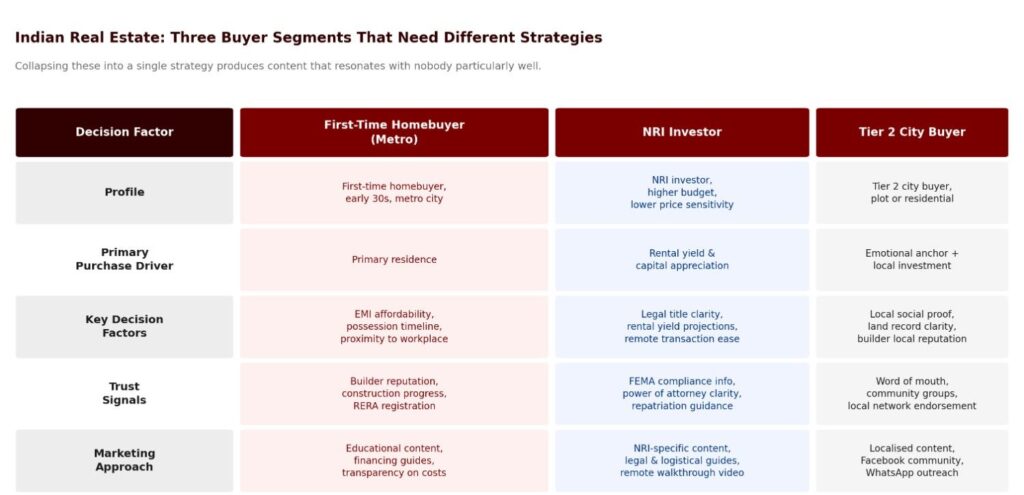
Once those segments are defined, the content, channels, and messaging for each become considerably clearer. The question stops being “what should we post?” and becomes “what does this specific type of buyer need to trust us and move forward?”
Making Your Website a Sales Environment
Most real estate websites in India are digital brochures. They show project renders, list amenities, display a price range, and ask for a callback.
That structure made sense when the website was a secondary touchpoint after an on-site visit. It makes very little sense now that the website is often the first, second, and third touchpoint before any human interaction occurs.
A website built for the current buyer journey needs to do several things simultaneously.
It needs to answer the questions buyers are actually asking.
- What is the actual possession date, not the aspirational one?
- What is the exact carpet area versus the super built-up area?
- What is the current construction status, and how is it evidenced?
- What approvals are in place?
These questions are non-negotiable for any serious buyer, and if your website forces them to call a sales team to get the answers, a meaningful percentage of those buyers will move on to a competitor whose website is more transparent.
It needs to build trust through specificity.
Vague quality claims (“world-class amenities,” “prime location”) create no differentiation and build no trust. Specific, verifiable details do, which include:
- The name of the architect.
- Actual footage of the construction site.
- The RERA registration number linked to the relevant portal.
- A timeline of project milestones with delivery dates against actuals.
It needs to be fast and functional on mobile.
This is not a recommendation. The majority of real estate research in India now begins on mobile. Thus, a site that loads slowly, displays unresponsive elements, or buries critical information behind registration forms will lose buyers before they form any impression of your project at all.
Landing page structure matters for paid traffic.
If your Google Search Ads are driving traffic to a generic homepage rather than a project-specific landing page that directly addresses the search query, you are paying for impressions that convert at a fraction of their potential.
Project landing pages should match ad intent precisely: the same project name, the same price range, the same offer, above the fold.
Real Estate SEO in India: Where Discovery Happens
Ranking for “apartments in Mumbai” or “2BHK flats in Bangalore” is largely a futile exercise for individual developers and brokers. Those terms are dominated by property portals with decade-long domain authority and massive editorial infrastructure. Competing directly is expensive and slow.

The opportunity is elsewhere, and it is significant.
Micro-market and locality-level search queries carry strong intent and considerably lower competition.
Someone searching “under-construction apartments in Whitefield below 80 lakhs” or “RERA-approved plots near Pune airport” is not browsing. They are actively evaluating.
These queries happen at volume, and most developers are not capturing them because their SEO investment, if it exists at all, is concentrated on high-volume head terms they cannot win.
Informational content that supports the research journey builds organic traffic from buyers at earlier stages.
Content that can attract buyers who are in the research phase and create an impression as what educated them includes:
- Guides on understanding RERA regulations,
- how to evaluate construction quality before booking,
- what to look for in a builder’s track record, and
- how to calculate the total cost of ownership including stamp duty and registration.
Local SEO infrastructure is consistently underbuilt by real estate brands.
Google Business Profile, locality-specific page content, structured data markup for properties and projects, and consistent NAP (name, address, phone) signals across directories all contribute to how prominently a brand appears in location-based searches.
Most developers treat this as an afterthought rather than a foundation.
The long-term compounding effect is real. Unlike paid search, which stops generating results the moment the budget is paused, a well-built organic presence continues to deliver qualified traffic with no marginal cost per visitor. For a sector where a single converted lead can be worth several lakh in commission or margin, the payback on SEO investment is often substantially better than comparable paid spend; it just takes longer to materialize.
Trust-Driven Content for High-Stakes Buyers
Property purchase is not an impulse. It is often the largest financial commitment a household will make, and the threshold of trust required before someone books is correspondingly high. The content you produce should be designed to cross that threshold, not just to generate impressions.
Project documentation content converts better than marketing copy.
- Floor plan breakdowns with honest area calculations.
- Construction update videos showing actual progress rather than renders.
- Legal document explainers that help buyers understand what they are signing.
These are not glamorous content formats. They are genuinely useful, and genuinely useful content earns the kind of trust that promotional content cannot.
Video walkthroughs from real buyers are among the highest-converting content assets in real estate. Not scripted testimonials.
Candid conversations with people who have already purchased, discussing what the process was actually like, what surprised them, and what they would tell someone evaluating the same project. This format works because it reduces the perceived risk that underlies every property decision.
Area and locality guides serve a dual purpose. They answer genuine research questions from buyers evaluating a micro-market while simultaneously building topical authority for location-specific search queries.
A well-produced guide to infrastructure development, connectivity, social amenities, and investment trends in a specific locality attracts organic traffic and positions the brand as a knowledgeable local authority rather than a transaction-focused advertiser.
NRI-specific content is underserved relative to its commercial value. NRI buyers often have higher budgets, lower price sensitivity, and a genuine need for detailed guidance on legal, financial, and logistical aspects of purchasing Indian property from abroad.
Content that attracts a high-value segment that most developers’ content programs completely ignore includes
- documents that address specific questions,
- repatriation of rental income,
- power of attorney documentation, and
- FEMA compliance.
Paid Media: What Works and What Drains Budget
Paid advertising in Indian real estate operates in a high-cost, high-stakes environment. Cost per lead on Google Search for competitive property keywords can be substantial, and lead quality from broad campaigns is notoriously variable. The developers who get acceptable returns from paid media are the ones who have structured their campaigns around intent and funnel stage rather than pure reach.
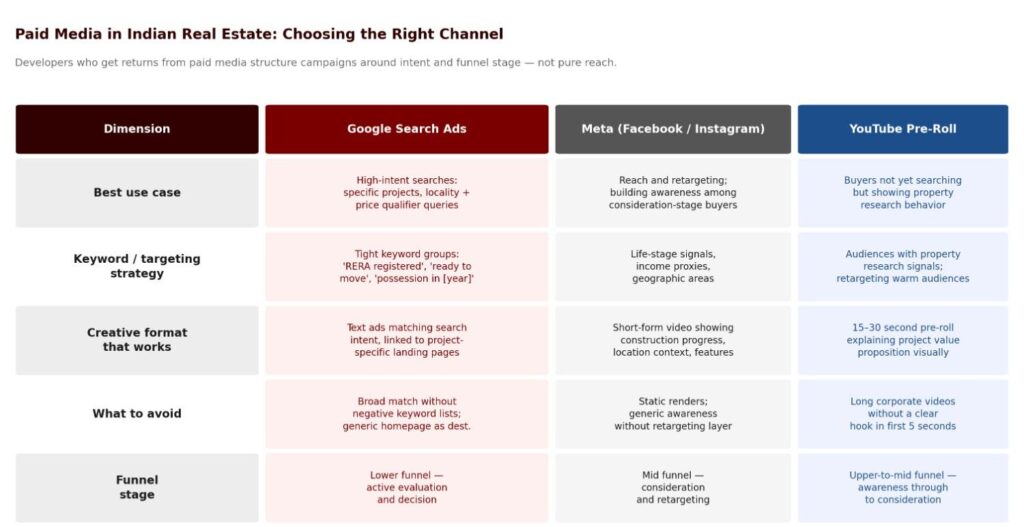
Google Search Ads work best when structured around specific project names, locality-qualified terms, and high-intent modifiers like “ready to move,” “RERA registered,” and “possession in [year].”
Broad match campaigns for generic terms burn the budget on low-quality traffic. Tight keyword groups with strong negative keyword lists and project-specific landing pages outperform broad awareness campaigns substantially.
Meta advertising (Facebook and Instagram) is well-suited for reach and retargeting in real estate, particularly for generating awareness among buyers in the consideration stage. The targeting capability for life-stage signals, income proxies, and geographic areas is strong.
But creative quality determines performance more than targeting precision at this point in the platform’s maturity. Static images of renders perform poorly. Video content, particularly short-form video showing construction progress, project features, and location context, generates materially better engagement.
YouTube pre-roll is underutilized by most real estate brands relative to its potential.
Video content that explains a project’s value proposition in 15 to 30 seconds, targeted at audiences showing property research behavior, can efficiently reach buyers who are not yet searching on Google but would engage with the right visual story.
Retargeting is non-negotiable. A buyer who visited your project page and did not convert is far more valuable than a cold audience member.
Retargeting sequences that show project-specific content to warm audiences, across Google Display, Meta, and YouTube, are consistently among the highest-ROI activities in a real estate paid media program.
What to stop spending on: Generic brand awareness campaigns that cannot be tied to inquiry volume. Portal lead packages that generate high volumes of contacts who have no genuine intent. And any paid activity that is not supported by a landing page and follow-up sequence built for conversion.
Social Media Strategy: What Works and Where
Social media marketing for Indian real estate suffers from a consistent strategic error: treating all platforms the same and measuring success by follower count rather than inquiry quality.
Instagram works well for aspirational visual content, particularly for premium and luxury projects.
Construction updates, design detail showcases, lifestyle content related to the project’s location, and short video walkthroughs perform in this environment.
The audience skews toward younger, urban, digitally engaged buyers. For affordable housing or Tier 2 city projects, Instagram reach may be smaller but can still be effective for building brand awareness.
Facebook remains the most effective organic social channel for reaching established-age buyer segments in India.
This is particularly true for those in the 35 to 55 bracket, making primary residence or investment decisions. Community building through project-specific Facebook groups, where buyers ask questions and share updates, creates social proof and loyalty that no advertising campaign can replicate.
YouTube has a compounding value that most real estate brands underestimate.
A library of project walkthrough videos, area guides, and buyer education content builds ongoing organic reach through search within YouTube itself, a search engine with enormous property research volume in India.
Videos published eighteen months ago continue generating views and inquiries if the keyword targeting is reasonable.
LinkedIn matters primarily for commercial real estate and for institutional outreach.
However, it does not have much impact on residential sales. Deploying a significant resource on LinkedIn for a residential developer with retail buyers serves little purpose.
Email and WhatsApp: The Conversion Channels That Close Deals
Lead generation is the beginning of the sales process, not the end. How you nurture inquiries between first contact and booking determines what percentage of your marketing investment converts to revenue.
Email marketing for real estate works best as a structured nurture sequence rather than a broadcast channel. An inquiry from someone who downloaded a brochure on Monday should trigger a sequence:
- a same-day acknowledgment with a specific follow-up offer,
- a construction update mid-week,
- a financing guide at day five,
- a testimonial video at day eight.
The content should match what they expressed interest in, not generic brand communications.
WhatsApp is the most underutilized digital marketing channel in Indian real estate, given how central it is to how Indians actually communicate. A WhatsApp Business account with a structured catalog, quick-reply templates for common inquiries, and a permission-based broadcast list for project updates operates as a direct line to interested buyers at essentially zero marginal cost. The open rates are dramatically higher than those of email. The response rates are higher still.
The caveat: WhatsApp communication requires discipline. Buyers who have opted into project updates expect relevant, timely information. Brands that send too frequently, or send irrelevant content, see immediate opt-outs and reputation damage.
The standard should be: Only send something when there is genuine news worth sharing.
Reputation Management as a Commercial Asset
In a sector where trust is the primary obstacle to conversion, online reputation is not a defensive consideration. It is an active commercial lever.
Prospective buyers in India now routinely search for reviews of developers before initiating contact.
- They check Google reviews.
- They search on MagicBricks, Housing.com, and 99acres review sections.
- They look for complaints on consumer forums.
- They ask for opinions in Facebook groups and housing communities.
What they find during that informal due diligence shapes whether they ever become a qualified inquiry.
The developers who manage this well do not simply respond to reviews. They
- Design touchpoints in the customer journey that encourage satisfied buyers to share their experience publicly.
- monitor mentions across platforms.
- Respond to negative reviews with specificity and transparency rather than defensive corporate language.
A thoughtful response to a genuine complaint that acknowledges the issue and explains what was done about it often builds more trust with prospective buyers than an unbroken string of five-star ratings.
RERA complaint history is now searchable. Online forums preserve project delay discussions indefinitely. Reputation in this market has a long memory. Investing in reputation management as a proactive function, not just a damage control response, reflects the commercial reality of how buyers make decisions.
Analytics: Measuring What Actually Drives Bookings
Real estate marketing has a measurement problem.
Marketing teams track
- digital metrics,
- leads,
- cost per lead,
- website sessions,
- campaign performance.
Sales teams track
- showroom visits,
- site visit rates, and
- bookings.
The two datasets rarely talk to each other, which means resource allocation decisions are based on incomplete information.
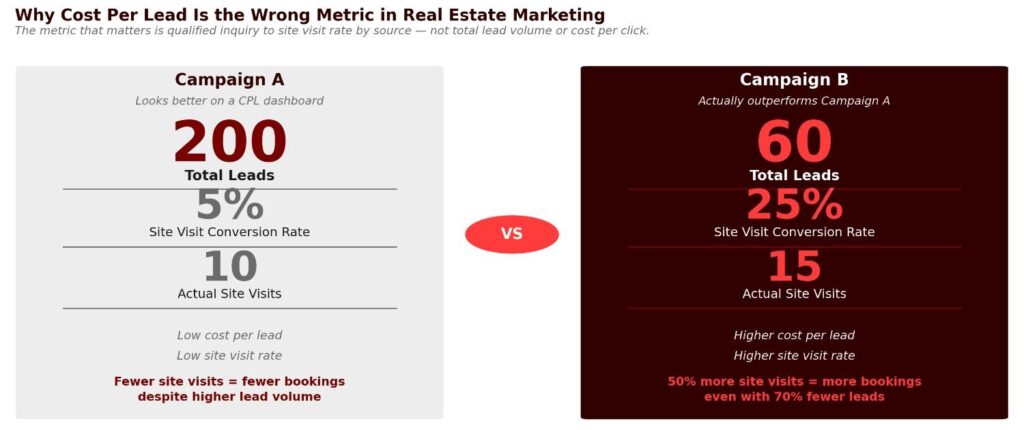
The metric that matters is qualified inquiry to site visit rate, by source. Not total lead volume. Not cost per click. The rate at which inquiries from a given channel convert to actual site visits is the most reliable leading indicator of bookings in residential real estate.
When you have that data by channel, the comparison becomes honest. A campaign that generates two hundred leads at a low cost per lead but converts five percent to site visits is outperformed by a campaign that generates sixty leads at a higher cost but converts twenty-five percent, even though the second campaign looks worse on a cost per lead dashboard.
Setting up that attribution requires connecting your marketing platforms to your CRM and tracking source through the entire pipeline. It is a more complex infrastructure than most real estate marketers have built, but the commercial decisions it enables are worth the investment.
The Strategic Architecture
Digital marketing for Indian real estate is not a collection of tactics. It is a system designed to build trust incrementally across a buyer journey that spans weeks or months, to be visible at every research touchpoint, and to convert that visibility into qualified interactions that a sales team can work with.
The brands that build this effectively treat organic search, content, paid media, social, and email not as separate channel budgets but as connected components of a single pipeline.
They measure them by their contribution to qualified inquiries and site visits, not by their individual channel metrics. And they invest in the foundational elements, website quality, content depth, local SEO infrastructure, and reputation management.
These investments compound in value over time rather than reset with every campaign cycle.
That is the version of real estate digital marketing worth building.
Want to Have a Solid Digital Marketing Pipeline for Your Real Estate Business?
If you want to understand where your current inquiry pipeline is leaking, or how your digital presence compares against what developers in your market segment are building, a structured audit gives you an honest starting point. Request a teardown and get a clear read on where the highest-leverage changes are.