The most common way SEO teams are using ChatGPT right now is also the least effective: Generating content at volume and hoping search performance follows. It does not, at least not in any durable way.
The teams extracting genuine value from AI in their SEO workflows are using it for a different set of tasks entirely, ones that accelerate research, systematize optimization, and free up human editorial capacity for the work that actually requires judgment.
This guide covers how to use ChatGPT effectively across the SEO workflow, with specific prompts that produce useful outputs and honest context about where the tool’s limitations require human intervention.
How to Think About ChatGPT’s Role in an SEO Workflow
Before getting into specific prompts, here’s a framing that will save you from the most common mistakes: ChatGPT is a pattern-recognition and text-generation system trained on existing content. It is structurally excellent at tasks that require synthesizing established knowledge, generating structured outputs from defined inputs, and producing first drafts of content types that follow recognizable patterns.
It is structurally poor at tasks that require original insight, current data, brand-specific voice, or the kind of nuanced strategic judgment that comes from working in a specific industry or with specific customers.
This means the highest-value use cases for ChatGPT in SEO are:
- research acceleration,
- structural ideation,
- optimization task execution, and
- draft generation for content that will be substantially edited by a subject-matter expert.
The lowest-value use cases are:
- publishing AI-generated content without expert review,
- using it to replace keyword research tools, or
- treating its content recommendations as a substitute for audience intelligence.
Google’s position on AI-generated content is worth understanding accurately: The search quality guidelines focus on whether content demonstrates genuine expertise, experience, authority, and trustworthiness, not on how it was produced. AI-generated content that passes those tests can rank. AI-generated content that reads like an average of everything already published does not, because it does not give users anything they could not find elsewhere.
Keyword Research: Where ChatGPT Adds Real Value
ChatGPT is not a keyword research tool. It does not have access to search volume data, keyword difficulty scores, or current search trends. Using it as a substitute for Ahrefs, SEMrush, or Google Search Console will produce unreliable outputs.
What it is useful for in keyword research:
- expanding your thinking about how audiences describe problems,
- generating semantic variations you might not have considered, and
- mapping intent categories against your existing keyword list.
Prompt 1: Audience language mapping
“I’m doing keyword research for a [describe product/service] targeting [specific audience]. List 20 ways this audience might describe their problem before they know our solution exists. Use informal, conversational language, not marketing language.”
Why this works: The output gives you the vocabulary your audience uses at the top of the funnel before they have searched for your specific offering. These phrases are often more useful for content strategy than bottom-funnel transactional keywords.
Prompt 2: Search intent classification
“Here is a list of keywords related to [topic]: [paste keyword list]. For each keyword, classify the likely search intent as informational, commercial investigation, or transactional. Then suggest which content format would best serve each intent.”
This is a fast way to sort a keyword list by funnel stage when you are planning content architecture. Review the output critically because intent classification is occasionally wrong for ambiguous keywords.
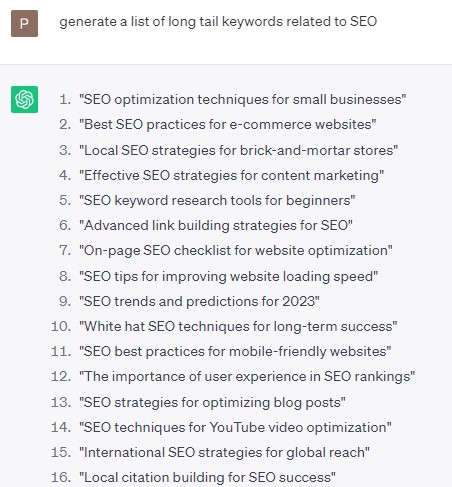
Prompt 3: Long-tail expansion from a seed keyword
“Generate 30 specific long-tail keyword variations for the seed keyword [keyword]. Focus on variations that indicate a specific problem, use case, or audience segment rather than general interest in the topic.”
The output quality here depends heavily on how specific your prompt is. A vague seed keyword produces vague long-tail variations. A specific seed keyword with defined context produces variations worth evaluating against search volume data in your actual keyword tools.
Prompt 4: Competitor content gap analysis
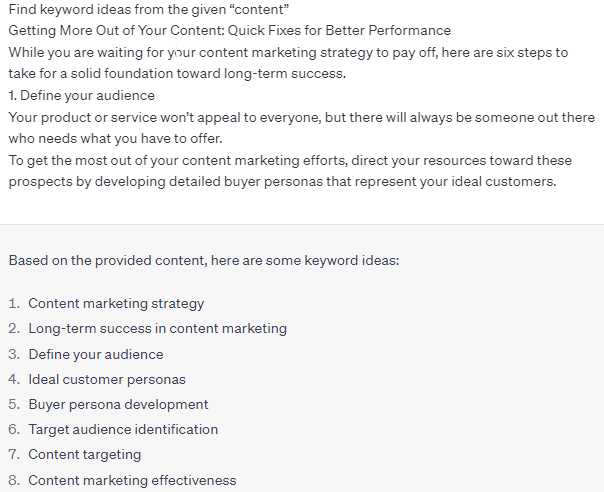
“Here is a list of keywords our competitor is ranking for: [paste list]. Identify patterns in these keywords that suggest topics or audience segments we may not be addressing. Group them into thematic clusters and suggest the intent behind each cluster.”
This works best when you are feeding it a real keyword list extracted from a competitive intelligence tool rather than asking it to generate a hypothetical competitor’s keyword set.
Content Creation: Using ChatGPT as a Starting Point
The workflows that produce genuinely useful content with AI assistance involve significant human editorial input at the draft and review stages. The prompts below are designed to produce outputs worth editing, not outputs worth publishing as written.
Prompt 5: Content brief generation
“Create a detailed content brief for an article targeting the keyword [keyword] for an audience of [describe audience]. The brief should include: recommended title, suggested H2 structure, key questions the article must answer, entities and concepts to cover, and what a competing article typically misses that this piece should address.”
The content brief output is usually 70-80% usable. The section on what competing articles miss is the part most worth reviewing critically, since ChatGPT’s knowledge is limited to its training data and may not reflect current SERP reality.
Prompt 6: Outline generation with strategic framing
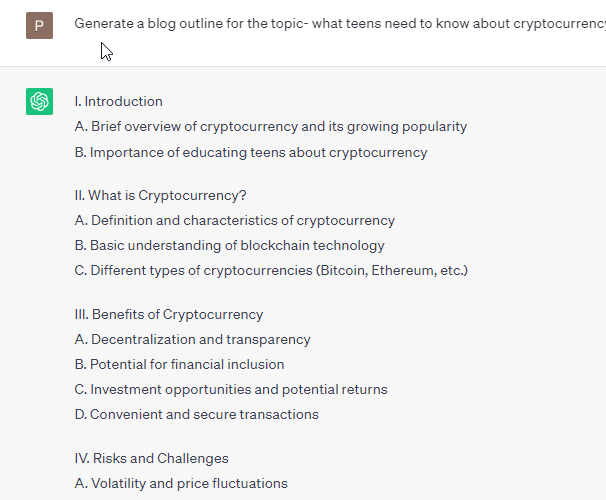
“Create a detailed outline for a [word count] article on [topic] targeting [audience]. The article should follow an Awareness to Decision journey, starting with the reader’s problem, building to strategic understanding, and ending with a clear action framework. Include suggested H2s, H3s, and brief notes on what each section should accomplish.”
This prompt produces structural scaffolding that is useful for organizing your own subject-matter expertise. The outline tells you what to write about. Your expertise determines what you actually say.
Prompt 7: FAQ generation for a service or product page
“Generate 15 specific, commercially relevant FAQs for a page about [product/service] targeting [audience]. Include questions that reflect purchase hesitations, comparison questions, and questions that indicate the user is close to making a decision. Provide concise, direct answers to each.”
FAQ content generated this way is useful for both the page itself and for identifying schema markup opportunities. Review the questions to ensure they reflect your actual customer experience, not generic category questions.
Prompt 8: Blog post introduction variants
“Write 5 different opening paragraphs for an article about [topic]. Each should use a different hook approach: a counter-intuitive claim, a specific scenario, a direct challenge to conventional wisdom, a data-driven observation, and a question that reframes the reader’s understanding of the topic. Keep each under 100 words.”
Generating multiple opening options and selecting the strongest is a more efficient use of AI than asking it to write a single introduction, because the variation gives you something to evaluate rather than something to accept by default.
Prompt 9: Product description optimization
“Rewrite this product description [paste existing copy] for two different audiences: [audience A] who cares primarily about [benefit A], and [audience B] who cares primarily about [benefit B]. Keep each version under 150 words. Emphasize outcomes over features, and use the language each audience uses, not marketing language.”
Product descriptions are a high-volume content type where AI assistance produces significant time savings with manageable review requirements.
On-Page SEO: Systematic Optimization at Scale
ChatGPT is well-suited for the systematic, pattern-based tasks in on-page SEO because these tasks have clear inputs, established best practices, and outputs that can be reviewed efficiently.
Prompt 10: Meta title and description generation
“Write 5 meta title options and 3 meta description options for a page targeting the keyword [keyword]. The page is about [brief description]. Meta titles should be under 60 characters and lead with the primary keyword. Meta descriptions should be under 155 characters, include a clear value proposition, and have a soft call to action. Avoid generic phrasing.”
Always generate multiple options and select based on which best matches your brand voice and the specific page’s conversion intent. The first option is rarely the best.
Prompt 11: Image alt text for a product or content page
“Write descriptive alt text for the following images on a page about [topic]: [describe each image briefly]. Alt text should accurately describe the image content, include relevant keywords where natural, and stay under 125 characters. Do not start with ‘image of’ or ‘photo of’.”
This is a genuine time-saver for e-commerce sites with large image libraries where alt text is systematically neglected.
Prompt 12: Internal linking opportunity identification
“Here is a list of articles on our website: [paste titles or URLs with brief descriptions]. For a new article about [topic], suggest which existing articles are most relevant for internal linking, what anchor text would be appropriate for each link, and where in the new article structure each link would best appear.”
The output is useful as a starting framework. Verify that the suggested anchor text accurately represents the linked page’s content before implementing.
Prompt 13: Schema markup generation
“Generate JSON-LD schema markup for a [page type: article, product, FAQ, local business, etc.] with the following details: [provide relevant structured data including name, description, relevant attributes]. Format it correctly for Google’s structured data requirements.”
Review schema markup outputs against Google’s structured data documentation before implementation. ChatGPT occasionally generates technically incorrect schema, particularly for more complex schema types.
Prompt 14: Heading structure audit and improvement
“Here is the current heading structure of my article: [paste H1, H2, H3 list]. The target keyword is [keyword]. Identify any structural problems with this outline and suggest an improved heading structure that better signals content organization to search engines and creates a clearer reading flow for the audience.”
Technical SEO: Support, Not a Substitute for Audits
ChatGPT can explain technical SEO concepts, help draft documentation, and generate code snippets, but it cannot actually audit your website.
Prompts that ask it to “audit” a URL will produce generic observations, not site-specific findings.
Prompt 15: Robots.txt review guidance
“Here is my current robots.txt file: [paste content]. Explain what each directive does, identify any potential issues, and suggest improvements for a website that wants to allow indexing of all content pages while blocking admin and checkout pages.”
Prompt 16: Hreflang tag generation for international SEO
“Generate hreflang tags for a website that has English content for the United States, United Kingdom, and Australia, and Hindi content for India. The base URL structure is [describe URL structure]. Include the x-default tag appropriately.”
Review hreflang output carefully. The logic of x-default assignment and region versus language targeting is an area where AI outputs sometimes contain subtle errors.
Prompt 17: XML sitemap structure guidance
“Explain how to structure an XML sitemap for a website with [describe site structure: e-commerce with product, category, and blog pages / or corporate site with services, case studies, and resources]. Include guidance on sitemap indexing for a site with over 10,000 pages, and what pages should be excluded.”
Prompt 18: Core Web Vitals improvement suggestions by symptom
“My website has a poor Largest Contentful Paint score. The main content of the page is a hero image followed by a text block. Describe the most common technical causes of LCP problems in this page structure and the specific fixes for each, in order of typical impact.”
Link Building: Research and Outreach Assistance
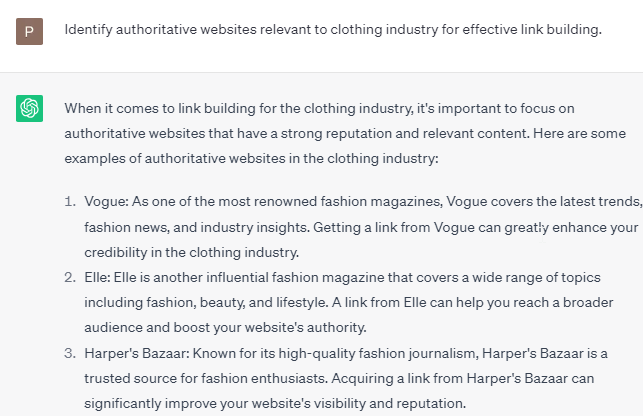
ChatGPT cannot identify actual link opportunities because it does not have access to current web data. What it can do is assist with the research framing and outreach execution.
Prompt 19: Outreach email drafts
“Write a link building outreach email for a website in the [industry] space. We want to request a link from [type of site: resource page, editorial blog, industry directory]. Our content offering is [describe what you are linking to and why it is valuable]. The email should be under 200 words, lead with value to the recipient, avoid generic phrases like ‘I came across your site,’ and not sound like a mass outreach template.”
Outreach emails from ChatGPT require significant personalization before sending. Use the output as a structural template, then add specific details about the recipient’s site and why your content is relevant to their specific audience.
Prompt 20: Guest post pitch angles
“I want to pitch a guest post to [type of publication] in the [industry] space. Generate 10 specific article topic ideas that would appeal to their editorial team. The topics should reflect genuine expertise in [your area of expertise], serve their audience’s interests, and provide a natural opportunity to reference [your content or brand] as context.”

Prompt 21: Follow-up email sequence
“Write a two-email follow-up sequence for link-building outreach that has not received a response after 7 days. The follow-up should be brief, add a small additional value point, and assume the original email was read but not prioritized. Avoid being aggressive or guilt-inducing.”
Social Media and Content Distribution Support
Prompt 22: Social media variants from a long-form article
“Here is a 2,000-word article on [topic]: [paste article]. Generate: three LinkedIn posts adapted from the key insights (each under 250 words with a distinct angle), five Twitter/X posts that pull specific data points or claims from the article, and two different Instagram caption variations with suggested hashtag categories.”
This is one of the most efficient ChatGPT use cases in content marketing because it takes existing intellectual work and systematically adapts it for distribution without requiring the AI to generate original insight.
Prompt 23: Hashtag research and categorization
“Generate a categorized hashtag strategy for content about [topic] on [platform]. Include: five broad reach hashtags, ten mid-tier community hashtags, and five niche, highly-specific hashtags. Explain the engagement dynamic of each tier.”
Verify hashtag suggestions against actual platform performance before committing to a strategy. ChatGPT’s training data has a knowledge cutoff and cannot reflect current hashtag trends.

Advanced Prompting: Getting Better Outputs
The quality of ChatGPT outputs is directly determined by prompt quality. The most common reason for disappointing results is vague or underspecified prompts that leave the model too much latitude to default to generic responses.
Specificity principle
Every variable that is left unspecified in a prompt will be filled in by the model with the most average, generic option from its training data. Specify your audience, your industry, your content goals, your brand voice, and the constraints you are working within.
Role assignment
To consistently produce more focused outputs than prompts without a role context, try prompts that begin with
- “Act as a [specific expert] with [specific experience] working on [specific problem]”
Output format specification
If you want a structured output, specify the format explicitly. Prompts that produce structured outputs that are easier to work with than prose include:
- “Return this as a table with columns for [specify]”
- “format this as a JSON object with the following fields”
Iteration
The first output from any non-trivial prompt is rarely the best. To produce progressively better outputs, prompting for revisions with specific direction can be done using
- “make the tone more direct and less promotional”
- “shorten each point to two sentences maximum”
- “add specific examples for each recommendation”
A practical template that combines these principles:
“Act as a [specific role] with 10 years of experience working with [specific industry]. I need [specific output] for [specific audience] with [specific constraints]. The tone should be [describe tone]. Format the output as [specify format]. Avoid [list what to avoid].”
What ChatGPT Cannot Do in SEO, and Why This Matters
Being clear about limitations prevents teams from building workflows that fail silently.
ChatGPT does not have access to
- real-time search data,
- current keyword volumes,
- live SERP analysis, or
- current competitor rankings.
Any prompt asking it to perform these functions will produce fabricated or outdated information.
It cannot replace a technical SEO audit. A prompt asking it to identify your site’s indexing issues or crawl errors cannot work without actual site access. Use Screaming Frog, Google Search Console, or a dedicated audit tool for this.
Its knowledge has a training cutoff date, which means recent algorithm updates, newly emerged ranking factors, and current search trends are outside its reliable knowledge base.
And it cannot produce the kind of differentiated, experience-based content that builds topical authority in competitive search categories. That requires people with direct expertise who can articulate observations that are not already present in the existing corpus of published content.
The SEO teams using ChatGPT most effectively have integrated it as an efficiency layer in existing workflows, not as a replacement for the strategic and editorial judgment that determines whether their content actually competes in search.
Planning to Streamline Your Workflow with ChatGPT?
If you want to assess how AI tools fit into your current SEO workflow and where the highest-leverage opportunities are for your specific content program, that is a practical conversation worth having.