
Most dental clinics that invest in digital marketing are doing the basics adequately and the important things poorly.
They have a website. They have a Google listing. They may even be running some ads. But they lack the strategic architecture that turns those individual tactics into a predictable, compounding patient acquisition system.
This guide is not a list of things to try.
It is a structured approach to building a digital presence that generates consistent new patient bookings, protects your reputation, and builds the kind of local authority that makes your practice the default choice in your area over time.
Why Digital Marketing Matters More for Dental Practices
Healthcare decisions, including choosing a dentist, are among the highest-consideration purchases a consumer makes. The decision process involves trust signals, proximity, social proof, and reputation in a way that most consumer categories do not. A patient selecting a dental clinic is not primarily optimizing for price. They are looking for evidence that the practice is competent, accessible, and trustworthy.
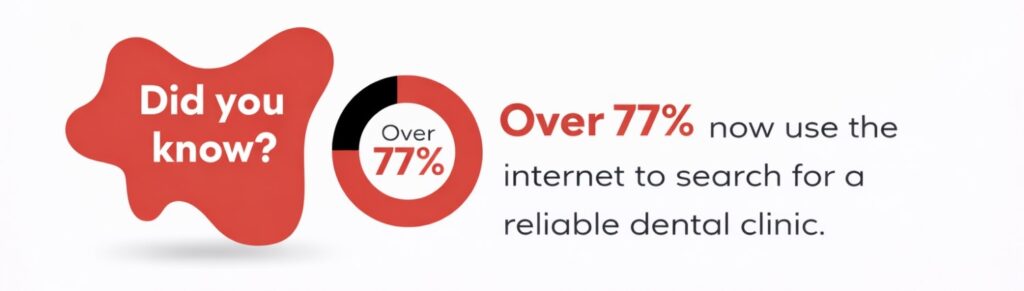
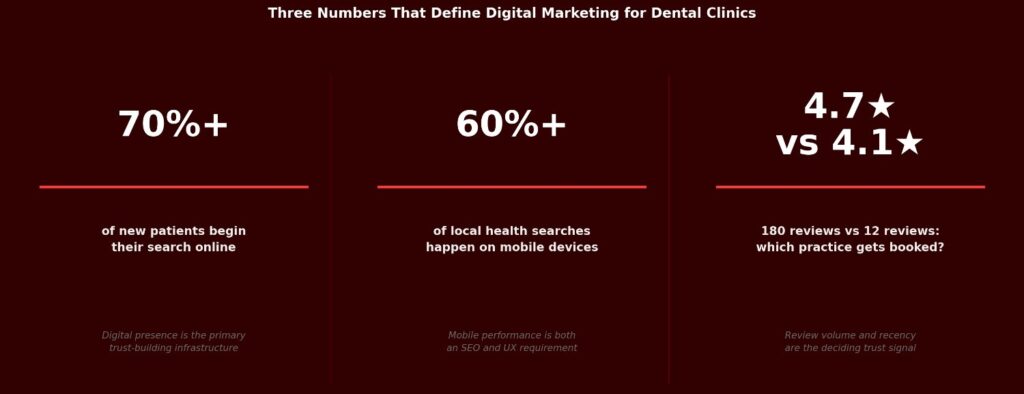
This means your digital presence is not just a marketing channel. It is the primary trust-building infrastructure for every potential patient who does not already know you. For most practices, over 70% of new patients now begin their search online before ever contacting the clinic. If your digital presence does not establish credibility and remove hesitation, the clinical quality of your work is irrelevant to that prospective patient.
The practices with strong digital presences are not necessarily doing more marketing than their competitors. They are doing it more intentionally, with a clearer understanding of what moves a potential patient from search query to booked appointment.
The Stepping Stones of Digital Marketing for Dental Practices
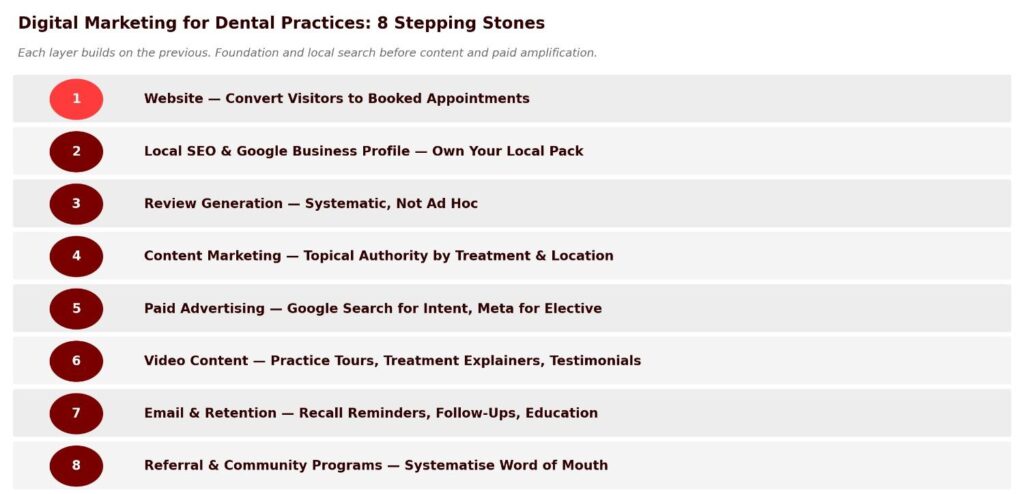
1. The Foundation: Your Website as a Patient Acquisition Asset
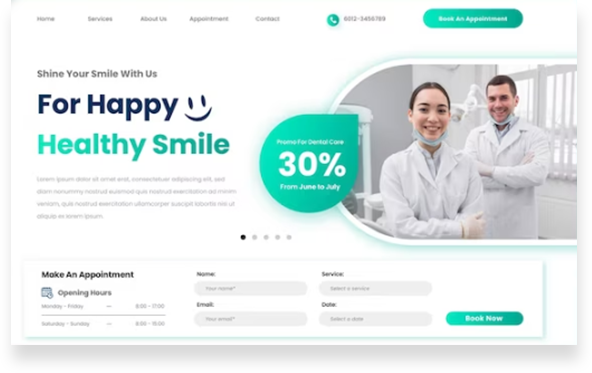
The primary function of a dental clinic website is not to look professional. It is to convert visitors, meaning to move someone from browsing to booking. These are related but different objectives, and most dental websites are optimized for the former at the expense of the latter.
What high-converting dental websites do differently
They make the booking action frictionless. Online appointment booking, ideally without requiring a phone call, is now an expectation rather than a differentiator. Practices that require patients to call during business hours to book are losing a meaningful proportion of after-hours search traffic to competitors who offer instant booking.
They answer the questions patients are actually asking before the consultation.
- What does a root canal actually involve?
- Will it hurt?
- What does the practice’s approach to anxious patients look like?
- Is the practice accepting new patients?
- What insurance or payment plans are accepted?
These are not objections to handle at the reception. They are decision factors that, when addressed clearly on the website, directly increase conversion rates from visitor to booking.
They present social proof where it matters in the decision journey. Patient testimonials, Google review ratings, and before-and-after treatment photography (with appropriate consent) should appear on high-traffic pages, not just buried on a dedicated testimonials page that most visitors never reach.
Technical baseline requirements
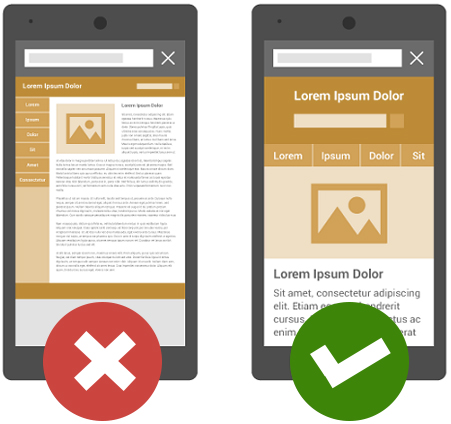
Mobile performance is non-negotiable. Over 60% of local health searches happen on mobile devices, and Google’s ranking algorithm uses mobile experience as a primary ranking signal. A website that loads slowly or displays poorly on mobile is both a user experience failure and an SEO liability.
Core Web Vitals, specifically Largest Contentful Paint, First Input Delay, and Cumulative Layout Shift, are the technical performance metrics that translate most directly to both user experience quality and Google’s assessment of your page quality. Running a Google PageSpeed Insights test on your key pages is a reasonable starting point for identifying what needs attention.
HTTPS security is now table stakes. An insecure site creates visible trust warnings in most browsers, which is a particularly damaging signal for a healthcare provider, where trust is the primary purchase driver.
2. Local SEO: The Highest-ROI Channel for Dental Clinics
For a geographically constrained service like a dental clinic, local search visibility is the single most important digital marketing variable.
A practice that ranks consistently for “dentist near me,” “dental clinic [suburb],” and category-specific queries like “cosmetic dentist [city]” is capturing the highest-intent, ready-to-book traffic available.
Google Business Profile as a revenue asset
Your Google Business Profile is typically the first impression a potential patient has of your practice in search results. It surfaces in Google Maps and the local pack before organic website listings, and for mobile searches. It is often the only result the user engages with before calling or navigating.
Managing this profile actively, not just claiming it, is one of the most time-efficient digital marketing investments available to a dental practice.
What active management looks like:
- keeping hours, phone number, and address current;
- publishing photos of the practice interior, team, and technology regularly;
- responding to every review within 48 hours;
- using the Q&A section to answer common pre-consultation questions; and
- posting updates about new services, special offers, or team additions.
The practices that consistently appear in the Google Maps local pack across relevant local search queries share common characteristics:
- high review volume,
- high review recency,
- high response rate to reviews,
- complete and accurate profile information, and
- consistent NAP (name, address, phone number) information across directories.
These are operational habits, not technical interventions.
Review generation as a systematic process
Online review volume and recency are significant factors in local pack ranking, and more importantly, they are primary conversion drivers for health service decisions. A practice with 12 Google reviews averaging 4.1 stars is objectively less credible to a new patient than one with 180 reviews averaging 4.7 stars, regardless of the actual quality of care.

The mistake most practices make: Asking for reviews ad hoc, depending on staff remembering, rather than building review generation into the patient discharge workflow. A simple, consistent process where satisfied patients receive a direct review link via SMS immediately after their appointment outperforms irregular verbal requests.
What to avoid:
- incentivizing reviews,
- soliciting reviews only from patients you expect to rate positively, or
- using platforms to artificially inflate your review count.
These approaches violate Google’s policies and, in the healthcare context, also have ethical implications.
Responding to negative reviews without making them worse
Negative reviews require a response, but the response needs to be carefully calibrated. Healthcare privacy regulations restrict what you can confirm or deny about a patient’s experience. A response that inadvertently confirms a patient relationship or discloses treatment details can create compliance issues more serious than the negative review itself.
The correct approach:
- acknowledge the feedback,
- express a general commitment to patient experience, and
- invite the person to contact the practice directly to discuss their concern.
Do not argue the facts of the specific incident publicly. Do not be dismissive.
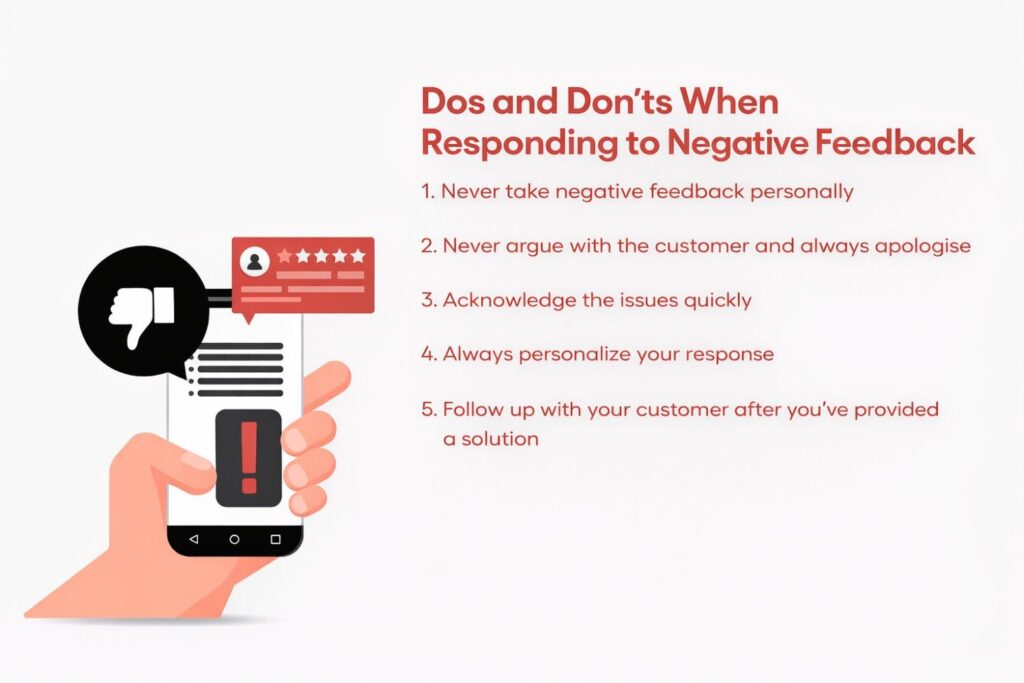
Brief, professional, and empathetic responses to negative reviews actually increase trust with prospective patients who read them, because they demonstrate how the practice handles difficult situations.
3. Content Marketing: Building Long-Term Search Visibility
Content marketing for dental practices is not about producing blog posts for the sake of content volume. It is about building topical authority in local search for the specific treatments and patient concerns that drive revenue for your practice.
The content investment that delivers the best long-term return is structured around the questions patients ask at different stages of the decision process.
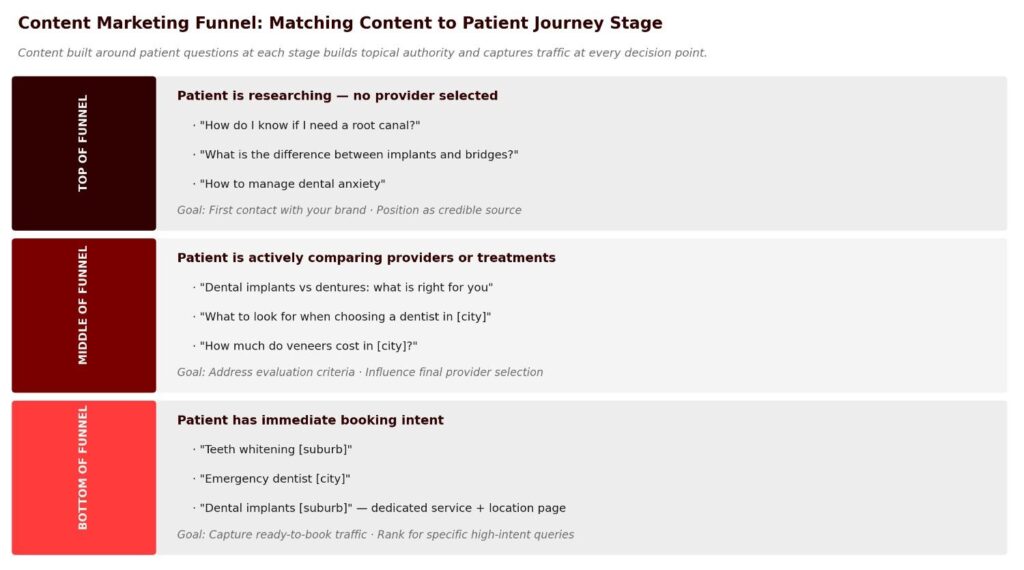
Top-of-funnel educational content captures patients in the research phase.
Pages that address questions like “how do I know if I need a root canal,” “what is the difference between dental implants and bridges,” or “how to manage dental anxiety” attract patients before they have selected a provider.
Ranking for these queries creates the first point of contact with your brand and positions your practice as a credible source before the booking decision is made.
Middle-funnel comparison and evaluation content serves patients who are actively comparing providers or treatment options.
Content like “dental implants vs dentures: what is right for you,” “what to look for when choosing a dentist in [city],” or “how much do veneers cost in [city]” addresses the specific evaluation criteria that drive final provider selection.
Bottom-funnel service and location pages capture patients with immediate booking intent.
Dedicated pages for each major service, each location if you operate multiple clinics, and each suburb or area you serve allow you to rank for specific high-intent queries like “teeth whitening [suburb]” or “emergency dentist [city].”
The critical execution requirement: Each page must be substantive, specific, and written with genuine clinical knowledge evident in the content.
Thin or generic service pages do not rank in competitive local markets. The practices with strong organic visibility have pages that genuinely explain the treatment, address patient concerns, outline the process, and give patients enough information to feel confident about booking.
4. Paid Advertising: What Works and What Wastes Budget
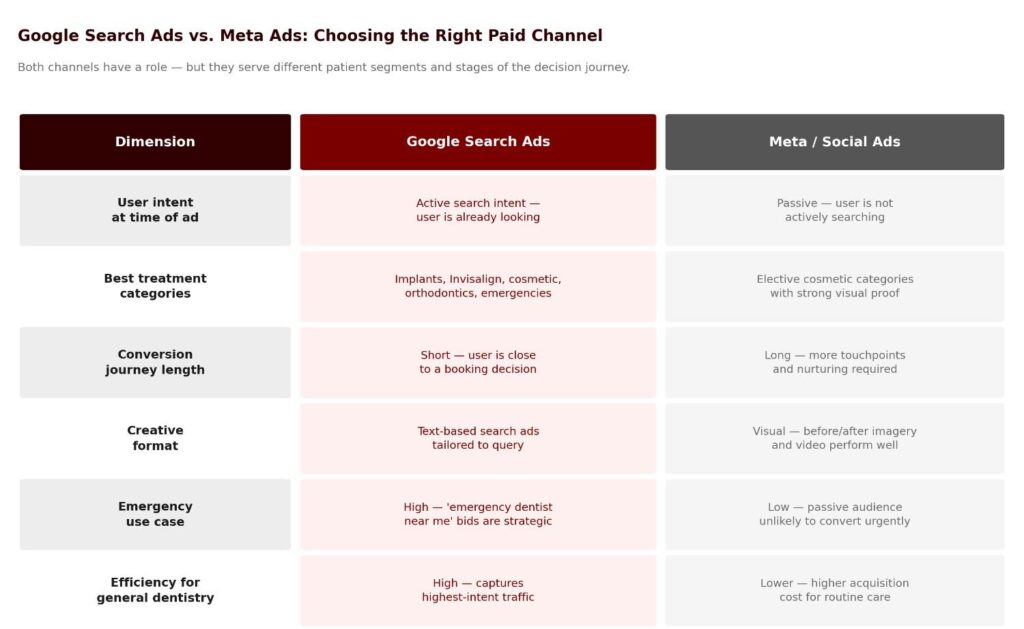
Google Search advertising for dental clinics can deliver high-quality patient acquisition, but the economics depend almost entirely on campaign structure and conversion infrastructure.

Running broadly targeted ads to a website with a poor booking experience is an efficient way to spend a significant budget for disappointing results.
The campaigns worth running
Branded search campaigns protect your name from competitor bidding and typically produce the lowest CPA in the account. For a practice with any meaningful brand awareness in the local market, branded campaigns are worth running at modest spend.
High-value treatments like implants, Invisalign, cosmetic dentistry, and orthodontics deserve their own focused campaigns. These services bring significantly higher patient lifetime value, which makes higher CPCs not just acceptable but strategic.
Instead of sending all traffic to a generic homepage, create dedicated campaigns with tailored landing pages for each treatment. This improves relevance, increases conversion rates, and ensures your ad spend is working where it matters most.
Emergency dental queries, “emergency dentist near me” and related variants, represent the highest-intent local search category for dental practices. These users have an immediate need and are making a same-session decision. If your practice handles dental emergencies, these queries are worth bidding on even at aggressive CPCs.
What to avoid
Broad match campaigns without negative keyword management waste budget on searches with no appointment intent. Vanity metric optimization, running campaigns toward impression volume or click volume rather than appointment bookings or calls, produces activity without revenue. And running campaigns without tracking call conversions means you are optimizing blind, because a significant proportion of dental appointment conversions happen by phone, not online form.
Meta and social advertising
Social advertising for dental practices works best for elective or cosmetic treatment categories where before-and-after imagery creates visual proof of outcomes. Teeth straightening, cosmetic whitening, and smile makeover categories have visual storytelling potential that search advertising does not.
For general dentistry and routine care, social media advertising is typically less efficient than search for patient acquisition. Unlike search, where users already have intent, social requires you to interrupt someone who isn’t actively looking for a dentist.
This creates a longer conversion journey. This means more touchpoints, more nurturing, and ultimately higher acquisition costs.
5. Video Content: The Highest-Engagement Format in Dentistry
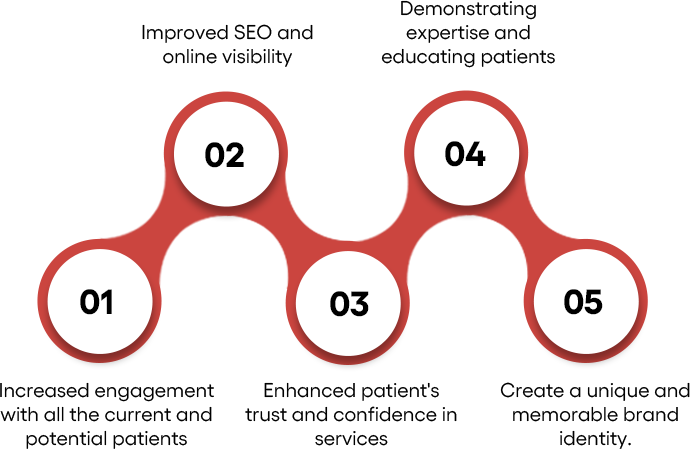
Video consistently outperforms static content for healthcare decisions because it addresses the trust and anxiety dimensions of the patient experience in ways text cannot.
The formats worth investing in:
Practice tour and team introduction videos reduce new patient anxiety by giving them a preview of the environment and the people they will encounter.
This is particularly valuable for patients with dental anxiety, who represent a significant proportion of adults who delay dental care. A practice tour video on your website and Google Business Profile addresses a real patient concern before they arrive.
Treatment explanation videos for complex or anxiety-inducing procedures, such as root canals, implants, or extractions, serve both as educational content and as anxiety-reduction tools.
A short, clear explanation of what the patient will experience, presented by a clinician in a calm and professional manner, converts at higher rates than text equivalents for these procedure categories.
Patient testimonial videos carry more credibility than written reviews because they are harder to fabricate and allow potential patients to see and hear from people like themselves.
For elective treatments where outcome quality is the primary decision factor, authentic video testimonials are among the most effective conversion assets a practice can produce.
The production requirement does not need to be studio quality. Authentic, well-lit videos recorded in the practice environment with clear audio consistently outperform polished corporate videos in healthcare trust contexts. The patient is evaluating whether this feels real and whether this practice feels like somewhere they would be comfortable. Authenticity serves that evaluation better than production value.
6. Email Marketing and Patient Retention
The economics of patient retention are straightforward: a patient retained is a patient you did not have to pay to acquire again. For dental practices, where recall visits, family referrals, and treatment upgrades represent a significant proportion of revenue, retention marketing directly affects practice profitability.
Email is the most cost-effective retention channel for most dental practices because the cost per communication is near zero once the infrastructure is in place, and the audience is already patients who have chosen you.
What an effective practice email program looks like
Automated recall reminders, timed to each patient’s recall interval, are the baseline. These should be personalized to the individual patient’s name and scheduled timing, not generic “it’s time to book your checkup” blasts.
Treatment follow-up emails post-procedure, checking on recovery and satisfaction, serve dual purposes: They demonstrate care for the patient, which builds loyalty, and they create a natural opening for requesting a review when the experience is positive.
Educational content sent on a reasonable cadence, once or twice monthly at most, keeps your practice visible to patients between visits without becoming intrusive.
The content should be genuinely useful: seasonal oral health reminders, explanations of new technologies or treatments now available at the practice, or honest information about common dental conditions.
The mistake to avoid:
Purchasing email lists or sending to patients who have not explicitly opted in to communication. In regulated healthcare markets, unsolicited health communications create compliance risk and, more practically, produce poor open rates and active unsubscribes that damage your sender reputation over time.
7. Virtual Consultations and Telemedicine: When It Adds Value
Virtual consultations are a genuine competitive differentiator for a specific patient segment: Those with high dental anxiety who benefit from a low-stakes first interaction before committing to an in-person visit, and those evaluating elective or cosmetic treatments who want to discuss options and costs before booking a clinical appointment.
For routine care and emergencies, virtual consultations add limited value because the clinical assessment requires in-person examination.
Positioning virtual consultations as the appropriate entry point for new patients evaluating cosmetic treatments, orthodontics, or implants creates a lower-friction initial touchpoint that increases the likelihood of eventual booking.
The operational requirement: Someone needs to be available to conduct these consultations promptly. A virtual consultation offering that books appointments two weeks out is not a patient experience improvement. It needs to be positioned correctly in terms of response time and who will conduct it.
8. Community and Referral Programs
Patient referrals remain one of the highest-LTV acquisition channels for dental practices because referred patients arrive with pre-built trust, accept treatment recommendations more readily, and retain at higher rates than patients acquired through advertising.
A structured referral program removes dependence on passive word-of-mouth and creates a systematic mechanism for referral generation.
The most effective structures are simple: A defined incentive for both the referring patient and the new patient, clear communication about how the program works, and consistent execution at the front desk.
Community engagement, whether through school health education programs, local corporate health partnerships, or community event sponsorship, builds the kind of local brand awareness that creates organic search and referral volume over time. These investments do not produce immediate measurable ROI, but they contribute to the reputation capital that makes every other channel more efficient.
Measurement: The Must-Have Analytics Infrastructure
The most common gap in dental clinic digital marketing is not activity. It is attribution. Most practices do not know which marketing activities are generating new patient bookings because they have not connected their marketing data to their appointment data.
The minimum measurement infrastructure worth establishing:
- Google Analytics with conversion tracking for online appointment form completions,
- call tracking that attributes phone calls to the specific campaign or page that drove them, and
- a monthly review of Google Business Profile insights showing calls, direction requests, and website visits from the profile.
With this data, you can answer the question that matters: which marketing investment is generating the lowest cost per new patient booking? That answer should drive your budget allocation decisions, not marketing convention or vendor recommendations.
Key metrics to track monthly:
- New patient booking volume by acquisition source,
- Website conversion rate for booking actions by page and device type,
- Google review volume and rating trend, and
- Google Maps ranking for your key local search queries.
These data points give you a reasonably complete picture of local digital marketing performance without requiring sophisticated analytics capability.
Prepped to Build the Online Visibility of Your Dental Practice?
Building a digital presence that reliably generates new patients for a dental practice is not a complex undertaking, but it does require intentional strategy and consistent execution over time. The practices that have built strong local digital authority did not get there through any single campaign. They got there by consistently doing the fundamentals well, measuring what works, and compounding the advantage over months and years.
If you want an objective assessment of where your current digital presence has gaps and where the highest-leverage improvements are, a structured practice audit is the clearest starting point.