Spending on Instagram posts and ignoring Google is the single most common reason good restaurants stay invisible. A channel-first strategy changes that, and it compounds over time.
Why Kolkata’s Restaurant Market Rewards Digital Operators
Kolkata’s food scene is genuinely competitive in a way that few Indian cities are. The density of dining options per square kilometre in areas like Park Street, Salt Lake, or Behala is high, and consumer loyalty is fragile when discovery happens through aggregators that surface five alternatives the moment your rating dips.
The operators who are growing profitably share one thing: They treat digital marketing as infrastructure, not advertising. Not something you spend on when bookings are slow. Something you build so that slow seasons don’t happen the same way twice.
That shift in framing matters because it changes
- which tactics you prioritise,
- how long you give them before evaluating, and
- whether you measure the right outcomes.
Footfall and covers matter. Cost per acquisition matters. Repeat visit rate matters. Ranking positions, follower counts, and impressions are inputs, not outputs.
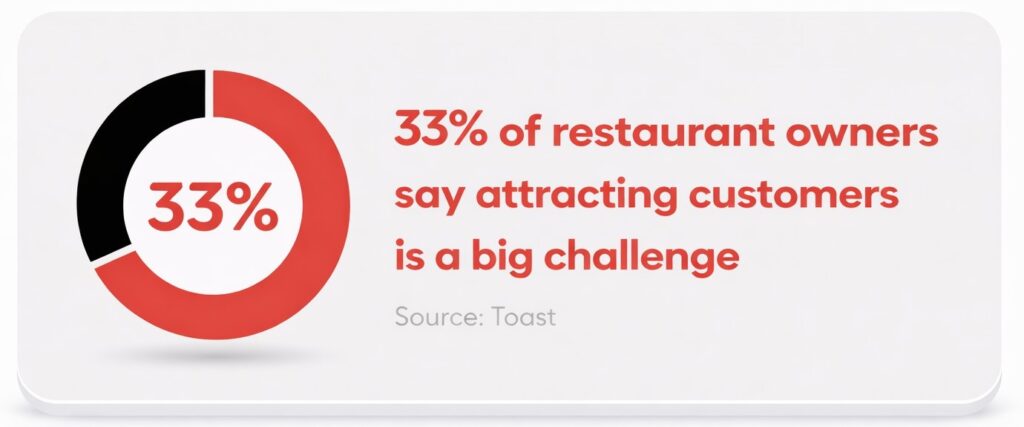
78% of restaurant searches lead to a visit within 24 hours
92% of diners check reviews before choosing a new restaurant
4x higher conversion rate for searches with “near me” intent
These numbers are not specific to Kolkata, but the behaviour they describe absolutely is.
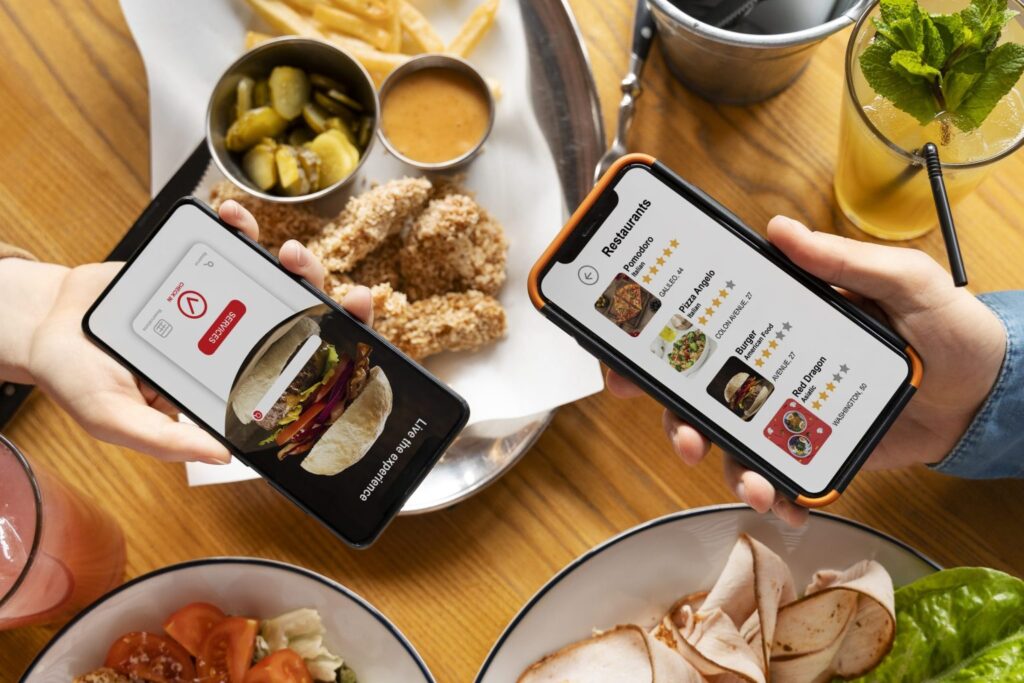
Bengalis research food with near-academic thoroughness. A Kolkata diner comparing biryani spots or looking for a specific cuisine in New Town will check Google, read at least three reviews, scroll through your photos, and look at your address before making a decision.
If you’re not present and credible at every one of those touchpoints, you lose to a competitor who is.
The restaurants winning in Kolkata right now are not necessarily the best ones. They’re the most findable ones with the most credible digital presence at the moment of decision.
The Foundation: Owned Assets Before Paid Reach
There’s a sequencing problem that kills digital ROI for most independent restaurants. They start with paid ads or influencer partnerships before they’ve built the assets that make those activities efficient.
You can spend heavily on Meta ads to drive traffic to a website that loads slowly, shows an outdated menu, and has no online reservation option. Every rupee spent produces friction, not conversion.
Get your owned infrastructure right first. Then amplify it.
Your Website Is Your Hardest-Working Asset
Not Instagram. Not Zomato. Your website is the only digital property you fully control, and it’s the one Google trusts most when deciding whether to surface you in local search results.
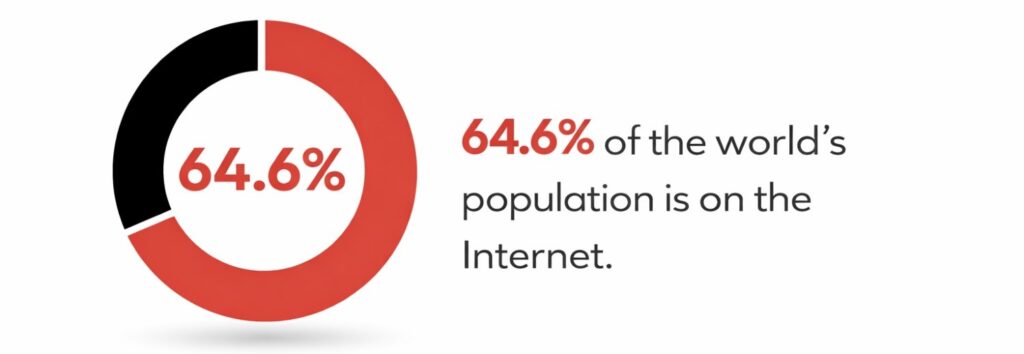
A restaurant website that performs commercially does a few specific things well.
- It loads in under three seconds on mobile, because over 70% of food-related local searches happen on phones.
- It shows a current, legible menu, not a PDF that requires downloading or a JPEG that can’t be indexed.
- It has a clear, low-friction path to reservation or ordering.
- And it has enough structured content for Google to understand what you serve, where you are, and who you’re for.
Common mistakes here are understandable but costly.
- Many Kolkata restaurants have visually attractive websites that are built entirely in JavaScript frameworks without server-side rendering, which means search engines see near-empty pages.
- Others have menus that haven’t been updated since 2021.
Both problems are fixable, but they take time to recover from in organic search.
Google Business Profile Is Not Optional
Your Google Business Profile is often the first thing a prospective diner sees. It appears before your website in most local searches. It contains your hours, photos, menu link, reviews, and directions. It’s where your star rating lives.
Treat it like a product, not a listing.
- Update your hours when they change, especially around festivals and public holidays in Bengal, when getting this wrong causes real damage to trust.
- Upload high-quality photos regularly, because profiles with recent photo activity consistently outperform dormant ones.
- Use the posts feature to highlight specials or events.
- And if someone leaves a review, respond to it, whether it’s positive or negative.
A 4.2-star restaurant with 400 reviews and an active, well-maintained profile will outperform a 4.6-star restaurant with 40 reviews and a neglected one. Volume and recency matter to the algorithm and to humans.
Local SEO: The Channel with the Best Payback Period
For most restaurants, local SEO has a better payback period than any other digital channel. The traffic it generates is high-intent, it doesn’t stop when you stop paying, and it builds a compounding asset over time.
The trade-off is that it takes longer to see results compared to paid advertising.
Most restaurant owners either skip SEO entirely or approach it with a surface-level keyword stuffing mindset that stopped working years ago. The right approach is more systematic.
Keyword Strategy for Restaurant Search
The searches that bring customers to a restaurant have a specific structure. They combine a cuisine or dish type with a location:
- “Bengali thali Salt Lake”,
- “rooftop restaurant New Town Kolkata”,
- “best biryani near Gariahat”,
- “cafe with WiFi Ballygunge”.
Your site and your GBP need to be optimised for the specific variants your target customers are using, not generic phrases like “restaurant in Kolkata” where competition is broad and conversion intent is lower.
The smartest keyword work happens at the intersection of what people search and what you can realistically rank for. A new restaurant won’t rank for “best restaurant in Kolkata” in six months. But it can absolutely rank for “Mediterranean restaurant Alipore” or “family dining Park Circus” if the content and signals support it.
Review Volume and Response Strategy
Reviews are a local ranking signal and a conversion driver at the same time. Restaurants that systematically ask satisfied customers for Google reviews, and respond professionally to all of them, consistently outrank comparable restaurants that treat reviews passively.
The operational habit that works: Train your floor staff to mention Google reviews at the point of payment for satisfied tables.
A simple, genuine ask at the right moment, on a busy Saturday night, generates more reviews than any automated email sequence will. Keep it human.
For negative reviews, respond within 24 hours. Acknowledge the specific issue, apologise without being defensive, and note what you’ve changed or offer to make it right.
The audience for that response is not just the reviewer; it’s the 50 people who read it next week.
Social Media Strategy That Actually Drives Covers
The mistake most restaurant owners make on social media is treating it as a broadcast channel. Post a food photo. Post a reel. Post a promotion. Repeat.
The result is an account with decent followers and no measurable impact on reservations or walk-ins.
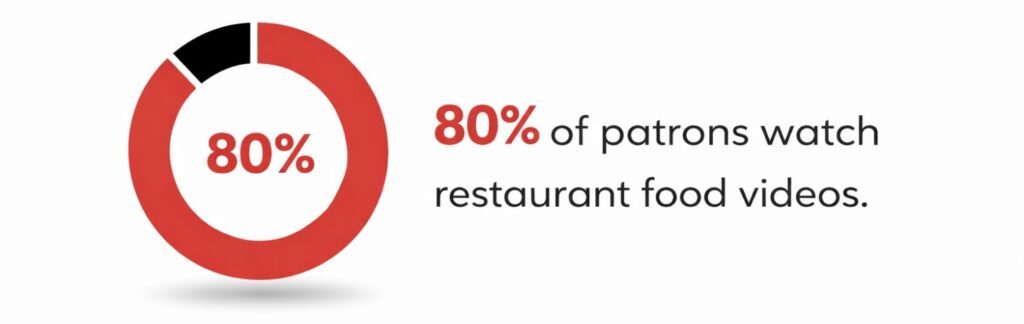
Social media for restaurants works when it does two things: builds an audience of people who are likely to dine with you, and gives them a reason to act. Those are different objectives, and they require different content.
Instagram and Facebook: Platform-Specific Priorities
Instagram remains the dominant visual discovery platform for food in Kolkata. Reels have significantly higher organic reach than static posts in the current algorithm, which means investing in short-form video, even simple ones shot on a good phone, gives you more organic distribution than polished photography alone. Behind-the-scenes content, chef stories, and ingredient sourcing perform well because they create the kind of emotional connection that aggregator listings cannot replicate.
Facebook’s utility for restaurants now lies more in advertising and event promotion than in organic reach. If your target audience skews above 30, Facebook ad targeting for local dining is still cost-effective for driving specific actions like reservation bookings or event attendance.
Influencer Collaborations: What Works and What Doesn’t
Kolkata has a strong food blogger and influencer ecosystem. Done well, a collaboration can generate meaningful discovery and social proof. Done poorly, it burns a marketing budget with nothing to show for it.
The variables that predict success are specificity and genuine alignment. A food creator who regularly covers your cuisine type and neighbourhood, with an audience that matches your target demographic, is worth far more than a larger creator whose audience is geographically dispersed or culinarily misaligned. Micro-influencers with 5,000 to 50,000 engaged followers in Kolkata typically outperform celebrity collaborations in terms of actual cover bookings generated.
Always set measurable outcomes before agreeing to a collaboration. Offer a unique booking code or track referral links. Otherwise you’re spending money on attribution you can’t prove.
Paid Channels: When to Invest and What to Expect
Paid advertising should accelerate a working organic presence, not substitute for one. If someone clicks a Google Ad and arrives at a poorly structured website with no clear call to action, you’ve paid for a bounce.
For most restaurants, the two paid channels worth prioritising are Google Search Ads and Meta Ads, and they serve different purposes in the funnel.
Google Ads for High-Intent Search
Search ads capture demand that already exists. Someone searching “anniversary dinner Kolkata” or “best seafood restaurant Ballygunge” is close to a decision.
Bidding on those terms puts you in front of a commercially ready audience. The cost per click is generally modest for restaurant-specific terms in Kolkata compared to national markets, and conversion rates are high when the landing experience matches the search intent.
The tactical mistake to avoid: Running broad match campaigns without negative keyword lists. You’ll end up paying for irrelevant clicks from people searching for cooking classes or food delivery apps, not sit-down dining.
Meta Ads for Awareness and Retargeting
Facebook and Instagram ads work best for restaurants in two specific scenarios.
- First, building awareness for a new opening or a significant change, a new chef, a new menu, a refurbishment, where you need to reach people who don’t yet know about you.
- Second, retarget people who’ve visited your website or engaged with your social content, where you’re closing a consideration loop rather than opening one.
The expectation management point: Paid social for restaurants rarely produces an immediate, easily trackable ROI. Its value is in the cumulative effect on brand recall and the shortening of the decision cycle for people already in your consideration set. Measure it over 60 to 90-day windows, not week by week.
Delivery Platforms, Email, and the Retention Problem
The dependency risk that almost no restaurant owner talks about openly: Swiggy and Zomato are distribution channels you don’t own.
They’re useful for reaching new customers and filling off-peak slots, but every customer who orders through them knows them as a Swiggy customer, not yours.
You don’t get their contact details. You can’t remarket to them. And the commission structure means your margins on those orders are materially lower than direct orders.
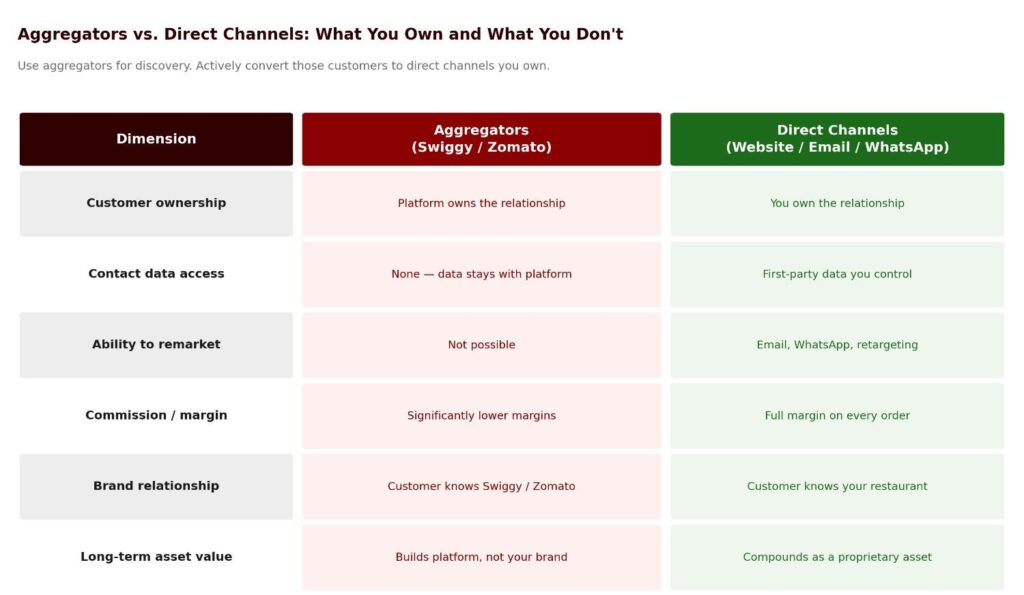
The strategic move is to use aggregators for discovery while actively converting those customers to direct channels. A simple tent card at the table, a packaging insert, or a loyalty incentive that applies only to direct orders is a low-cost mechanism for rebuilding a direct customer relationship from aggregator-generated traffic.
Email Marketing: Underused and High ROI
Email is probably the most underused channel in restaurant marketing in India.
When it works, it works exceptionally well, because you’re reaching people who’ve already eaten with you, with a message they’ve opted into, at effectively zero cost per send.
The list-building problem is real. Most restaurants don’t systematically collect email addresses, so they have nothing to send to.
The fix is straightforward: Collect emails at the point of reservation, through your WiFi login process, or through loyalty programme sign-ups. Even 500 genuine email subscribers who’ve dined with you recently are a more valuable asset than 5,000 Instagram followers who followed you for a contest.
What to send: Advance notification of seasonal menus, private event invitations, and exclusive offers for repeat customers. Keep frequency low and quality high. Monthly is usually sufficient. Weekly risks fatigue unless your content is genuinely compelling.
A Prioritised Playbook: 21 Digital Marketing Strategies for Kolkata Restaurants
These are sequenced by impact and foundation dependency, not alphabetical order. Start with the ones that build infrastructure before moving to amplification.
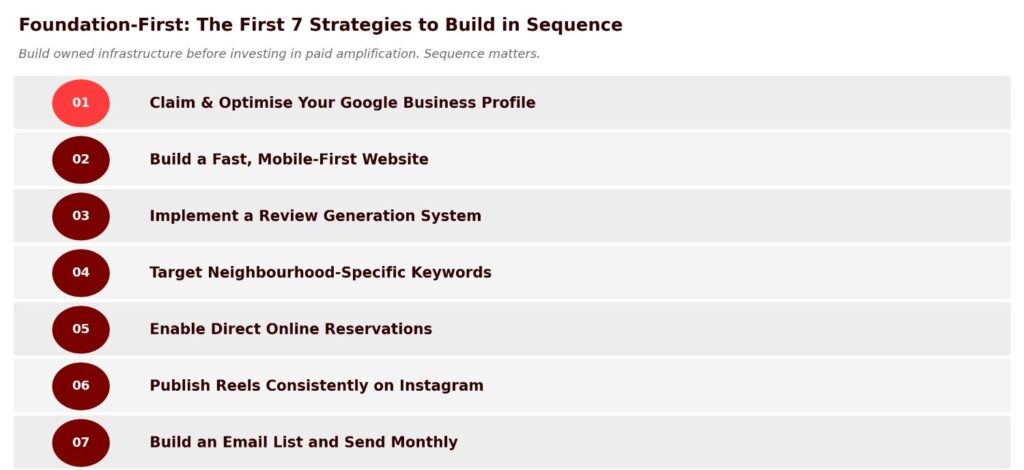
01 Claim and Optimise Your Google Business Profile
Verify ownership, fill every field, upload recent photos, set accurate hours, and connect your menu link. This is the single highest-leverage action for local visibility, and it costs nothing but time.
02 Build a Fast, Mobile-First Website with Structured Content
Host an indexed, text-based menu. Include schema markup for LocalBusiness and Restaurant. Ensure page speed passes Core Web Vitals on mobile. This is your SEO foundation.
03 Implement a Review Generation System
Train staff to ask for Google reviews at the right moment. Respond to every review within 24 to 48 hours. Target a steady stream of new reviews monthly, not a burst then silence.
04 Target Neighbourhood-Specific Keywords in Your Content
Create dedicated content targeting your locality plus cuisine type combinations. “North Indian restaurant Dum Dum” converts better than generic city-level terms, and competition is significantly lower.
05 Enable Online Reservations Through Your Own Website
Every booking that comes directly saves on aggregator commission and gives you first-party data. Use a simple booking widget. Remove friction relentlessly.
06 Enable Online Ordering for Direct Delivery
Even a basic WhatsApp or website ordering flow for direct orders reduces dependency on aggregators. Incentivise it with a small direct-order discount that more than covers the cost of the aggregator commission you avoid.
07 Publish Reels Consistently on Instagram
Three to four Reels per week outperform daily static posts for organic reach. Prioritise kitchen footage, plating moments, and genuine staff personality. Authentic beats polished in the current algorithm.
08 Build an Email List and Send Monthly
Start collecting now. Offer a meaningful first-visit incentive for opt-ins. Send once a month with something worth opening: a seasonal menu preview, a behind-the-scenes story, a reservation-only event.
09 Run Google Search Ads on High-Intent Local Terms
Target cuisine plus neighbourhood queries and “near me” variants. Use exact and phrase match to control spend. Start with a modest daily budget of ₹300 to ₹500 and iterate based on actual booking data.
10 Collaborate with Kolkata Food Micro-Influencers
Identify creators with 5,000 to 50,000 engaged Kolkata-based followers who regularly cover your cuisine type. Offer a hosted experience, not a paid post. Set a tracking mechanism before agreeing.
11 Implement User-Generated Content Campaigns
Create a branded hashtag. Feature customer content in your Stories. A table tent or packaging insert with the hashtag and a small incentive, a discount on the next visit, generates a steady stream of authentic social proof.
12 List Accurately on All Major Online Directories
Zomato, Dineout, JustDial, Bing Places, Apple Maps. Inconsistent NAP (name, address, phone) across listings is a local SEO signal problem. Audit and standardise all of them.
13 Run Seasonal and Festival Promotions with Landing Pages
Durga Puja, Poila Baisakh, and Christmas in Park Street are high-intent booking periods in Kolkata. Create dedicated pages with specific search terms and promote them six to eight weeks in advance.
14 Offer and Promote Free WiFi with Email Capture
A WiFi login portal that asks for an email address before granting access is one of the most low-friction list-building mechanisms available. Capture permissions. Use them.
15 Implement a Retargeting Campaign for Website Visitors
People who’ve visited your menu page or reservation page but didn’t book are warm prospects. A simple Meta retargeting campaign showing your best dish and a direct booking link is high-value and low-cost.
16 Partner with Local Businesses for Cross-Promotion
Nearby offices for corporate lunch programmes, hotels for guest dining recommendations, and gyms for post-workout nutrition partnerships. These are not glamorous, but they generate consistent, low-CAC bookings.
17 Produce Video Content Beyond Just Food
Chef origin stories, supplier visits, preparation processes, and cultural context behind signature dishes build brand depth that purely aesthetic food photography cannot. It’s also far less competitive content territory.
18 Host and Promote Events with Their Own Digital Presence
A monthly supper club, a live music evening, a cooking class. Events give you recurring reasons to email your list, post on social, and generate press mentions. They also bring in customers who wouldn’t otherwise try you.
19Monitor Competitor Performance Systematically
Track which competitors rank above you for your target search terms. Audit their GBP, their review velocity, and their website content. SEO is a relative game. You don’t need to be perfect; you need to be better than the alternatives Google is showing for your queries.
20 Build a Loyalty Programme with Digital Integration
Even a simple points-based system, managed through WhatsApp or a basic app, increases repeat visit rate measurably. Loyalty customers have lower CAC, higher average spend, and drive disproportionate referral volume.
21 Measure What Matters: Revenue Metrics, Not Vanity Metrics
Track cost per reservation, direct order rate versus aggregator rate, email list growth, review velocity, and organic search traffic to your menu and booking pages. Everything else is noise unless you can connect it to one of those numbers.
What Realistic Timelines Look Like
One of the most damaging expectations in restaurant digital marketing is the belief that SEO should produce results within a month, or that a single influencer collaboration will fill tables for a quarter.
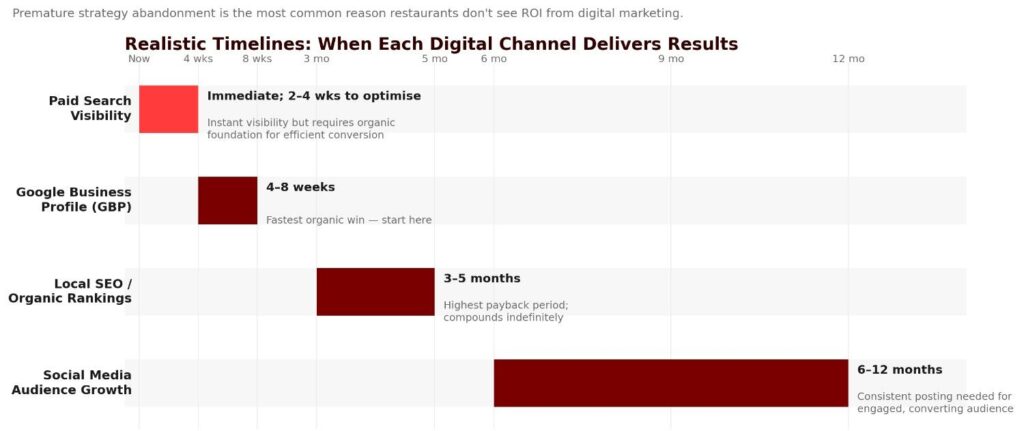
Neither is true, and believing either leads to premature strategy abandonment.
Local SEO for a new or unoptimised restaurant in Kolkata typically shows meaningful movement in organic ranking within three to five months of consistent work.
- The GBP improvements tend to be faster, often four to eight weeks if you’re starting from a neglected baseline.
- Paid search delivers visibility immediately, but requires two to four weeks of data before you can optimize efficiently.
- Social media compound effects are even slower. Building an engaged audience that reliably converts to diners takes consistent posting over six to twelve months.
The shortcut, paid amplification of content that’s already performing organically, works. However, random boosts on posts that haven’t proven organic engagement rarely do.
The businesses that get the best long-term results treat digital marketing like kitchen prep. You don’t stop doing mise en place because it didn’t produce orders yesterday. You do it because it makes everything else work better.
See What This Looks Like for Your Restaurant
We audit Kolkata restaurants’ digital presence and identify the highest-leverage improvements, typically with a clear prioritisation by expected impact and effort. No pitch. No pressure. A genuine strategic view of where you stand and what’s worth doing next.