
Amazon’s temporary expansion of dynamic bid adjustments for Prime Day is a meaningful lever for sellers who understand how to use it. It is also a fast route to inflated ad spend for those who treat it as a simple “turn it on and win more” feature.
The distinction matters because the P&L consequences of mismanaging bids during a 48-hour high-competition event can take weeks to unwind.
This piece covers what the expanded adjustment actually does, the economics behind it, how to set up campaigns for it intelligently, and where most sellers make mistakes that erode the very margin they were hoping to capture.
What Dynamic Bids Up and Down Actually Does
To use this feature strategically, you need to understand the mechanism, not just the marketing description.
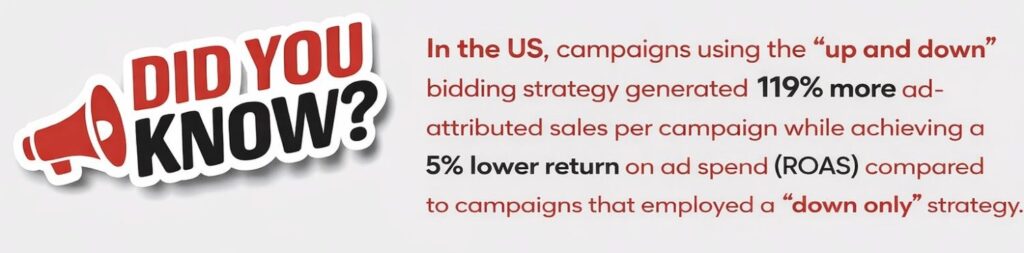
Amazon’s standard Sponsored Products bidding gives sellers three options: fixed bids, dynamic bids down only, and dynamic bids up and down. The “up and down” setting allows Amazon’s algorithm to adjust your bid in real time based on its assessment of conversion probability for a given auction.

Under normal operating conditions, Amazon can raise your bid by up to 100% for top-of-search placements and up to 50% for product page placements when conversion signals are strong. It can also lower your bid when signals suggest a click is unlikely to convert.
What changes for Prime Day: Amazon temporarily expands the maximum upward adjustment to 100% for both top-of-search and product page placements. If your base bid is $2, your effective bid in a high-probability auction can reach $4. This expansion is designed to help sellers compete for prominent placements during a period when both traffic volume and competition are substantially elevated.
The mechanical effect: More auction wins in high-intent placements, which typically means higher impressions, higher click volume, and, assuming your product listing and pricing are competitive, higher sales. The trade-off is that your actual CPC can be significantly higher than your base bid, and during Prime Day specifically, so can your competitors’ bids, which raises the floor across the entire auction.
What sellers often misunderstand: The algorithm’s conversion probability signal is based on historical data and real-time behavioral signals.
It does not know that
- your specific product is priced competitively for Prime Day,
- you have a strong promotional offer, or
- your category sees unusual purchase patterns during the event.
The algorithm is doing its best inference based on patterns. Your job is to ensure that the other variables it cannot control, listing quality, pricing, reviews, and promotional visibility, are optimized before the auction mechanics take over.
The Prime Day Bid Expansion: A Concrete Look at the Economics
Before adjusting any campaign settings, run through the economic logic for your specific situation.
Take a base bid of $3 with dynamic up and down enabled. Under normal conditions, Amazon might raise this to $4.50 for a product page placement (50% maximum) or $6 for a top-of-search placement (100% maximum). During Prime Day, both caps move to 100%, meaning your effective bid can reach $6 across both placement types.
Whether that economics works depends on your product’s contribution margin and your category’s conversion rates.

If your product retails for $45 with a 30% contribution margin after COGS, fulfillment, and Amazon fees, your gross contribution per unit is roughly $13.50. If your conversion rate on these placements is 12%, your cost per acquisition at a $6 CPC is $50. That is unprofitable at the unit level.
If your conversion rate is 25% because your product is well-matched to Prime Day demand, well-reviewed, and correctly priced, your cost per acquisition at the same $6 CPC is $24. That is inside your margin at this price point.
The math changes dramatically based on conversion rate assumptions, and Prime Day conversion rates can move significantly in either direction from your baseline. High-demand categories with genuinely competitive Prime Day offers tend to see conversion rates well above normal. Categories with heavy competition or undifferentiated products often see conversion rates compress because shoppers have more options and more price comparison behavior.
The practical preparation step most sellers skip: Before setting base bids for Prime Day campaigns, calculate your maximum allowable CPA at your Prime Day pricing and your realistic conversion rate range. That calculation sets a ceiling on what base bid is defensible. Working backward from target economics is more rigorous than starting from “what bid gets me visibility” and hoping the margin holds.
Setting Up Campaigns for the Expanded Adjustment
The mechanics of enabling dynamic bids up and down are straightforward. The strategic decisions that determine whether those mechanics produce good outcomes require more care.
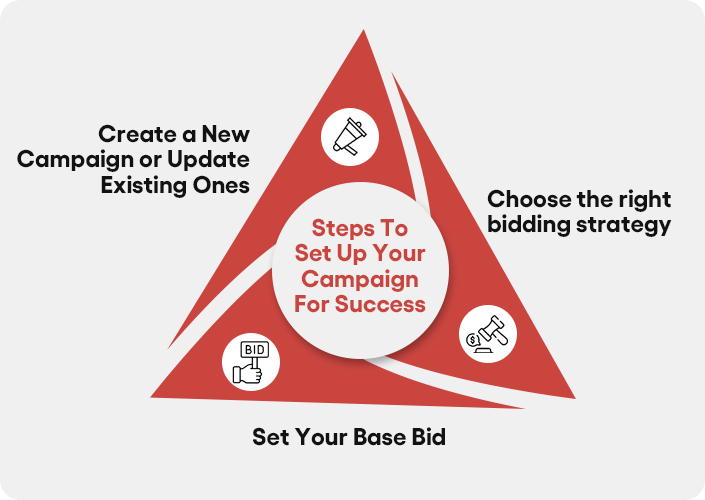
For new Prime Day campaigns:
- When creating a Sponsored Products campaign, navigate to the Campaign Bidding Strategy section and select “Dynamic bids – up and down.”
- Set your base bid based on the backward-from-margin calculation described above, not based on what gets you to page one at any cost.
- Select your ad placements deliberately: if your product converts better from search than from product pages, you may want to weight your placement bid modifiers accordingly.
For existing campaigns:
- Navigate to the Campaign Settings page,
- Select the campaign you want to update, and
- Change the bidding strategy.
Be aware that changing the bidding strategy on a campaign mid-flight can temporarily affect performance while the algorithm recalibrates.
For high-stakes Prime Day campaigns, you can create a duplicate campaign with the updated strategy a week before the event and run it alongside the existing campaign briefly. This lowers the risk of updating active campaigns with established performance history.
Base bid calibration:
The most common error sellers make is setting base bids that are too high, on the assumption that “Amazon will just raise them when it makes sense.”
The problem is that a high base bid means Amazon starts from a higher floor before applying the upward adjustment, which can push effective CPCs into unprofitable territory even for well-converting placements. Set base bids conservatively and let the dynamic adjustment do its work from a rational starting point.
Budget considerations:
With bids potentially doubling under expanded adjustment, your daily budget can exhaust significantly faster than your historical burn rate would suggest.
If a campaign was spending $200 per day under normal conditions with standard dynamic bidding, assume Prime Day spending could run substantially higher, especially in the peak hours of the event. Set campaign budgets that reflect this and monitor intraday spend rather than relying on end-of-day reviews.
Optimizing Before Prime Day: What Actually Moves the Needle
Dynamic bidding improves your probability of winning auctions. It does not fix a product listing that fails to convert once the click lands.
The conversion rate variables that determine whether your increased ad spend generates profitable returns are all outside the bidding algorithm’s control.
Product listing quality is the conversion multiplier that bid adjustments assume is already strong.
Images need to clearly communicate the product and its differentiating attributes. For Prime Day specifically, a main image that clearly shows the deal value (if you’re running a promotional price) and communicates the core benefit quickly has a measurable effect on CTR from ad placements.
This, in turn, affects quality signals that feed back into auction dynamics. Title copy should lead with the attributes buyers in your category search for. Bullet points should answer the pre-purchase questions that prevent conversion.
Pricing and promotional framing:
Prime Day shoppers are actively comparing prices across sellers and against their own purchase history.
If your Prime Day pricing is not genuinely competitive, or if your promotional discount is not clearly visible in the listing, you will win impressions with elevated bids and convert them at below-normal rates. The combination is the worst-case scenario for campaign economics.
Review velocity and star rating:
Amazon’s algorithm factors review signals into its conversion probability assessments. Products with strong review velocity and ratings above 4.0 stars systematically get more favorable treatment in dynamic bid adjustments because the historical conversion data support it.
There is nothing you can do about this in the week before Prime Day, but it is a meaningful structural variable for longer-term competitive positioning.
Keyword selection and match types:
Prime Day is not the time to discover that your broad match keywords are capturing irrelevant traffic at elevated CPCs.
Tighten your keyword targeting in the weeks before the event. Identify the specific queries that have historically driven conversions for your products and concentrate budget on those.
Broad match expansion into tangential queries is expensive under normal conditions and significantly more expensive when your bids are doubling.
Managing Risks: Where Prime Day Dynamic Bidding Goes Wrong
The expanded bid adjustment creates real risk if approached without guardrails. Understanding the failure modes helps you set up the right controls before the event starts.
Unconstrained spend against unverified conversion rate assumptions is the primary risk.
Sellers who set base bids optimistically, do not cap budgets appropriately, and assume their Prime Day conversion rates will match or exceed their historical baseline can find themselves significantly over budget with ROAS well below target.
Prime Day conversion rates are highly category and product-dependent. What works for a high-demand consumer electronics product does not translate to a niche category with limited Prime Day relevance.
Bid inflation across the competitive landscape:
When every seller in a category enables dynamic up and down with expanded adjustments, CPCs rise across the entire category, not just for aggressive bidders. Your effective CPC is a function of your maximum bid and your competitors’ maximum bids.
In competitive categories, the net effect of everyone increasing bids simultaneously can be that CPCs rise substantially while conversion rates stay constant, compressing margins across the board. This is a real dynamic, not a hypothetical.
The diminishing returns problem with ad creative:
Elevated bids generate more impressions and clicks.
If your ad creative and listing do not differentiate your product effectively from the competitors, who are also spending aggressively on the same placements, click-through rates can be lower than expected and conversion rates can disappoint.
More spend into a poorly converting system just surfaces the underlying listing problem at greater cost.
Post-Prime Day algorithm adjustment:
If your campaign runs at significantly higher CPC and lower conversion efficiency during Prime Day, those data points feed back into Amazon’s campaign history.
In the weeks following Prime Day, you may see performance variability as the algorithm recalibrates around the anomalous event period data. Plan to review and potentially adjust campaigns in the two weeks after Prime Day, not just during it.
Practical Risk Controls
Set explicit daily budget caps for all Prime Day campaigns.
This should be done before the event begins, and do not rely on intraday manual adjustments to contain overspend. At peak Prime Day traffic levels, campaigns can exhaust daily budgets in hours. Once a budget is exhausted, your ads stop serving regardless of how the event is performing, which creates its own risk of missing the highest-intent shopping windows.
Use placement bid multipliers deliberately.
If you know your product converts significantly better from top-of-search than from product pages, set a positive bid multiplier for top-of-search and leave the product page placement at baseline. Concentrating your expanded adjustment budget on your highest-performing placement type is more efficient than applying the full expansion uniformly across all placements.
Monitor in four-hour intervals during the event rather than end-of-day.
Prime Day shopping behavior is concentrated in specific windows. Early morning and evening tend to see higher traffic volume. If your campaigns are exhausting the budget in the first few hours and going dark for the remainder of the day, the budget allocation logic needs adjustment.
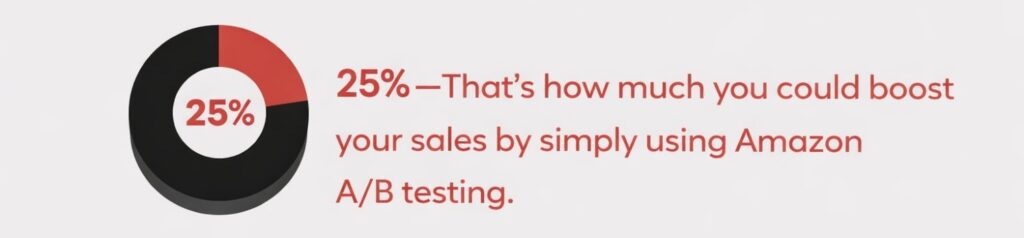
Run A/B tests on ad creative before Prime Day, not during it.
Testing during the event introduces variables at the worst possible time. Identify your best-performing creative variants in the two to three weeks before Prime Day and enter the event with proven assets.
Leverage Amazon’s automated rules to set performance-based bid or budget adjustments.
For example, you can set a rule that reduces bids by 15% if ROAS drops below a defined threshold over a four-hour window, which provides a mechanical backstop against runaway spend without requiring constant manual oversight.
Evaluating Results: What to Measure After Prime Day
The metrics that matter most for evaluating your Prime Day campaigns are not the ones that look most impressive in a headline summary.
Total sales volume is a vanity metric during Prime Day. Almost every seller with adequate inventory and reasonable listings will see higher sales volume during the event simply because traffic is elevated.
The relevant question is whether your sales volume came in at an acceptable rate.
ROAS normalized against the Prime Day period:
Compare your ROAS during the Prime Day window against your typical ROAS at the same budget level during non-event periods. If ROAS declined significantly despite higher sales volume, the expanded bid adjustment may have generated conversions that were available at a lower cost during normal periods.
Some ROAS compression during a competitive event is expected. Significant compression suggests either bid overextension or conversion rate underperformance.
New customer rate:
One of the legitimate strategic arguments for more aggressive Prime Day bidding is the opportunity to acquire new customers who may not have found your brand through normal search behavior.
If your Post-Purchase analytics show a higher-than-usual proportion of first-time buyers, the Prime Day investment may be building LTV that does not appear in the same-period ROAS.
Inventory sell-through rate:
If you positioned specific inventory for Prime Day promotion and sold through it, the campaign served its purpose regardless of whether ROAS was perfectly optimized.
Inventory carrying costs and potential markdown risk in the future are real costs that favor faster sell-through during high-traffic events, even at slightly compressed margins.
The Broader Strategic Frame
Prime Day dynamic bid expansion is a tactical lever within a larger Amazon advertising strategy.
Used well, it concentrates spend into the highest-intent auctions during a period when buyer motivation is elevated, which is exactly when efficient ad spend should be most aggressive.
Used poorly, it inflates ad costs during an event that your competitors are also investing in heavily, generating marginal sales at economics that look good in absolute volume but deteriorate on a per-unit basis.
The sellers who extract the most consistent value from Prime Day advertising are typically those who enter the event with
- well-optimized listings,
- a clear bid ceiling based on their margin structure,
- deliberate targeting that concentrates on proven high-conversion queries, and
- the discipline to monitor intraday performance rather than setting campaigns and walking away for 48 hours.
The expanded bid adjustment is a useful tool. Its value depends entirely on the quality of the decisions made before it is switched on.
Finalizing Your Bid Strategy Before Prime Day?
If you want to review your current Amazon campaign architecture ahead of Prime Day, or pressure-test whether your bid strategy is set up to generate profitable returns rather than just sales volume, a focused campaign audit will surface the adjustments worth making. Request a campaign teardown and we will tell you specifically where the gaps are.