

Performance marketing gets sold as the answer to John Wanamaker’s problem, the idea that half your advertising spend is wasted and you cannot figure out which half.
The promise is accountability: you pay for results, not exposure. You know exactly what each action costs, you can optimize in real time, and you stop subsidizing campaigns that produce impressions without revenue.
That promise is largely real. But the framing often skips the constraints and the strategic trade-offs that determine whether performance marketing becomes a durable growth engine or an expensive treadmill.
Understanding both sides of that ledger is what separates the companies that build scalable acquisition programs from the ones that optimize their way into channel dependency.
What Performance Marketing Actually Is
Performance marketing is a model where advertising costs are tied to specific, measurable outcomes rather than paid upfront for reach or visibility. You pay when someone
- clicks,
- converts,
- registers,
- purchases, or
- takes whatever downstream action you define.
The cost structure shifts from speculative to contingent. This applies across multiple channel types.
- Paid search (PPC) charges per click on ads triggered by specific keyword queries.
- Paid social platforms charge per click or per conversion event, depending on how you configure the campaign.
- Affiliate marketing pays a commission when a referred customer completes a desired action.
- Display and programmatic advertising can be structured on a cost-per-acquisition basis.
The common thread is outcome-based pricing, which creates a different relationship between spend and return than traditional brand advertising.

What distinguishes performance marketing operationally is the measurement infrastructure it requires. You need conversion tracking, attribution configuration, and clean data pipelines to know what you actually paid for each outcome. Without that, you are not doing performance marketing; you are doing paid media with a results-based billing arrangement and no reliable way to evaluate it.
Why the Pay-for-Results Model Matters Commercially
The core financial argument for performance marketing is straightforward: It transfers a portion of advertising risk from buyer to platform.
When you pay per click or per conversion rather than per impression, underperforming creative or poorly targeted audiences cost you less, not because the problem is solved, but because the billing model is aligned differently.
This creates several real advantages for how marketing budgets operate.
Budget efficiency compounds over time.
In a traditional advertising model, every dollar is spent whether or not it performs. In performance marketing, the measurement feedback loop allows you to continuously shift spend toward what is working.
Over a six to twelve-month optimization cycle, the efficiency gains from this iteration can be significant. Campaigns that started with a $90 CPA can reach $40 to $50 through systematic testing of audiences, creative, and bidding strategy.
Risk-adjusted budget decisions become possible.
When you know your cost per acquisition and your customer LTV, you can make mathematically grounded decisions about how much to spend. Performance marketing gives you the input data to have that conversation with confidence.
If a customer acquired through paid search costs $60 and has an LTV of $800, the economics support aggressive scaling. If a display campaign is running at $150 CPA with LTV data suggesting those customers have lower retention rates, the case for cutting the budget is clear.
Accountability structures work in both directions.
The same transparency that lets you evaluate channel performance also lets you hold agencies and internal teams accountable against specific metrics rather than subjective assessments of effort.
This changes the nature of the client-agency relationship and makes performance marketing a more auditable investment than traditional media.
The constraint worth acknowledging: Performance marketing optimizes for the actions you measure, which are not always the actions that matter most. If you optimize a campaign toward the lowest CPA without accounting for LTV differences across customer segments, you can efficiently acquire a lot of customers who churn quickly. The model is only as good as the business logic embedded in the performance targets.
The Main Channels and What Each One Is Built For
Paid Search
Paid search captures demand that already exists. When someone searches for a specific product, service, or solution, they have self-identified their interest. Paid search puts your offer in front of that intent at the moment it is expressed.

This makes paid search highly efficient for conversion since the audience is pre-qualified by their own search behavior. It also makes paid search vulnerable to two structural challenges.
- First, you are competing with every other advertiser targeting the same queries, which drives up costs in competitive categories.
- Second, paid search does not create demand; it captures it. If branded search volume is low and category awareness is limited, the addressable audience through search is constrained regardless of budget.
For most businesses, paid search is a core performance channel, but not a complete acquisition strategy. It works best as the capture layer for demand that other channels — content, SEO, brand advertising, word-of-mouth — have helped create.
Paid Social
Paid social operates differently from search. The audience is defined by demographic and behavioral data rather than expressed intent. You are reaching people based on who they are and what they have done, not what they are searching for right now.
This creates more variability in performance.
- A well-targeted paid social campaign reaching the right audience with creativity that resonates can produce acquisition costs comparable to paid search.
- A poorly targeted campaign with undifferentiated creative can burn a significant budget with minimal return.

Paid social is particularly effective for
- categories where visual demonstration matters,
- audiences that can be precisely defined by behavioral or interest data, and
- upper-funnel awareness that eventually converts through other channels.
It is less effective as a standalone conversion channel in B2B or in high-consideration categories where buyers need multiple exposures before taking action.
Attribution is also more complex in paid social. The view-through attribution windows that platforms use to claim credit for conversions can overstate actual contribution significantly. Holdout testing, running control groups with reduced or no exposure, is the only reliable way to measure the true incremental contribution of paid social campaigns.
Affiliate Marketing
Affiliate marketing externalizes a portion of the marketing function to third-party publishers who promote your products in exchange for a commission on outcomes. The performance structure is clean: You pay only when a conversion occurs.

The practical complexity is in affiliate quality and network management. Not all affiliate traffic is equal.
- Content affiliates who drive organic search traffic to well-considered reviews
- Comparison content tends to produce higher-quality customers than coupon or discount affiliates, who intercept customers who were already going to purchase anyway.
The latter inflates conversion numbers without creating new demand, which means you are paying a commission on revenue that would have happened regardless.
Building an effective affiliate program requires investing in affiliate recruitment, relationship management, and ongoing quality monitoring. The commission structure also needs to be calibrated carefully. Too low, and you cannot attract quality affiliates; too high, and the economics erode.
Display and Programmatic
Display advertising in a performance context is typically structured around
- retargeting or showing ads to users who have already visited your site or interacted with your brand, or
- prospecting campaigns targeting defined audience segments.
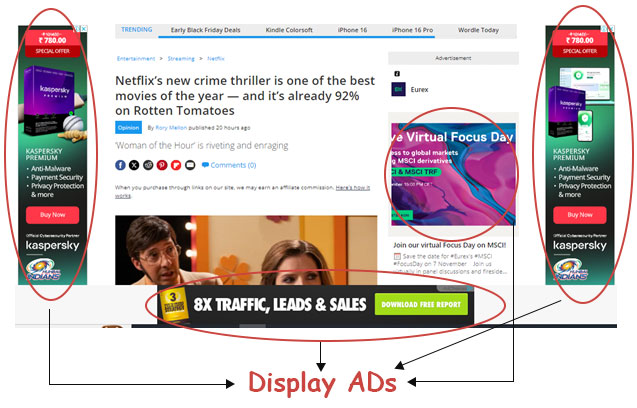
Retargeting displays can be efficient for capturing consideration-stage buyers who have expressed interest but not converted. It works well when the creative is differentiated, and the frequency is managed carefully. Excessive retargeting exposure can produce negative brand effects that offset conversion gains.
Prospecting display is harder to attribute accurately and tends to produce less efficient direct conversion metrics than search or social. Its value is more accurately measured through brand lift studies and incrementality testing than through last-click conversion data.
The Metrics That Matter and the Ones That Mislead
Performance marketing generates a significant amount of data, and not all of it is equally useful for making resource allocation decisions.
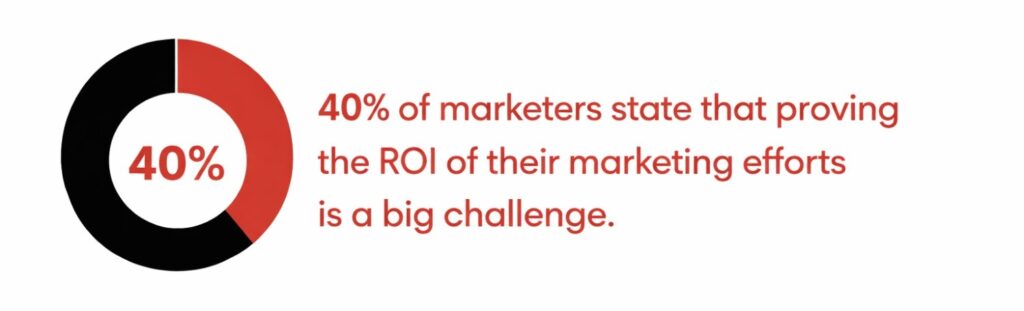
Conversion rate measures the proportion of users who take a desired action after engaging with an ad.
It is a useful diagnostic metric where low conversion rates on high-traffic campaigns indicate either targeting or message mismatch. However, it does not answer the question of whether the campaign is profitable.
Cost per acquisition (CPA) is the metric most commonly used to evaluate performance marketing efficiency.
It tells you what you paid, on average, to produce one conversion. The critical context requires a CPA that looks efficient in isolation may be completely unsustainable when compared against the actual revenue or LTV that acquired customers generate.
Return on ad spend (ROAS) measures revenue generated per dollar of advertising spend.
A 4x ROAS means four dollars of revenue for every dollar spent. ROAS is more useful than CPA for evaluating revenue efficiency, but it measures gross revenue rather than contribution margin. A 4x ROAS campaign with high product costs or significant fulfillment expense may be producing little or no profit.
Customer lifetime value (LTV) is the metric that makes all the others interpretable.
Your CPA target, your acceptable ROAS floor, your budget scaling decisions — all of these should be grounded in what a customer is actually worth over the duration of their relationship with your business, net of costs.
Without LTV data segmented by acquisition channel, you cannot know whether you are acquiring customers who will be profitable at the costs you are paying.
LTV:CAC ratio is the metric that senior operators track most carefully.
A ratio below 1:1 means you are paying more to acquire customers than they will ever generate in profit. A ratio of 3:1 or above typically indicates sustainable acquisition economics, though the appropriate target varies significantly by category, margin structure, and payback period requirements.
The measurement mistake that costs companies the most: Optimizing toward the lowest CPA without understanding LTV variation across segments. Paid social campaigns frequently produce lower CPAs for audiences that also have lower retention rates and LTVs. If you only look at acquisition cost, you are making the channel look better than it is.
The Seven Business Cases for Performance Marketing
The original framing of “seven reasons” is accurate. Here is what each one actually means in practice, with the constraints left in.
1. Measurable return on spend.
You know what each conversion costs. You can calculate efficiency against LTV. This is a genuine advantage over brand advertising, where impact is real but harder to trace directly to revenue.
The caveat: measurability depends entirely on the quality of your attribution setup. Poor tracking produces confident-looking numbers that are wrong.
2. Audience targeting precision.
Modern performance channels allow targeting at levels of granularity that traditional media cannot match by
- search intent,
- behavioral history,
- demographic profile, and
- lookalike modeling against existing customer data.
This reduces waste relative to broad-reach advertising.
The risk: over-targeting can reduce reach to the point where you are only reaching people already predisposed to convert, without expanding the addressable market.

3. Real-time optimization capability.
Campaign performance data is available continuously, enabling rapid iteration on creative, targeting, and bidding strategy. This is a meaningful operational advantage.
The discipline required: Distinguishing signal from noise in early campaign data, which requires sufficient conversion volume to produce statistically reliable conclusions. Optimizing on small sample sizes produces changes that feel decisive and often move things in the wrong direction.
4. Budget control and flexibility.
You can scale spend up or down in response to performance data, seasonality, or business priority. There is no locked-in media commitment requiring spend on underperforming campaigns.
This flexibility has real value, particularly for businesses with variable revenue cycles or constrained capital.
5. Multi-channel reach.
Performance marketing channels span search, social, display, and affiliate, covering different stages of the buyer journey and different audience segments. A coordinated multi-channel performance program can cover more of the funnel than any single channel approach.

The complexity cost: attribution across channels becomes significantly more difficult, and channel-specific optimization can optimize local performance at the expense of overall funnel efficiency.
6. Scalability with maintained efficiency.
When a performance channel is working — when CPA is sustainable, LTV justifies the acquisition cost, and the audience has not been exhausted — increasing budget typically increases volume without proportionally degrading efficiency. This is the scale lever that makes performance marketing attractive for growth-stage businesses.
The practical limit: most channels experience efficiency erosion as you scale into less optimal audience segments or drive up auction prices in paid search.
7. Customer relationship depth over time.
Well-executed performance marketing, particularly in retargeting and lifecycle contexts, can build repeat purchase behavior and deepen customer relationships through personalized, behaviorally relevant touchpoints.
The important distinction: this is a long-cycle benefit and should not be the primary justification for performance marketing investment. The near-term case rests on acquisition efficiency. Relationship depth is a downstream output, not an immediate return.
Building a Proper Performance Marketing Program
The businesses that generate the best long-term returns from performance marketing do not treat it as a series of campaigns. They treat it as an infrastructure investment, building
- measurement systems,
- audience data,
- creative libraries, and
- optimization processes that compound in value over time.
A few principles that distinguish programs that compound from programs that plateau:
Measurement quality is a prerequisite, not a nice-to-have.
Before scaling spend, invest in clean conversion tracking, proper attribution configuration, and LTV data that segments customers by acquisition channel. The cost of making decisions on bad data at scale is higher than the cost of building measurement infrastructure correctly at the start.
Test budgets should be protected.
The temptation to reallocate all budgets to what is currently working is a scale trap. What is working now reflects current market conditions, creative fatigue, and audience saturation levels that will change.
Maintaining a dedicated testing allocation against new channels, creative approaches, and audience hypotheses is what prevents the program from becoming dependent on a single channel that eventually degrades.
Organic and paid should be built in parallel.
Performance marketing captures existing demand efficiently. SEO and content marketing create demand at a lower marginal cost over time. The programs are complementary: organic builds the audience and intent that paid search captures, and paid social amplifies the content that builds organic authority.
Companies that invest in both tend to see their performance marketing efficiency improve over time as organic volume increases. Companies that invest only in paid acquisition face rising CPAs as category competition increases.
The economics must pencil in your target payback period.
Know what payback period your business can support and make sure your CPA targets reflect it. A SaaS business with a 24-month average customer tenure can sustain longer payback periods than a consumer brand with high churn.
These constraints should be built into performance targets, not treated as post-hoc rationalizations when the numbers come in.
What to Evaluate Before Scaling Performance Spend
Before significantly increasing performance marketing investment, it is worth pressure-testing a few assumptions:
Is your attribution setup capturing the actual customer journey or just the last tracked click?
If you are running multi-channel programs and measuring on last-click, you are likely undervaluing upper-funnel channels and over-crediting bottom-funnel capture. The budget decisions that follow from that measurement will systematically underinvest in demand creation.
Do you have LTV data by acquisition channel?
If not, you are optimizing acquisition costs without knowing whether they are actually producing profitable customers. This is one of the most common and costly gaps in performance marketing programs.
Is there a performance floor that accounts for channel health over time?
- Paid search CPAs typically increase as category competition grows and as you exhaust your highest-intent query volume.
- Paid social efficiency typically declines as audience saturation increases and creative fatigue.
Planning for this degradation in your performance targets is more realistic than assuming current efficiency is sustainable indefinitely.
Ready to Learn What Performance Marketing Can Offer Your Business?
Performance marketing done rigorously is one of the more defensible growth investments available to a scaling business. The measurement infrastructure, audience data, and optimization processes you build are assets that persist and compound. But the companies that get the most from it are the ones that set it up with clear business logic, honest measurement, and realistic expectations about what the channel can and cannot do on its own.
If you want to assess whether your current performance marketing program is structured to compound or whether it is optimizing toward metrics that do not fully reflect business value, that review is worth doing before the next budget cycle.