Keyword optimization is not dead, but it is no longer sufficient to win in search. The brands that are quietly pulling ahead right now are not the ones with more content. They are the ones with more precise answers to the underlying question.
That distinction matters more than it sounds.
A user who types “solar panels Philippines” is not asking for a product catalogue. They are most likely a homeowner who is calculating whether a significant capital investment will pay off over their electricity bill horizon, feeling uncertain, and looking for someone to resolve that uncertainty without wasting their time. The keyword is a signal. The intent is the real brief.
Most SEO content still responds to the signal and ignores the brief. That is what intent-first SEO is designed to fix, and it is why AI models now routinely surface smaller, less authoritative sites over well-funded ones that have spent years accumulating content volume.
This piece explains what intent-first SEO actually is, how AI has changed the rules around intent interpretation, and what a practical shift in approach looks like for a content and SEO program at scale.
Why Traditional Keyword SEO Leaves Revenue on the Table
Early search engines were lexical matching systems. They looked for the words in a query on a page and ranked pages that had those words more prominently or more frequently. This led to a generation of SEO content that was structured around keyword presence rather than human relevance. The content answered the machine, not the person.
Google spent a decade building its way out of that model.
The introduction of Hummingbird, then RankBrain, then BERT, and now large language model integration across the core algorithm has progressively moved search from matching words to inferring meaning.
The shift was gradual enough that many SEO programs did not fully adapt. They kept measuring keyword rankings, producing content structured around keyword clusters, and optimizing for what their tools could measure rather than what their readers actually needed.
The practical consequence is a large amount of content that ranks adequately for the query but fails to serve the reader.
Pages that list “best CRM options” without helping someone understand whether they need a CRM at all. Blog posts about “how to reduce electricity costs” that cover tactics without acknowledging the financial anxiety driving the search. Product pages that optimize around feature keywords without addressing the decision risk that makes buyers hesitate.
When AI-generated answers and AI Overviews started appearing in search results, this gap became commercially significant. AI systems do not just retrieve a page that matches the query. They evaluate which content best satisfies the complete intent behind the query and synthesize an answer from it. Content that addresses only the surface keyword is less useful to the model and less likely to be cited.
The competition has shifted from “who has the most relevant page” to “who best understands what the searcher is actually trying to accomplish.” Those are different problems, and they require different approaches.
What Intent-First SEO Actually Means
Intent-first SEO is the practice of structuring content decisions around the full purpose behind a search query, not just its literal vocabulary. It requires identifying not only what someone is searching for, but why they are searching, what situation they are in, what outcome they want, and what uncertainty or friction stands between them and that outcome.
This is not a philosophical reframe. It has direct implications for how content is structured, what topics are covered on a single page, how internal linking is organized, and where investment in new content is prioritized.
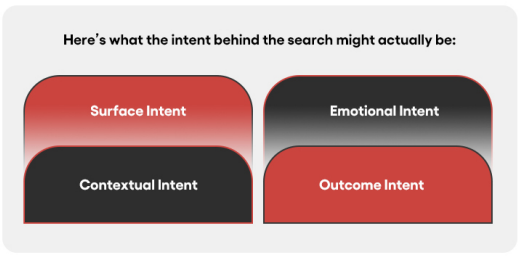
Intent operates in layers, and understanding each layer changes the content brief.
The Surface Query
This is the literal text someone types. It tells you the topic but almost nothing about the person. “Running shoes” is a surface query. So is “CRM software” or “solar panel cost.” This layer is where most SEO programs stop.
Contextual Intent
Context shapes what a useful answer looks like. Someone searching “running shoes” at 11 PM after their first treadmill session is in a different situation from a competitive trail runner comparing specific models. The same keyword, a completely different content brief. Age, location, device type, time of day, and the specificity of surrounding modifiers all signal context. Intent-first content accounts for the most probable context and addresses it directly rather than writing generically for all possible readers.
Emotional Intent
Searchers arrive with a feeling, not just a question. That feeling might be urgency, anxiety, confusion, excitement, or frustration. A search for “AC bill too high” carries stress. A search for “Tuscan itinerary” carries anticipation. The tone and structure of content that serves those intents well is substantially different, and AI models are increasingly capable of matching emotional register to query type. Content that mismatches the emotional context of a query performs worse in AI evaluation than content that addresses it with appropriate directness or warmth.
Outcome Intent
This is the end goal: what the person wants to have accomplished when they are done. Not “I want to know about running shoes” but “I want to buy a pair that will not injure my knees and will last a year of regular use without exceeding my budget.” Outcome intent is where content has an opportunity to create genuine loyalty. When content helps someone complete a goal, not just learn a fact, they remember the source. That behavioural signal feeds back into search performance over time.
| Traditional SEO Focuses On | Intent-First SEO Focuses On |
| Keywords | What the searcher really wants |
| On Page Tags | Why they are asking the question |
| Search Volume | What outcome they expect |
| Backlinks | Where they are in their journey |
| Long-form Content | What emotion they feel (curiosity, frustration, urgency, risk, doubt) |
How AI Changed the Evaluation Criteria
The way AI models evaluate content relevance differs meaningfully from how traditional ranking algorithms worked, and the difference has practical consequences for how content should be built.
AI Models Interpret, Not Just Retrieve
Traditional ranking algorithms retrieved pages that matched query signals and ranked them by authority and relevance indicators. AI models interpret the meaning of a query and evaluate which available content best satisfies that meaning. A page that contains the right keywords but misses the underlying intent scores worse in this evaluation than a page with less precise keyword optimization that actually resolves the reader’s situation.
This is why some brands have watched smaller competitors outrank them for terms they have historically owned.
The competitor may have less domain authority, fewer backlinks, and a smaller content library, but their answer more precisely matches what the searcher needed.
AI Rewards Completeness Across Intent Layers
For queries with significant commercial or decision-making weight, AI models prefer content that addresses the full spectrum of intent rather than the surface question alone.
A piece on HVAC energy efficiency should explain the mechanics behind electricity consumption and why bills rise during certain seasons. It should also acknowledge the frustration homeowners feel when energy costs spike.
Content that provides specific numerical guidance on potential savings and explains when a larger investment makes financial sense will be valued more highly than a simple listicle like “10 ways to lower your AC bill.
The structure that satisfies multiple intent layers also tends to produce longer and more internally linked content, which aligns with the hub-and-spoke architecture that has been best practice in content strategy for years. The difference is that AI evaluation gives that architecture a functional purpose in ranking, not just an organizational one.
AI Penalizes Mismatched Emotional Register
This is a nuance that most SEO programs have not yet fully addressed. When a query’s emotional context is urgent or anxious, and the content responds in a breezy, listicle tone, the mismatch degrades performance. AI systems trained on human-written content implicitly assess whether a page’s voice fits the emotional context of the query it is targeting. This affects which content gets surfaced in AI Overviews and cited in AI-generated answers.
Practical Application: What Shifts When You Work Intent-First
The conceptual framing above is useful, but the real question is what changes in practice. The answer is: quite a lot, starting with how you brief content and ending with how you measure it.
Start with Questions, Not Keywords
A keyword tool tells you what people type. It does not tell you what they are trying to resolve. The most useful starting point for intent-first content planning is a list of questions a real person in your buyer segment would actually ask at different stages of their decision process.
For a company selling CRM software, that means moving beyond “CRM software” as a brief and instead mapping questions like: How do I know if my team actually needs a CRM? What does implementation really cost, including time? Which CRM integrates with the tools we already use? What does a realistic onboarding process look like? What do teams that failed at CRM adoption have in common?
Each of those questions maps to a specific intent, a specific moment in the buyer journey, and a specific emotional context. Briefing content against those questions produces work that satisfies multiple intent layers. Briefing against “CRM software” produces a product page.
Tools like AnswerThePublic, Google’s People Also Ask results, and community forums in your category are useful inputs here. So is asking a generative AI to roleplay as a frustrated or confused buyer and surface the questions they would actually ask.
The goal is to move beyond the keyword mindset and into the buyer’s head.
Structure Content as Progressive Resolution
Intent-first content is structured as a journey from problem to resolution, not as a document that presents information in the order that was easiest to write. The reader arrives with a specific state of knowledge and a specific need. Good intent-first content meets them where they are, acknowledges what they are dealing with, builds the understanding they need to act, and guides them toward a resolution.
In practice, this means opening by naming the real problem or situation, not the topic. It means sequencing explanations so that each section builds on the last rather than covering disconnected subtopics. It means anticipating the questions that naturally arise from each section and either answering them in-line or linking to content that does.
A page structured this way also tends to have longer dwell time, which is a meaningful behavioural signal. Readers who feel understood stay longer. That attention signal accumulates and influences ranking over time.
Write for the Probable Reader, Not the Abstract Query
The mistake that produces generic content is writing for “the person who searches this keyword” rather than a specific, probable person in a specific situation. A search for “emergency roof repair” at 7 AM during a rainstorm is not the same as the same query at 2 PM on a dry Tuesday. The first reader needs immediate guidance, a fast decision framework, and reassurance. The second is probably researching in advance.
Most queries have a dominant contextual profile. Identify it and write for that profile. The content will feel more specific, more useful, and more credible, and AI models will evaluate it accordingly.
Build Semantic Coverage Through a Hub Architecture
No single page can satisfy every intent layer for a broad topic. A pillar page on HVAC energy efficiency can address the dominant intent, but the person who wants to understand the physics of compressor efficiency, the person calculating ROI on a solar installation, and the person trying to interpret their electricity bill all need different depths of coverage.
A hub-and-spoke content architecture handles this by building a central pillar that covers the broad intent and links to cluster pages that address specific intents in depth.
The internal linking is not just organizational. It signals to AI systems that your site has comprehensive, connected authority across the topic, which improves how the model evaluates your brand as a source.
The common mistake is building cluster pages that are thematically related but not intentionally linked.
The semantic network only functions as a ranking asset when the links are explicit, and the content is genuinely cross-referenced.
What This Looks Like In Practice
An HVAC company had published a page targeting “how to reduce AC power consumption” and held a page four ranking for over eight months without meaningful traffic or conversions.
The content was technically accurate. It listed efficiency tips, explained thermostat settings, and compared energy ratings across unit types.
The problem was that none of it acknowledged the reader’s actual situation: a homeowner in a tropical climate dealing with a summer electricity bill that had climbed to a level that felt unsustainable, looking for reassurance that something could be done, and a realistic estimate of what savings were achievable.
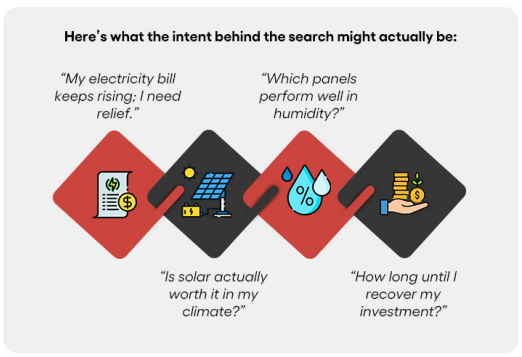
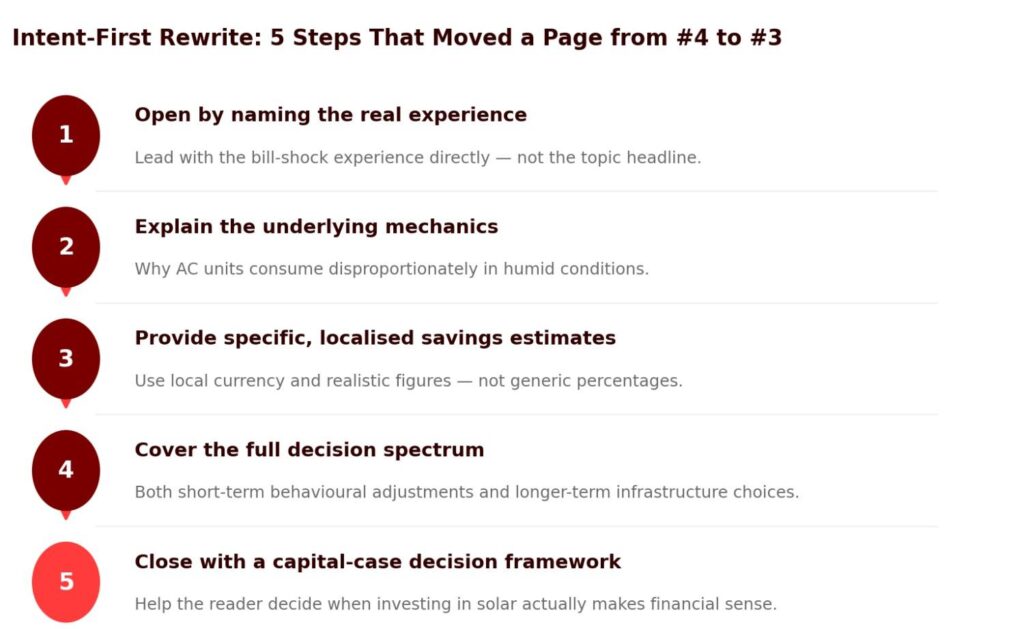
The rewrite addressed the full intent stack.
- It ended with a framework for deciding when the capital case for solar makes sense.
- It opened by naming the bill-shock experience directly.
- It explained why AC units consume disproportionately in humid conditions.
- It gave specific, localized savings estimates (in the local currency, not generic percentages).
- It covered both short-term behavioural adjustments and longer-term infrastructure decisions like unit replacement or solar.
The page ranked third within three weeks of republication, appeared in AI-generated answer summaries for the primary query, and earned featured snippets for four related long-tail variants. The keyword did not change. The intent alignment did.
Measuring Intent Alignment, Not Just Rankings
One of the challenges with intent-first SEO is that the results require different measurement inputs than traditional keyword tracking.
Rankings tell you where a page sits. They do not tell you whether the page is actually serving the intent well.
The signals that indicate strong intent alignment are behavioural. Average time on page, scroll depth, return visit rate for informational content, and conversion rate for commercial content all reflect whether readers felt the content resolved their situation. Pages with strong intent alignment tend to have materially longer dwell times and lower bounce rates than pages that rank for the same keyword but address it superficially.
AI citation rate is an emerging metric worth tracking.
Tools that monitor how often your content is cited in AI-generated answers provide an early signal on whether your content is being evaluated as authoritative across intent layers. Brands that are showing up consistently in AI Overviews and chatbot answers for their target queries have typically built content that satisfies the full intent stack, not just the surface keyword.
The practical measurement approach is to establish baseline behavioural metrics on your existing top-performing pages, rewrite the lowest-performing subset using an intent-first framework, and compare behavioural outcomes over a 60 to 90-day window. Rankings often follow behavioural improvement, but the behavioural signal is the lead indicator.
Where Most Programs Get Stuck
Intent-first SEO requires changing how content is briefed and approved, not just how it is written. That organizational friction is where most programs stall.
Content teams that are measured on output volume have a structural incentive to brief against keyword lists rather than intent maps.
A keyword list is faster to generate, easier to assign, and produces more pages per quarter. An intent map takes longer to build, requires genuine category knowledge, and produces fewer but more substantive pages. Switching requires changing what leadership measures and values.
The second friction point is that intent-first content is harder to edit through a standard review process.
When the brief is “cover these keywords,” anyone can verify whether the page includes them. When the brief is “address the anxiety of a homeowner who has just received a shocking electricity bill,” evaluating whether the content succeeds requires more judgment and more familiarity with the reader.
Building that judgment into a content program takes time.
Neither of these is a reason to delay. There are reasons to sequence the change carefully, starting with a targeted pilot on a high-value cluster before attempting to shift the full program.
See How This Applies to Your Content Program
If your SEO program is producing content volume without the intent precision to compete in AI-mediated search, a structured content audit can identify where the gaps are and which clusters represent the highest-value rewrite opportunities. The shift from keyword-first to intent-first is practical and measurable. The question is where to start.
→ Request a content intent audit for your top-priority cluster